What Should I Pay Attention To When Buying a Second-Hand / used BMG Brown Machine Group CS-5500 Thermo Former?
If you’re looking at a used Brown Machine / BMG CS-5500 thermoforming line, there are many things to inspect/verify to avoid surprises. These are large, complex machines with many subsystems (heating, forming, trimming, controls, etc.), so wear or failures in any of them can lead to major downtime or expense. Below is a detailed checklist + common issues + questions you should ask.
What the CS-5500 is & what to verify up front
From public listings, typical specs are:
- Mold size ~ 50″ × 50″.
- Maximum draw depth around 7″.
- Sheet width ~ 53″ in many cases.
- Trim press often included (e.g. Brown T-350L).
So when you inspect, you’ll want to verify that the machine you’re buying matches the capabilities you need (size, depth, throughput, trimming, etc.).
What to Pay Attention To When Buying Used
Here are the key areas to check, with some specific issues to watch for with the CS-5500 line, plus things likely to cost you later.
| Subsystem / Area | What to Check | Why It Matters / What Can Go Wrong |
|---|---|---|
| Heating / Oven System | • Inspect heating elements / thermal panels. Are they all functioning? Are there dead zones? • Check insulation: old/damaged insulation causes heat loss, uneven heating; high power consumption. • Verify temperature controls, sensors (thermocouples), calibration. • Check oven doors / seals, extras like reflectors. | Uneven heating causes non-uniform forming, wasted material, rejects. Replacing heaters or sensors can be expensive. |
| Forming & Platen Mechanisms | • Check platen surfaces for flatness, damage or warpage. • Check platen stroke / draw capability; verify it’s correct (e.g. 7″ draw) and smooth. • Inspect the clamp or sheet clamping mechanism for wear. • Check hydraulic or pneumatic systems powering platen or clamp (hoses, valves, pistons) for leaks, sticking, lag. • Movement should be smooth, no binding. | Worn or out-of-tolerance platens/clamps cause bad forming; uneven pressure. Hydraulics failures = major repair. |
| Oven Stops / Indexing / Motion Control | • The top & bottom oven “zones” or stops (horizontal stops) should be aligned and properly indexed. If it’s a multi-stop oven, ensure every stop works. • Check the sheet feed mechanism / web indexing (if applicable) for precision, slippage. • Motors, belts, chains, guide rails—look for wear. • Check whether servo drives or older analog drives are used; newer servos are better. Some listed CS-5500s have upgraded servo drives. | Poor indexing or inconsistent sheet feed leads to mis-formed parts, wasted material. Replacing or upgrading drives is expensive. |
| Trim Press & Downstream Equipment | • If a trim press (e.g. T-350L) is included, test its operation: platen alignment, stroke, tonnage capability, dies/trims condition. • Check safety guards, tooling availability. • Check trim press control / linkage. • Check whether any other downstream equipment (unwind stands, waste handling, vacuum pumps) are included and their condition. | Trim press issues can completely halt production; tooling or die wear can significantly affect output quality. |
| Vacuum / Vacuum Pumps / Air Systems | • Vacuum system: is the pumping capacity adequate? Any leaks? • Air lines, blow-off, vacuum seals – condition of seals, gaskets. • Compressed air supply: regulator, dryer, filtration. • Pneumatic/hydraulic actuators if used. | Weak vacuum or leaks = poor forming, throughput loss. Repairing vacuum pumps or sealing large systems is expensive. |
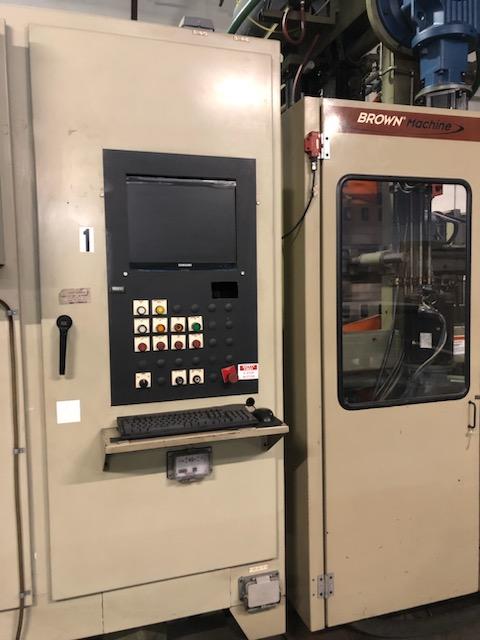
| Electrical / Controls | • What control system is used? (PLC, local Brown/BMG offered controls, or third party such as Allen-Bradley etc.). Is it working? • Are spare or replaced boards documented? Are there software versions / backups? • Wiring condition; any damaged wiring, corrosion. • Sensors, limit switches, safety interlocks: Do they work? • Is the machine safe (emergency stops, guards)? • What voltage / phase is required; does that match your facility? • Upgrades: some CS-5500s have upgraded controls / servo drives. That may be a big plus. | |
| Frame, Structure, Sheet Path & Mechanical Integrity | • Check the frame for corrosion, deformation, weld cracks. • The sheet path should be straight; parts that guide the sheet should be undamaged. • The forming mold attachments, clamps etc. Check for alignment. • Check platen parallelism / squareness. If surfaces are warped over time, this can degrade forming. • Check rollers, bearings, bushings where applicable. | |
| Wear & Maintenance History | • Running hours / tonnage, workload history: what kind of sheet material, duty cycle. • Has the machine been idle for long periods? Does that cause issues (seized bearings, dry seals etc.) • Maintenance records: when were heaters replaced, when was oven rebrick/relining, hydraulic seals, vacuum pump service, etc. • Any history of major repairs or downtime events. | |
| Consumables / Tooling / Spares | • Are molds / forming dies included? What condition? • Are spare heating elements, sensors, belts etc included? • How easy/hard is it to get Brown / BMG spare parts in your region (import costs, delivery time). • Tooling cost for trim die, clamps etc. | |
| Energy / Utilities Requirements | • Power requirements (voltage, phase, amperage). Will your facility accommodate. • Utilities: compressed air, vacuum, cooling water (if used), chilled water, etc. • Energy consumption: older ovens heat inefficiently. May cost more to run. • Ventilation, exhaust air or heat dumping. • Water for cooling (if needed) – check pumps, piping etc. | |
| Safety and Compliance | • Are any safety standards relevant in your country (guards, interlocks, emissions) met? • Are parts of the machine missing that are required for safe operation (doors, shields)? • Safety training materials, documentation. • Does the machine produce fumes or need ventilation or exhaust? Are those systems present and working? | |
| Documentation / Manuals | • User manuals, electrical/hydraulic schematics, parts lists. • Software / control program backups. • Drawings of molds/mold dimensions. • Historic maintenance logs. Helps with troubleshooting later. |
Common Issues / Weak Spots with CS-5500 & Similar Lines
From what I can see in listings and what people in plastics equipment resale note, these are some of the problems that tend to show up in CS-5500 machines or similar Brown lines:
- Dead heating zones or failed heating elements especially in the oven, causing nonuniform heating.
- Vacuum leaks: seals degrade, gasket material becomes brittle; vacuum strength declines, impairs forming.
- Control / servo drive obsolescence: old control units or drives may be hard to service or find parts. Upgrades are sometimes done (as in the listing in Arlington machinery).
- Trim press misalignment or worn dies: dies warp or wear; misalignment causes flashing or bad trim.
- Wear of mechanical guides / sheet feed path: rollers, bearings, guide rails, alignment drift.
- Hydraulic or pneumatic system leaks or sluggish response: seals, hoses, valves tired.
- Excessive power or utility costs for older machines (poor insulation, inefficient heaters).
Special Questions to Ask the Seller / Tests to Run
Here are some questions you should ask and tests you should try (if possible) before purchase or as part of negotiation.
- Operational Demonstration
- Can you see the machine in full operation under load with a sheet similar to what you’ll use?
- Watch a full cycle: heating, forming, cooling (if needed), trimming. Look for uniform forming, speed, reject parts.
- Heat Distribution Check
- Use an IR thermometer or thermal camera to check oven zone uniformity.
- Temperature readouts: do top and bottom heaters reach setpoints quickly and maintain them.
- Vacuum / Seal Check
- Test the vacuum level under load. Are there leaks, long pull-down times?
- Check seals, gaskets, vacuum chamber integrity.
- Alignment Tests
- Measure platen parallelism. Are both platen faces flat and aligned?
- Check clamp / mold alignment.
- Electrical / Control Tests
- Boot up the control system; run through menus, check alarms and error logs.
- Confirm voltage/phase compatibility.
- Test limit switches, safety interlocks, E-stop. Everything should stop cleanly.
- Oven Maintenance
- Ask when the last time oven was cleaned, insulation replaced, elements serviced.
- Any arcs / smoking / odd smells during heating.
- Trim Press Performance
- Try trimming a part to see whether the cut is clean, aligned.
- Check the condition of the die, the ram, platen surfaces.
- Utility / Facilities Compatibility
- Confirm that your power supply (voltage, phase) is correct. If not, what cost to adapt.
- Does the machine require dedicated air supply / vacuum supply / cooling? Is your plant prepared for that.
- Spare Parts / Tooling Availability
- What spares come with the machine? Heating elements, molds, dies etc.
- Are local suppliers for spare parts available? What are typical lead times and cost?
- History and Documentation
- Maintenance records, repair history. <br> – Any records of accidents, overheating, fires, structural damage. <br> – Manuals, schematics.
- Total Life / Usage Metrics
- How many hours it has run, under what conditions (material types, thicknesses, production volume).
- Has it had periods of being idle (which can also cause degradation).
- Transportation / Installation Costs
- Size and weight. Getting it moved, installed, leveled, aligned is non-trivial. Make sure those costs are in your calculation.
Factors Affecting Value / What a “Good Buy” Looks Like
When negotiating or evaluating whether the asking price is fair, consider:
- How many of the major subsystems are new or refreshed (e.g. ovens, control system, vacuum pumps). If many are recent, machine has more life left.
- How much of the tooling & spare parts are included. A machine with good dies and spare heaters can save you a lot.
- Proximity of the seller / shipping / import duties. The cost to bring, rig, install can be large.
- The cost of running (utilities, maintenance) may make an “older” cheaper machine cost more in total cost of ownership.
- The useful remaining lifetime of wear parts (heaters, molds, vacuum pumps, seals).