What is Portable Line Boring Machine & Bore Welder used for Excavator Machinery repair Tool in Heavy Construction Equipment, Mining Machinery, Cranes, Excavators, Bulldozers, Tractors, Backhoes?
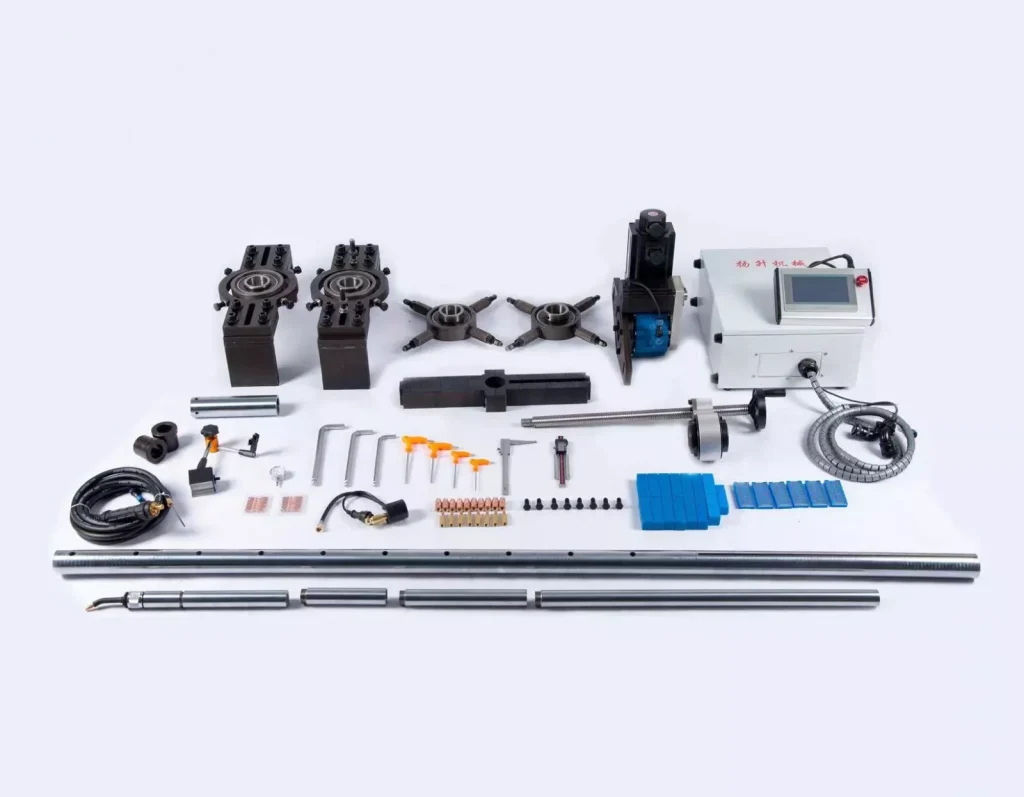
Portable Line Boring Machines (PLBMs) and Bore Welders are specialized on-site machining and repair tools designed for restoring precision in cylindrical bores (holes) on heavy machinery components. These tools are essential in industries like heavy construction, mining, and earthmoving, where equipment such as excavators, bulldozers, cranes, tractors, backhoes, and loaders experiences significant wear and tear. The primary purpose is to repair oversized, worn, misaligned, or damaged bores—particularly pivot points and pin holes—without the need to disassemble and transport the equipment to a workshop. This minimizes downtime, reduces costs, and enhances safety by allowing repairs directly at the job site.Technically, these systems address issues arising from operational stresses, such as cyclic loading, vibration, abrasion from debris, and corrosion in harsh environments. For example, in excavators and bulldozers, the boom, arm, bucket, and undercarriage bores (where pins and bushings articulate) can elongate by 0.1–1 mm or more over time, leading to play (looseness), reduced structural integrity, and accelerated failure. PLBMs and Bore Welders restore bores to original tolerances (typically ±0.01–0.05 mm) using a combination of material buildup (welding) and precision machining (boring), ensuring concentricity and alignment.Technical Explanation of Portable Line Boring MachinesA Portable Line Boring Machine is a compact, modular machining system that performs line boring—a process where a rotating cutting tool (boring bar) is fed axially through a series of aligned bores to enlarge, align, or resize them precisely. Unlike stationary lathes or CNC mills, PLBMs are engineered for mobility, with weights ranging from 20–100 kg (depending on model), and can handle bore diameters from 35 mm to 800 mm or more, with boring strokes up to 600–1000 mm.Key Components and Working Principle:
- Boring Bar and Drive System:
- The core is a hardened steel boring bar (diameters: 25–80 mm, lengths: 0.5–3 m, often modular for extension). It acts as both the tool holder and rotating shaft.
- A drive unit (electric, pneumatic, or hydraulic motor, 0.5–5 kW power) rotates the bar at speeds of 0–300 RPM (variable via inverter controls for optimal cutting). Axial feed is provided by a lead screw or ball screw mechanism, advancing the cutter at rates of 0.01–0.5 mm/rev.
- Precision bearings (e.g., tuneable support bearings) are mounted at multiple points along the bar to minimize deflection and vibration, ensuring straightness within 0.02 mm over 1 m. This is critical for multi-bore alignment in components like excavator booms.
- Mounting and Alignment System:
- Clamps or fixtures attach the bar to the workpiece (e.g., via existing holes or machined faces). Optical or laser alignment tools (e.g., Brunson systems) ensure co-linearity between bores, compensating for angular misalignment up to 1–2 degrees.
- The setup allows “pass-through” operation, where the bar extends through the entire assembly without repositioning, ideal for long bores in crane jibs or mining equipment.
- Cutting Tools and Operation:
- Insert cutters (carbide or high-speed steel, indexable) are mounted on the bar’s tool ports. For facing (perpendicular machining), a facing head can be attached.
- Process: The bar is inserted, aligned, and rotated while fed forward. Coolant (e.g., water-soluble oil) is applied to reduce heat (cutting temperatures <200°C) and prevent thermal distortion. Material removal rate: 0.1–2 mm depth per pass, achieving surface finishes of Ra 1.6–3.2 µm.
- Tolerances: Restores bores to H7–H9 fits (ISO standards), with roundness <0.01 mm and cylindricity <0.02 mm.
Applications in Specified Machinery:
- Excavators and Backhoes: Repairs pin bores in the boom-arm-bucket linkage (diameters 50–200 mm), where wear from hydraulic forces causes ovality. On-site boring avoids boom disassembly, saving 20–50 hours of downtime.
- Bulldozers and Tractors: Restores kingpin or track frame bores, handling high torsional loads.
- Cranes: Aligns multiple bores in lattice booms or turntables for precise rotation.
- Mining Machinery: Services large dragline or shovel pivot bores (up to 500 mm), exposed to abrasive soils.
- Heavy Construction Equipment: General use for hydraulic cylinder mounts or gearbox housings, ensuring load-bearing capacity >10–50 tons per joint.
Advantages: Portability reduces logistics costs (no crane transport needed), and precision prevents secondary failures like bushing seizure.Technical Explanation of Bore WeldersA Bore Welder (also called Auto Bore Welder or Overlay Welder) is an automated welding system that deposits filler metal inside worn bores to rebuild material before boring. It is often integrated with PLBMs (e.g., in 2-in-1 units like the TECHTONGDA or BOA-M1) for a seamless weld-then-bore workflow. These are portable (2–20 kg), battery- or generator-powered, and connect to MIG (Metal Inert Gas) welders (100–200 A, 100% duty cycle for continuous operation).Key Components and Working Principle:
- Welding Head and Drive:
- A rotating welding torch or wire feeder (e.g., stepper motor-driven, 0–150 RPM) is mounted on a bar similar to the PLBM’s. It orbits the bore’s inner surface while advancing axially.
- Weld modes: Continuous (full buildup), skip/sector (to avoid overheating), or reverse (for uniform layers). Wire diameter: 0.8–1.2 mm (e.g., ER70S-6 for carbon steel), fed at 2–10 m/min.
- Automation via remote control or PLC: Bore diameter input auto-adjusts RPM and feed for consistent bead width (2–5 mm) and layer thickness (0.5–2 mm/pass).
- Power and Shielding:
- Integrates with MIG welders (Euro, Panasonic, or Miller connectors). Shielding gas: Argon/CO2 mix (80/20) at 10–20 L/min to prevent oxidation.
- Heat input: 0.5–2 kJ/mm, controlled to limit distortion (<0.1 mm). For large bores (>200 mm), multi-hour runs are possible without operator fatigue.
- Buildup Process:
- Pre-weld: Clean bore (grind/sandblast to SA 2.5 standard). Insert welding head, align, and weld in layers (2–10 layers, total buildup 5–20 mm).
- Post-weld: Cool (air or forced), then machine excess with PLBM. Achieves hardness of 200–300 HV, matching or exceeding original material (e.g., ASTM A36 steel).
- For irregular bores, it fills voids; for flanges/valves, it overlays seats.
Applications in Specified Machinery:
- Excavators, Cranes, and Backhoes: Welds up undersized pin holes (e.g., in boom bases or undercarriages), common in mini-excavators where access is tight (e.g., BOA-M1 for 60–230 mm bores).
- Bulldozers and Mining Machinery: Rebuilds track roller or ripper shank bores under high-abrasion conditions.
- Tractors and Heavy Equipment: Repairs hydraulic ram mounts, preventing leaks from misalignment.
- Integration: In systems like Climax BORTECH or Elsa, weld one bore while boring another, boosting efficiency by 30–50%.
Technical Integration of PLBM and Bore WelderMany systems (e.g., SLB50, BB5000) combine both: Weld to oversize (e.g., +10–20% diameter), then bore to spec. This “weld-and-bore” cycle restores geometry in one setup, using shared bars and mounts. For blind holes, morse taper ends or reversible heads enable access. Safety features include vibration dampening (<0.5 mm amplitude) and remote operation to avoid confined spaces.In summary, these tools enable precise, in-situ restoration of bores to OEM specifications, extending equipment life by 2–5 years and reducing repair costs by 40–70% compared to part replacement. They are indispensable for maintaining operational reliability in demanding environments.