What is Crimping Machine for Connections with Tubular Cable Lugs?
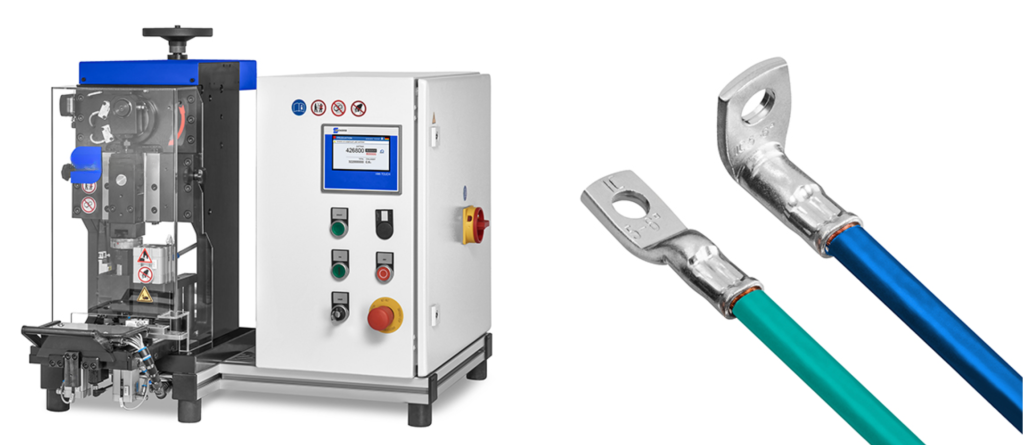
A crimping machine for connections with tubular cable lugs is a specialized tool or device used to create secure, reliable electrical connections by mechanically deforming (crimping) a tubular cable lug onto a conductor (wire or cable). Tubular cable lugs are metal connectors, typically made of copper or aluminum, designed to terminate cables for connection to electrical equipment, busbars, or other conductors. The crimping process ensures a strong, low-resistance electrical and mechanical bond between the cable and the lug.Here’s a technical explanation of the crimping machine and its operation:
1. Purpose and Functionality
- Purpose: The crimping machine is designed to attach tubular cable lugs to the stripped end of a conductor by compressing the lug’s barrel (the hollow, cylindrical part) around the cable strands. This creates a permanent, gas-tight connection that minimizes electrical resistance and prevents corrosion or loosening over time.
- Application: Used in electrical installations, power distribution, renewable energy systems, automotive, aerospace, and industrial applications where reliable, high-current connections are critical.
2. Components of a Crimping MachineA crimping machine typically consists of the following components:
- Crimping Head/Dies: The part that applies force to deform the tubular lug. Dies are shaped to match the lug’s size and shape, ensuring a uniform crimp. Common crimp profiles include hexagonal, indent, or circular.
- Hydraulic/Pneumatic/Mechanical Actuator: Provides the force needed to compress the lug. Hydraulic systems are common for high-force applications, while manual or pneumatic systems are used for smaller lugs.
- Control System: In automated or semi-automated machines, a control unit (manual, foot pedal, or electronic) regulates the crimping force and cycle.
- Frame/Body: A sturdy structure to support the crimping head and withstand the forces generated during crimping.
- Die Sets: Interchangeable dies allow the machine to accommodate different lug sizes and cable diameters.
3. Types of Crimping MachinesCrimping machines vary based on the scale of operation and application:
- Manual Crimping Tools: Hand-operated tools for low-volume or field applications. They use leverage to apply force and are suitable for smaller lugs (e.g., up to 50 mm²).
- Hydraulic Crimping Machines: Use hydraulic pressure to deliver high force for larger lugs (e.g., 10–400 mm² or more). These are common in industrial settings.
- Battery-Powered Crimping Tools: Portable, cordless tools with hydraulic mechanisms, ideal for fieldwork.
- Benchtop Crimping Machines: Stationary machines for high-volume production, often semi-automatic or fully automatic, with programmable settings for precision.
- Pneumatic Crimping Machines: Use compressed air for consistent force, typically in manufacturing environments.
4. Technical Process of CrimpingThe crimping process involves the following steps:
- Cable Preparation:
- The cable is stripped to expose the conductor (stranded or solid) to a length matching the lug’s barrel.
- The conductor is cleaned to remove dirt, oxidation, or insulation residue.
- Lug Selection:
- A tubular cable lug is chosen based on the cable’s cross-sectional area (e.g., 16 mm², 25 mm²) and the connection type (e.g., bolt size for the lug’s eyelet).
- The lug material (e.g., tinned copper) must be compatible with the conductor to prevent galvanic corrosion.
- Insertion:
- The stripped conductor is inserted fully into the lug’s barrel, ensuring no strands are left exposed.
- Crimping:
- The lug is placed into the crimping machine’s die.
- The machine applies controlled force to deform the lug’s barrel, compressing it around the conductor.
- The crimp profile (e.g., hexagonal) ensures uniform pressure, eliminating air gaps and creating a gas-tight connection.
- Inspection:
- The crimped connection is visually inspected for proper deformation, alignment, and no exposed conductor strands.
- Electrical testing (e.g., continuity or resistance tests) may be performed to verify the connection’s integrity.
5. Technical Specifications
- Force Capacity: Measured in kilonewtons (kN) or tons, ranging from 10 kN for small lugs to over 100 kN for large industrial lugs.
- Crimp Profile: Common profiles include:
- Hexagonal: Provides uniform compression, widely used for tubular lugs.
- Indent: Creates a deep indentation for high mechanical strength.
- Circular: Used for specific lug designs.
- Die Compatibility: Machines support a range of die sizes to match lug and cable dimensions (e.g., 6–630 mm²).
- Material Compatibility: Suitable for copper, aluminum, or bimetallic lugs, with specific dies to prevent over- or under-crimping.
- Precision and Repeatability: Automated machines ensure consistent crimp quality, critical for high-voltage applications.
6. Standards and ComplianceCrimping machines and their output must comply with industry standards to ensure safety and reliability:
- IEC 61238-1: Governs compression and mechanical connectors for power cables.
- UL 486A-486B: Standards for wire connectors in North America.
- DIN EN 13602: Specifies requirements for copper tubular lugs.
- Proper crimping ensures low contact resistance, high pull-out strength, and resistance to vibration and thermal cycling.
7. Advantages of Crimping with Tubular Cable Lugs
- Reliability: Creates a durable, low-resistance connection resistant to environmental factors.
- Efficiency: Faster than soldering or mechanical clamping, especially in automated setups.
- Versatility: Suitable for a wide range of cable sizes and lug types.
- Safety: Gas-tight crimps prevent oxidation and arcing, reducing the risk of electrical faults.
8. Challenges and Considerations
- Die Selection: Incorrect die size can lead to over-crimping (damaging the conductor) or under-crimping (loose connection).
- Operator Skill: Manual crimping requires training to ensure proper technique.
- Material Compatibility: Mismatched materials (e.g., aluminum cable with copper lug) can cause corrosion without proper precautions (e.g., bimetallic lugs).
- Maintenance: Hydraulic and pneumatic machines require regular maintenance to ensure consistent performance.
9. Applications
- Power Distribution: Connecting cables to switchgear, transformers, or busbars.
- Renewable Energy: Crimping lugs for solar panel or wind turbine connections.
- Automotive and Aerospace: High-reliability connections for battery cables or wiring harnesses.
- Industrial Automation: Wiring for motors, control panels, and heavy machinery.
In summary, a crimping machine for tubular cable lugs is a precision tool that ensures secure, low-resistance electrical connections by deforming a metal lug around a conductor. Its technical design, including force application, die selection, and crimp profile, is critical to achieving reliable connections that meet industry standards. For specific applications or machine recommendations, additional details about cable size, lug type, or production volume would help narrow down the best solution.