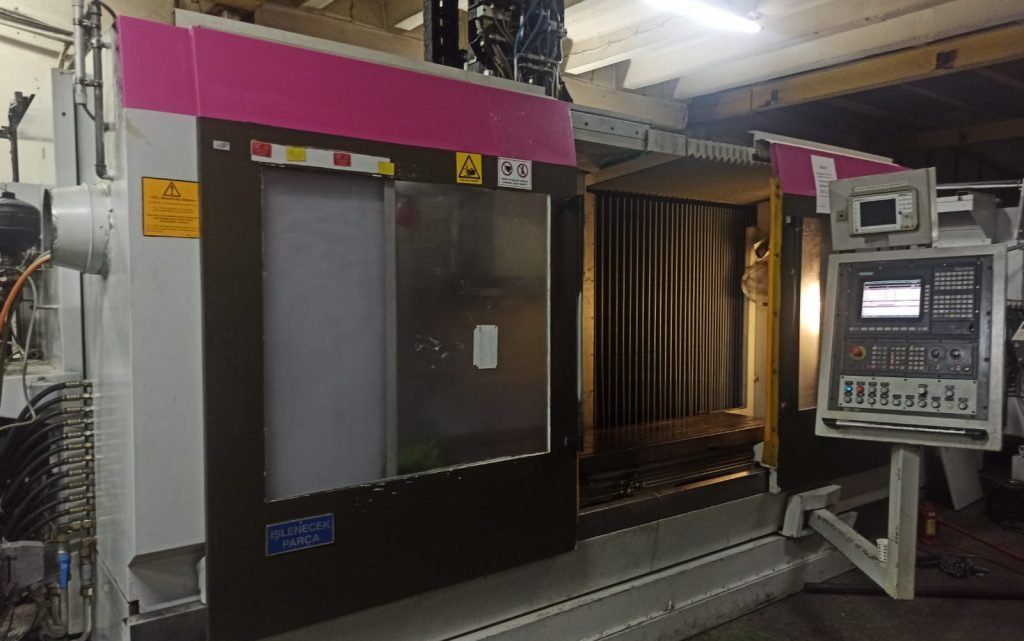
What Industry Experts Recommend Before Purchasing a Pre-Owned, Second-Hand, Surplus, Used Stama 840 C CNC 5 axis Machining Center Double Spinde Dividing Head made in Germany
1. Clarify Your Requirements & Constraints
Before even stepping into an inspection, be clear on:
- Part geometry & envelope constraints: Will your intended parts — with fixtures, tools, workholding — truly fit and move without interference in all 5 axes? Some 5-axis machines are marketed with idealized envelopes that don’t account for the trunnion, head, or fixturing.
- Tolerance / accuracy requirements: What positional, angular, and surface finish tolerances do you need? Your acceptable “error budget” sets a threshold for acceptable wear and refurbishment.
- Spindle speed, power, and torque needs: Do your materials or cutting strategies require high spindle speed, high torque at low rpm, or heavy-duty cuts?
- Control, software & compatibility: What CNC control do you already use (or plan to use)? Does the machine’s existing controller (or its upgrade path) match your CAM, probing, DNC, or network infrastructure?
- Service, parts, and support availability: A machine is only as good as your ability to keep it running. Before buying, verify whether spare parts (especially for spindle, bearings, drive electronics, encoders, rotary joints) are available or can be sourced.
- Total cost of ownership (TCO) vs purchase price: Include the cost of dismantling, shipping, reinstallation, calibration, refurbishment, lost time, replacement parts, operator training, etc.
Getting clarity on these will help you categorize red flags vs acceptable risks during inspection.
2. Documentation & Service History
One of the most critical predictors of a healthy used machine is how well it was cared for. Demands:
- Complete maintenance records (daily logs, lubrication, preventive maintenance, replacements). Reports should show regular servicing and care.
- Original factory drawings, schematics, manuals, parts lists (mechanical, electrical, hydraulics, pneumatic).
- Control history / software versions / upgrades: What software revisions are installed? Are older or legacy control modules still usable or replaceable?
- Historically replaced major subsystems: spindle rebuilds, ball screw replacements, axis drive modules, rotary joints, encoders, coupling replacements, etc.
- Calibration / alignment reports / accuracy tests: Past “check cuts,” machine geometry alignments, laser/ballbar tests, compensation maps, etc.
- Warranty, refurbishment certification, guarantees (if being sold by a broker or refurbisher).
If the seller cannot provide a reasonably complete and consistent record, the risk is high.
3. Visual & Mechanical Inspection (Preliminary)
Before you power up anything, start with a careful walkaround and visual inspection. Key items to inspect:
- Machine frame, casting, welds, joints: Any cracks, signs of rework, misalignments, or repairs.
- Way covers, sheetmetal guards, seals, splash shields: Are they intact, well-fitted, and have been maintained? Missing covers often suggest a poorly maintained machine.
- Guideways and linear systems: Check for scratches, gouges, scoring, corrosion, pitting, or signs of excessive sliding wear.
- Ball screws, lead screws, nut conditions: Play / backlash, surface wear, dusting, lubrication.
- Rotary axes / trunnion / dividing head: Inspect bearings, gear teeth, backlash, lubrication, balance, preload.
- Spindle condition: Check the spindle taper (e.g. HSK, BT, etc) for scoring, fretting, corrosion.
- Tool changer, magazine, tool holders: Smooth movement, no misalignment or binding.
- Hydraulic / pneumatic systems: Check for leaks, condition of hoses, oil quality, accumulator health.
- Cable harnesses, connectors, hoses: Look for discoloration, brittle insulation, exposed wires, patched repairs.
- Air filtration, coolant systems, chiller, mist systems: Are these intact, well-kept, free of sludge, rust, leaks?
- Floor mounting / base structure: Are there signs of previous relocation (excess anchor bolt holes, cracks), or foundation damage?
A careful visual inspection often reveals neglect that correlates with hidden issues down the line.
4. Functional & Dynamic Testing
Assuming the electrical & control systems are intact, the most revealing phase is turning the machine on and putting it through motions and tests. Experts commonly recommend:
- Axis movement & “hand-move” test: Jog each axis freely (with spindle off), check for smoothness, unexpected “notches,” binding, chatter, or vibration.
- Spindle test: Run the spindle through its full rpm range (low to high) and reverse. Listen for unusual noise, vibration, or bearing whine. Stop abruptly (M5 or equivalent) to test the braking unit.
- Cutting test / “test part” cut: If the seller can run a representative part or profile, do a real machining test. Check for chatter, surface finish, dimensional accuracy, repeatability, tooltracking under simultaneous motion. Many pitfalls only show up under actual load.
- Multi-axis coordination / simultaneous motion test: For 5-axis, run commands that simultaneously move multiple axes (e.g. interpolate a curved surface, tilt and rotate during a cut) to check path errors, dynamic behavior, and control robustness. Some 5-axis systems only do 3 + 2, not simultaneous 5. Confirm what you really need.
- Rotation / reversal tests on rotary axes: Rotate 180°, reverse, return to null, and measure for positional drift or backlash. Do multiple cycles.
- Backlash / accuracy checks: Use a ballbar, laser interferometer, or precision artifact to measure repeatability, positioning error, backlash, straightness, squareness, and volumetric accuracy.
- Thermal drift / warm-up test: Run the machine for a period until thermal equilibrium and re-check geometry or repeatability.
- Control integrity & sensor tests: Check that limit switches, safety interlocks, homing sensors, probes, encoders are functional and accurate.
- Tool change & gripping test: Cycle the tool changer multiple times; load/unload tool holders, check for mispositioning, jamming, speed of change, tool clamping consistency.
A machine that performs smoothly in all these tests (without anomaly) is significantly more reliable than one that only looks okay when idle.
5. Electrical / Control / Software Inspection
Even the most perfectly built mechanical machine is worthless if the control or electronics are compromised. Key checks:
- Control cabinet health: Inspect for dust, corrosion, burn marks, water damage, insect nests, or signs of overheating.
- Power supply & cooling: Are drives cooled properly? Are fans working? Are filters clean?
- Drive modules, amplifiers, PLCs, servo systems: Verify that each axis’s drive is responding, no faults, proper current draw, no lurking errors in the fault log.
- Wiring harnesses, cable drag chains, connector integrity: No cold joints, no brittle insulation, no loose terminals or splices.
- Encoders / feedback systems: Check encoder signals, linear scales (if present), rotary axis feedbacks.
- Control version / software integrity: Ensure the control firmware/software has not been corrupted, check for backup of the control, verify that programs and parameters are accessible.
- Safety systems / interlocks: E-stops, door interlocks, guards, crash sensors must function properly.
- Interface & connectivity: Check if the control can connect to your network, DNC, USB, remote diagnostics, or CAD/CAM interface.
- Redundant or backup systems: Some high-end 5-axis systems may have redundant systems or advanced diagnostics. Verify their state.
A red flag in this domain (e.g. burnt drive module, missing spares, corrupt software) may render the machine non-viable.
6. Alignment, Calibration & Geometric Integrity
A truly precise 5-axis machine depends on correct geometry. Important checks:
- Machine geometry baseline: Use a laser interferometer, ballbar, or CMM to assess straightness, squareness, pitch, yaw, roll, scale errors, volumetric accuracy.
- Volumetric compensation / calibration maps: Does the machine have a compensation map (error correction table) or the capability to input one? Can you adjust for kinematic errors?
- Trunnion / rotary axis alignment: Verify that the rotary axes are properly meshed, aligned, balanced; no undue radial or axial runout.
- Tool center point (TCP) calibration: Tilt / rotate the head and verify the tool tip stays within expected tolerances.
- Workpiece reference repeatability: Check that referencing / pallets / fixturing do not introduce systematic errors.
- Geometric drift under load: After a heavy cut, return to reference point and verify no hysteresis or creep.
- Thermal compensation: Does the machine have any built-in thermal compensation or predictive drift compensation features?
If the machine cannot meet geometric and volumetric accuracy close to your requirements (or be calibrated to it), then much of its potential is wasted.
7. Spare Parts / Consumables / Cost & Risk Assessment
Even a “good” used machine will eventually require parts. Before buying:
- Check availability and cost of spare parts: Spindles, bearings, rotary joints, encoder modules, servo modules, belt drives, couplings, sensors, seals, tool changers, etc. Are these obtainable?
- Lead times for critical parts: For German machinery (Stama is German), many parts may come from Europe; factor in shipping, customs, and lead time delays.
- Estimate refurbishment / reconditioning cost: Plan for wear-parts replacement, realignment, refurbishment of axes or spindle if needed.
- Consumables & maintenance supplies: Lubricants, coolant systems, filters, seals, gaskets.
- Service support & reliability: Are there local service agents or engineers who know this machine? Are control/drive vendors still supporting this generation?
- Warranty / guarantee: See if the seller or refurbisher offers any short-term guarantee or support period to mitigate your risk.
- Residual value / salvage: In worst-case, what’s the salvage or re-sell value?
A machine that looks cheap but forces you to pay heavily for unavailable parts is a trap.
8. Logistics, Installation & Relocation Risk
Even before the purchase, consider the non-machining aspects:
- Disassembly, transport & reassembly: Heavy components must be moved carefully. Are lifting eye points intact, can you remove heavy assemblies (spindle head, swivel axes, dividing head) safely?
- Foundation / floor requirements: Will your facility support the structural load, anchor points, leveling, vibration isolation, etc.?
- Utility requirements: Power (phase, voltage, amperage), coolant, compressed air, chip evacuation, dust/filtration, HVAC (temperature control).
- Site readiness: Will the machine fit through doors, ceilings, turrets, etc.?
- Calibration & alignment after installation: Plan for laser alignment, leveling, tool and work offset setup, thermal equilibration.
- Downtime / ramp-up: How much time is needed from “machine on (reassembled)” to “qualified production parts”?
If the cost or risk of relocation and commissioning is high, it may offset your purchase savings.
9. Negotiation & Contract Safeguards
To protect yourself, your purchase agreement should include:
- “Subject to inspection / acceptance” clause: You should reserve the right for a third-party expert or metrology firm to inspect the machine onsite (or conditionally upon delivery).
- Test cut / performance guarantee: Seller should agree to perform (or allow you to perform) benchmark cuts under load. If tolerances are not met, you can cancel or get a price reduction.
- Warranty / return period: Some period of warranty (e.g. 90 days) or limited guarantee on key subsystems (e.g. spindle, rotary axes).
- Spare parts inventory transfer / inventory: If possible, arrange for the seller to include a set of spare parts or components in the sale.
- As-is disclosure / defect list: Require the seller to disclose known defects, repairs, modifications.
- Liabilities and insurance: During transport, installation, until final acceptance, allocate responsibility for damage or loss.
- Payment milestones tied to acceptance: Don’t pay full price upfront; tie final payment to successful test / acceptance.
- Title, customs, import duties, certificates: Make sure there are no hidden liabilities regarding the machine’s origin, export restrictions, or customs duties.
- Support commitment: If possible, the seller or broker should commit to providing technical support or remote diagnostics for a limited period.
These contractual safeguards can be the difference between a sound investment and a financial disaster.
10. Expert / Third-Party Audit
Because 5-axis CNC machines are complex, many buyers engage an independent, experienced machine tool auditing consultant (or a metrology firm) to perform a guided inspection, detailed measurements, control and servo testing, and red-flag reporting. If the seller objects to an independent audit, that is itself a red flag.
Key “Red Flag” Warning Signs
During inspection or negotiation, watch for:
- Poor or missing maintenance documentation
- Scratched / corroded ball screws, guideways, or spindle taper
- Excessive vibration or unusual noise in spindle or axes
- Control faults, intermittent errors or flickering indicators
- Mismatched or patched wiring, soldered connections, non-factory wiring
- Older, obsolete CNC controllers or proprietary systems with no support
- Refurbishment done superficially (e.g. cosmetic paint, but not internal overhaul)
- Seller refuses or limits your ability to test or inspect
- No spare parts available, or prohibitively expensive
- Lack of calibration or alignment data
- High relocation / installation cost that erodes your savings
Summary
Purchasing a used 5-axis machining center like a Stama 840 C is one of the riskiest, but potentially most rewarding, capital investments your shop may make. If you follow a rigorous, methodical inspection and validation process — across mechanical, control, geometric, and contractual domains — you greatly improve your odds of acquiring a machine that performs reliably. Conversely, skipping or glossing over any major domain often leads to costly surprises, downtime, or even write-off.