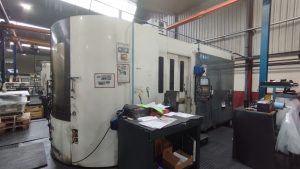
What Industry Experts Recommend Before Purchasing a Pre-Owned, Second-Hand, Surplus, Used Manzoni E200 2MR/SL 200 Floor Mounted CNC HS Stamping Press Tonnage 220 made in Italy
Pre-qualification & Requirements Definition
Before you even go see a candidate machine in person:
- Define your production needs
- What maximum tonnage do you need (material, thickness, forming vs blanking)?
- Stroke length, shut height / daylight, bed adjustment range.
- Die area (bolster size) – does your tooling fit the bolster area?
- Stroke rate (strokes per minute, continuous duty vs intermittent).
- Die complexity (progressive, deep drawing, transfer, blanking) and required feed / indexing.
- Control / automation compatibility (strip feeders, coil lines, blanking, servo presses, line integration).
- Tolerance / repeatability / parallelism / alignment demands.
- Floor loading, foundation, utilities (power, hydraulics, cooling, lubrication, compressed air).
- Investigate replacement parts, support, and serviceability
- Are spares for Manzoni presses (flywheels, crankshafts, bearings, cams, guides, clutch/brake parts, slide bushings, sensors, bushings) still obtainable?
- Is there a specialty press rebuilding or press maintenance shop in your region or country capable of overhauls?
- Are the control systems (CNC, PLC, drives, sensors) of a vintage era or proprietary, and can they be supported or modernized?
- Check whether the seller is strictly a broker, a refurbisher, or an end user — a refurbisher might have done hidden repairs or “cosmetic refurbishing.”
- Ask for preliminary documentation / history before visiting
- Service logs, maintenance history.
- Accident, repair, or rebuild history (e.g. if frame was repaired, cracked, welded).
- Control / CNC software versions, change logs.
- Drawings, schematics, spare parts list, original manuals.
- Past alignment and calibration reports, especially after major rebuilds.
If the seller cannot—or will not—produce these preliminary records, treat that as a red flag (unless they’re an old shop with poor records, but then your risk is higher).
1. Visual & Structural Inspection (Before Running)
At the site, before powering the press or running any cycles, do a thorough walkaround inspection. Key things to look for:
- Frame, base, welds, and structural integrity
- Inspect the press frame for cracks, repairs, welded patches, especially around corners, tie rods, uprights, tie bars.
- Look under paint layers for hidden cracks or welding scars.
- Check that the press base is flat and true; uneven base may indicate foundation issues.
- Any signs of bending, distortion or misalignment in the uprights or frame.
- Guideways, slide surfaces, bushings, rails
- Examine the slide / ram guides, surfaces, bushings, wear lines, scoring, galling.
- Look for uneven wear or polished zones that suggest side loads or misalignment.
- Check the condition of lubrication lines, oil ports, grease fittings, wipers, seals.
- Slide clearance – check for slop or play (by pushing / probing the slide by hand if possible).
- Crankshaft, connecting rods, bearings, cams
- Inspect bearing housings for oil leaks, discoloration, lubrication issues.
- Check for play or looseness in rod journals, crank pins, cam followers.
- Look for signs of overheating or discoloration, which might indicate previous bearing failure or misalignment.
- Flywheel, clutch, brake assembly
- Inspect the flywheel for cracks, uneven wear, keyway damage, balancing weights.
- Check the condition of the clutch and brake pack (if accessible), lining wear, pad condition, proper engagement surfaces.
- Look at the brake disc, rotor, and friction surfaces for scoring or glazing.
- Bolster / die area / bolster plate
- Examine the top bolster / die block, inspect for flatness, wear, surface finish, damage or gouges.
- Check the feature slots, bolt holes, T-slots, alignment pins or die guides.
- Inspect the ram face for parallelism, flatness, wear, damage.
- Hydraulic / pneumatic systems (if applicable)
- Oil tanks, reservoirs, piping, hoses, valves, filters: check for leaks, corrosion, cleanliness.
- Hydraulic pump motors, condition, vibration, mounting.
- Inspect accumulators, relief valves, pressure sensors, plumbing.
- Check condition of seals, gaskets, flexibility of hoses.
- Lubrication / oiling systems
- Are automatic lubrication or greasing systems present? Are they functional?
- Check lubrication lines, blockages, indicators, filters.
- Do the oil and hydraulic fluids in sight glasses or reservoirs look clean (no sludge, water contamination)?
- Are coolant / die spray systems intact?
- Electrical cabinet, wiring, control hardware
- Inspect control panels and cabinets for signs of dust, overheating, burnt wiring, corrosion, insect nests, water damage.
- Examine wiring harnesses, connectors, terminal blocks for signs of modifications, repairs, non-factory splices.
- Look for cable slack, wear at cable flex points, abrasion points.
- Verify that safety interlocks, E-stops, guard circuits, light curtains (if fitted) are intact.
- Mechanical integrity, fasteners, auxiliary components
- Check tie rods, anchor bolts, nuts & fasteners for tightness, torqueing, missing parts, signs of stress.
- Check alignment pins, guide posts, die alignment, bushings, alignment dowels.
- Inspect auxiliary components like transfer arms, feeders, rails, slide guides, scrap removal, guard systems.
- Overall cleanliness, maintenance “tone,” evidence of neglect
- A well-maintained press is often “neat.” Look for oil leaks, accumulated grime, neglected paint, obvious neglect.
- Areas with heavy oil leakage or staining may point to chronic maintenance issues.
If you discover structural cracks, heavy wear, sloppy guides, or undocumented modifications, you need to evaluate whether they are repairable (and at what cost) — cost of repair might exceed the “discount” of buying used.
2. Functional & Performance Testing
Assuming the press can be powered safely, proceed with careful functional tests under controlled conditions. These are essential to verify mechanical and operational integrity.
- Power-up & control verification
- Turn on the machine slowly, monitor electrical draw, voltages, any alarms in the control system.
- Bring up the control system, check diagnostics, error logs, runtime hours.
- Check all limit switches, home sensors, guard interlocks, safety circuits, emergency stops.
- Test inching / jog / manual mode operations to motion without die load.
- Dry cycling / slide motion under no load
- Cycle the press through its full stroke (slowly at first) and monitor motion smoothness, vibrations, odd noises, jerky motion.
- Cycle several times in both directions, at various speeds to detect any hesitations or misbehavior.
- Check that the slide returns consistently to its reference or “home” position.
- Clutch / brake engagement tests
- Engage and disengage the clutch and brake at different points, check for consistency, response, smoothness, and any slipping or delayed engagement.
- Test the brake stopping performance (with safe loads or simulated loads) and measure how quickly and reliably the slide stops.
- Monitor for brake drag or residual torque.
- Speed, acceleration, deceleration, dwell test
- Run the press at different speeds / SPM (strokes per minute) within its rated range (if possible).
- Check for variation in speed, stability, and whether the drive or control maintains speed under no load.
- Test dwell time consistency (at top dead center or bottom).
- Load / “dummy” test cut (if possible)
- If feasible, install a dummy die or soft metal workpiece to run a test under light load.
- Monitor actual behavior: vibration, noise, die knock, chatter, slide deflection, alignment drift.
- After stops/restarts, re-check alignment, slide return to zero, and whether performance shifts.
- Repeatability / positioning / alignment tests
- Use indicators, dial gauges or micrometers to check the repeatability of slide return position after multiple cycles.
- Check side-to-side, front-to-back parallelism of slide face vs bolster to see if the ram is tilting or binding.
- Measure any drift or hysteresis over cycles.
- Thermal / warm-up drift
- Let the press run for a while (at idle or light cycling) to warm up and settle. Recheck alignment, parallelism, slide position drift.
- Sometimes alignment shifts as temperature gradients develop in bearings or frame.
- Control feedback, sensors, CNC / automation functions
- If it has a CNC or servo indexing, test feeder(s), strip feed, index control under motion.
- Test sensors, repeatable plane indexing, feedback loops under motion.
- Check any transfer or auxiliary modules (if included) for operational integrity.
- Emergency / crash simulation
- Without loading, test E-stop, crash detection, overtravel protection, guard circuits.
- Verify that faults or limit overrun triggers safely stop the press without damage.
If the machine falters or shows anomalies under load or motion tests, you need to quantify the cost of repair — or walk away.
3. Documentation, History & Metrology Validation
Once the machine passes visual and functional tests, now dive deeper into the “paper trail” and precision metrics.
- Maintenance, repair & rebuild history
- All service logs, parts replaced, rebuilds, overhauls, known repairs.
- Previous alignment / calibration certificates.
- Spare parts inventory included (if any) or parts changes recently done (bearings, slide bushings, crank bearings, clutch pack, etc.).
- Any accident history (die crash, overload events, frame damage).
- Original drawings, schematics, manuals, parts list
- Electrical schematics, hydraulic diagrams, control logic (PLC / CNC), parts catalogs.
- Die setup drawings, alignment procedures, recommended tolerances.
- Metrology & alignment certification
- If the seller has recent alignment or calibration reports, compare to what you measured.
- Use independent metrology tools (indicators, laser alignment, dial gauge, straightedge) to validate parallelism, slide face alignment, frame deflection, ram-to-bolster parallelism.
- Check for vessel (structural) deflection under load if possible.
- Control / software audit
- Check versions of CNC/PLC software, patches, parameter backups.
- Validate whether programs, parameters, offset tables, feeds/speeds histories are intact and accessible.
- Check for obscure or custom modifications (hooks, macros, non-standard code) that may create long-term support problems.
- Spare parts quote & supply chain check
- Ask key spare parts quotes (bearings, crankshaft, slide bushings, clutch/brake parts, controls, sensors).
- Confirm lead times, shipping costs, and local vs international sourcing.
- Evaluate whether parts are obsolete or at risk of obsolescence.
- Operating cost / lifetime remaining
- Estimate how many hours or cycles the machine has run, the wear level, and what refurbishments might be required.
- Estimate lifetime of major wear components and the cost to recondition them.
- Consider renovation cost, alignment / calibration cost, and downtime.
- Accreditation / external audit
- If possible, hire a press specialist or independent third-party inspector to audit your candidate machine.
- If the seller objects to independent inspection, treat that as a red flag.
4. Risk Assessment & Total Cost of Ownership (TCO)
Even a seemingly “cheap” used press can become extremely expensive when hidden costs are counted. Before you agree:
- Cost estimate for refurbishment / repair
- Estimate costs to repair or replace any worn components (guides, crankshaft, bushing, clutch/brake, alignment, controls).
- Account for non-productive downtime, shipping, reassembly, and calibration.
- Transportation, installation & commissioning risk
- Dismantling and reassembly (are lifting points intact? heavy components removable?).
- Foundation preparation, leveling, anchoring, vibration isolation, structural support.
- Utility hookups, electrical, hydraulic, lubrication, cooling, air, etc.
- Commissioning, alignment, warm-up calibration, test runs.
- Spare parts and consumables cost
- Budget for lubricants, hydraulic fluids, filters, seals, belts, sensors, etc.
- Spare parts on hand (especially critical spares) to reduce downtime.
- Support and expertise overhead
- The need (or cost) to retain personnel or contractors who understand press mechanics, controls, maintenance.
- Residual / salvage value
- In worst-case, what is the scrap / salvage value of frame, castings, components (to recoup some cost).
- Estimate resale or trade-in value after refurbishment.
- Downtime / lost production risk
- Estimate how long before the press is back in production.
- Factor in risk margin for unexpected repairs or delays.
- Warranty / guarantee negotiation buffer
- Insist on a limited acceptance period, performance guarantee, or ability to return the machine if key metrics are not met.
5. Contractual Safeguards & Purchase Terms
To minimize your risk, structure your purchase contract with protective clauses:
- “Inspection & acceptance” clause
- Purchase conditional on final inspection by your technical team (or third-party) and acceptance.
- Allow walk-away if major defects are found or test criteria not met.
- Performance guarantee / test cut or cycle guarantee
- Seller should agree to run the press (with dummy or safe load) to demonstrate functionality. If performance metrics (smooth motion, repeatability, speed, no abnormal vibration) are not met, buyer may demand discount or cancellation.
- Spare parts / accessory inclusion
- Ask seller to include a package of spare parts (bearings, gaskets, seals, sensor modules, etc.) as part of the deal.
- Transfer of any remaining spare inventory, documentation, tooling, or manuals.
- Warranties / limited liability period
- Negotiate a limited warranty period (e.g. 90 days, 6 months) on key subsystems (crankshaft, bearings, clutch/brake, slide).
- Define liability for latent defects discovered post-commissioning.
- Payment tied to acceptance / milestones
- Do not pay full sum up front. Tie final payment to successful delivery, installation, calibration, and acceptance tests.
- Transport, insurance, and damage risk allocation
- Clearly define who bears risk during disassembly, transport, reassembly, and commissioning (i.e. who insures until final acceptance).
- If damage occurs in transit, stipulate recourse.
- Title, customs, export compliance
- Ensure clean title, absence of liens, ability to ship across borders (if applicable).
- Confirm compliance with export or import regulations.
- As-is disclosures / defect list
- Require seller to disclose all known defects, repairs, modifications, and maintenance history in writing.
- Support / training commitment
- If possible, get seller support (remote consultation, training, start-up help) for an agreed period after purchase.
6. “Red Flags” That May Indicate a High-Risk Machine
During inspection or negotiation, certain warning signs should raise serious concern (or cause you to walk away unless discounted heavily). Some red flags include:
- Missing, incomplete, or inconsistent maintenance / service records
- Structural cracks or weld repairs on the frame / tie rods
- Severely worn or scored guide surfaces or slide faces
- Excessive play or looseness in bearings, rods, crankshaft, connecting components
- Unusual noises, vibration, jerky motion, misbehavior during test runs
- Brake or clutch issues (slip, uneven engagement, drag)
- Control system faults, alarms, or missing / corrupted software
- Non-factory wiring, sloppy repairs, or undocumented modifications
- Obsolete controls / components with no replacement source
- Seller refusal to permit tests, inspection, or third-party audit
- Excessive refurbishment required (i.e. nearly “rebuild condition”)
- Excess transport / installation risk (e.g. weak lifting points, fragile components, inaccessible parts)
If multiple red flags appear, you should either negotiate a steep discount (with funds reserved for repairs) or decline.