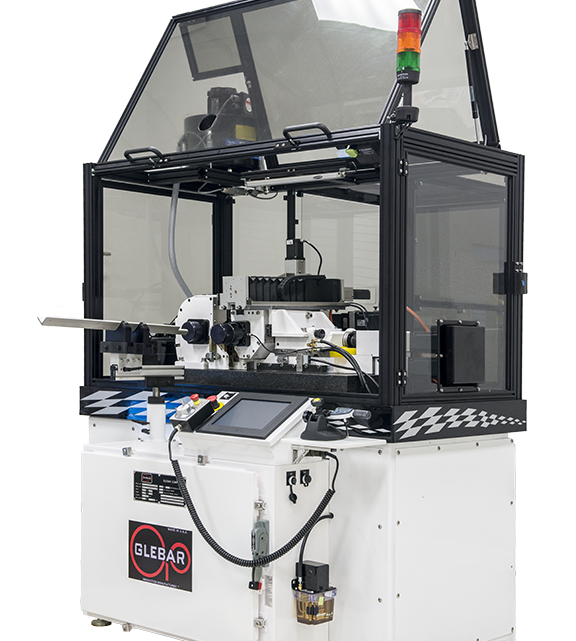
What Industry Experts Recommend Before Purchasing a Pre-Owned, Second-Hand, Surplus, Used Glebar GT-610 Infeed/Thrufeed Centerless Grinder made in USA
Preliminary Screening / Requirements Clarification
Even before visiting the machine, clarify expectations and screen sellers:
- Define your application envelope & tolerances
- What diameter, length, material (steel, carbide, titanium, etc.) will you grind?
- What roundness, cylindricity, surface finish, concentricity tolerances are required?
- What throughput (pieces per hour) / cycle time do you expect?
- Do you require “lights-out” / automated operation, gauging, feedback loops?
- What automation (feeders, conveyors, loading/unloading) must integrate?
- Ask the seller for baseline documentation
- Serial number, age / build year, and machine specification sheet (spindle power, speeds, slide travel, work wheel / regulating wheel data).
- Maintenance / service history, including major replacements or rebuilds.
- Any available alignment or calibration reports.
- Control software versions, warranty or support status, spare parts kit (if available).
- Photographs of the machine interior (slides, wheel spindles, dressers, work rest blades, coolant system).
- Running hours or part counts (if tracked).
- Check component / spare parts availability & support
- Can you obtain replacement parts for spindles, bearings, linear slides / guides, ballscrews, work-rest blades, dressers, sensors, control modules, etc.?
- Does Glebar or third-party suppliers still support key subsystems (electronics, control modules, scale systems, etc.)?
- Is there a local or regional precision grinding service / reconditioning shop that understands Glebar machines (for repairs, spindle rebuilds, slide reconditioning)?
- Screen for seller credibility & willingness for inspection
- If the seller refuses to allow inspection, test cycles, or third-party audit, that is a red flag.
- Compare their asking price with market for similar units (e.g., see used GT-610 listings: e.g. a 2022 unit offered for sale).
- Try to verify serial number / history via Glebar to see if machine was sold new, or if it has known issues.
If the seller can’t or won’t produce credible documentation, or refuses inspection, that significantly increases your risk.
1. Mechanical & Structural / Visual Inspection (Before Powering Up)
Once on site, before powering the machine, inspect all mechanical and structural elements:
- Frame, base, and structural components
- Look for cracks, weld repairs, warped plates, signs of structural stress or fatigue (especially around mounting points, slide paths).
- Check for distortions, misalignment, or sag in the machine bed, especially along the slide axis.
- Inspect the mounting of the machine (bolts, anchor points) to see if the machine has been relocated or had repairs.
- Slides, guideways, bearings, and linear motion components
- Inspect the slide surfaces and guideways for scoring, scratches, corrosion, pitting, or evidence of coolant infiltration.
- Check that the linear guide blocks / bearings are intact, lubrication lines are present, seals / covers exist.
- Manually (if safe) push / pry small amounts to see if there is play, binding, or uneven resistance along the slide travel.
- Examine the ballscrews, nuts, coupling, and ends for wear, backlash, or damage.
- Work wheel and regulating wheel spindles
- Inspect the spindles (taper bore, bearings, housings) for signs of heat damage, discoloration, wear marks, or misalignment.
- Inspect collets, chucks, nuts or fixture mounting points.
- Check for proper preload or clearance (if accessible) in spindle bearings.
- Look at the wheel mounting surfaces, key slots, and ensure they are intact and clean.
- Work-rest blade and blade support
- Check the work-rest blade for wear, flatness, alignment, and holder rigidity.
- Inspect the mechanism for blade lateral adjustment (if motorized) and its actuator / drive / sensors.
- Confirm that the blade holder, support arms, and adjustment features are intact, properly lubed, and free of damage.
- Wheel dressing system(s)
- Inspect the dresser(s) — whether CNC, hydrostatic, or mechanical — their slides, supports, diamond holders, actuators.
- Check for wear, runout, corrosion, damage to diamond edges or trimming surfaces.
- Coolant / lubrication / fluid systems
- Examine coolant tank, pumps, piping, filtration, tubing, seals, and screens.
- Check for contamination (chips, rust, sludge), leaks, or improper drainage.
- Inspect automatic lubrication or oiling systems for slides, bearings, and check lubrication lines and delivery.
- Check hoses, couplings, valves, and sensors (level sensors, flow sensors).
- Belts, couplings, gears, auxiliary components
- Inspect couplings and flexible elements between drives and spindles for wear, misalignment, or play.
- Inspect belts (if used) for cracks, fraying, tensioning.
- Check pulleys, gearboxes, idlers, and alignment of drivetrains.
- Inspect any additional modules, conveyors, feeders, or handling attachments for condition.
- Electrical cabinet / wiring visual checks (without powering)
- Inspect wiring harnesses, connectors, terminations, signs of overheating, burn marks, color fading, brittle insulation, non-factory splices.
- Look for dust, debris, coolant ingress, corrosion, stray chips or metal debris inside cabinets.
- Check that cable routing is reasonable, cable carriers or drag chains are intact, no obvious damage.
- Overall condition, signs of abuse or neglect
- A machine with clean, well-maintained exteriors, covers intact, guarding in place, and minimal accumulation of grime is a positive signal.
- Heavy leaks, sludge, missing guards, or “jury-rigged” repairs are red flags.
- Inspect for modification or non-original parts; make sure any modifications are documented and reversible.
If you find major structural or mechanical damage at this stage, it may not be economical to repair. Use what you see to estimate refurbishment cost, which should factor into your offer.
2. Power-Up, Functional Testing & Motion Evaluation
If the machine can be safely powered, proceed with careful tests. These tests will reveal dynamic behavior, control issues, and operational wear.
Important: Always follow proper safety practices, lockout procedures, and perhaps bring your own technical expert or service engineer to supervise testing.
- Power-up, control initialization, fault logs
- Power on gradually, observe voltage levels, current draw, any faults or error messages in the control.
- Check diagnostic data, logged faults, alarms, runtime hours, and error histories.
- Examine limit switches, homing / referencing sensors, safety interlocks, emergency stops. Ensure they respond properly.
- Jog / manual motion tests of slides (no load)
- Jog each axis/slide slowly and smoothly; watch for jerky motion, stick-slip, inconsistent travel, or resistance.
- Cycle back and forth over full travel, checking for any hysteresis, binding, or “notching” along the motion.
- Listen carefully for unusual noise or vibration in motion.
- Spindle run-up / no-load rotation tests
- Run the work wheel spindle across its full speed range, monitor noise, vibration, bearing hum, temperature, and response to acceleration.
- Do the same for the regulating wheel, checking stability, smoothing, and speed control.
- Evaluate spindle run-out (if accessible) or wobble / vibration under no load.
- Idle cycle test / repeated motion
- Cycle the grinder (with the control logic, feed moves, retracts, etc.) in idle mode to test repeatability, stability, and any drift.
- Perform multiple cycles to check if motion evolves (drift, lag, changes) over cycles.
- Dummy grinding / light cut test (if possible / safe)
- Mount a soft or non-critical workpiece (or dummy bar) and perform a light grinding pass.
- Monitor behavior: vibration, chatter, wheel loading, part ejection, stability.
- After stopping and restarting, check if the setup returns to the same alignment and position.
- Use gauging equipment to measure the resulting part, checking roundness, diameter, and surface finish.
- Feedback, closed-loop control, automatic compensation
- If the machine provides wheel wear compensation, gauging feedback loops, or closed-loop adjustment, test that the feedback path is functional.
- Trigger a compensation cycle or simulated wear and see if the system adjusts accordingly.
- Check that sensors (diameter, position, encoder scales) respond properly.
- Dress cycle, wheel balancing, auto functions
- Run the wheel dressing cycle, if available, and evaluate smoothness, repeatability, and the dresser mechanism’s precision.
- Inspect any automatic wheel balancing or dynamic balancing features under operation.
- Check that any auto-dress, auto-balancing, or automatic features work reliably.
- Thermal / warm-up drift tests
- Let the machine run (idle or light cycles) over a period to allow thermal equilibrium.
- Re-check critical dimensions, slide return positions, drift, and any shift in behavior.
- Safety, crash, and limit checks
- Test safety features: E-stop, guard interlocks, overtravel detection, limit switches, crash protection.
- Simulate or (under controlled conditions) test overtravel behavior to ensure the machine stops appropriately without damage.
- Operator interface, parameters, HMI check
- Verify that the HMI, control panel, input devices, and operator interface are fully functional.
- Check parameter access, editing rights, backup / restore functionality, configuration screens.
- Confirm that feed, speed, dwell, compensation parameters are accessible and modifiable.
If the machine fails or shows instability, drift, or control faults in these tests, you should quantify repair cost or hesitate.
3. Metrology, Alignment & Precision Validation
Because the GT-610 is built for precision (e.g. Glebar claims tight tolerances) , you must verify its geometrical accuracy and alignment before acceptance.
- Baseline alignment / geometric checks
- Use precision metrology tools (dial indicators, laser interferometer, autocollimators, straightedges, granite gauge blocks) to measure:
- Slide straightness, flatness, and parallelism.
- Angular alignment of work wheel axis vs machine reference.
- Radial and axial runout of spindles (if possible).
- Work rest blade alignment relative to wheel axes.
- Dresser geometry alignment and repeatability.
- Use precision metrology tools (dial indicators, laser interferometer, autocollimators, straightedges, granite gauge blocks) to measure:
- Repeatability / positional accuracy
- Repeatedly return to a reference position and measure deviations over cycles.
- Move to multiple positions and back, measure positional drift or hysteresis.
- In a grinding simulation, measure starting and ending diameters to confirm stability.
- Volumetric / functional accuracy (grind test)
- If possible, grind a known precision test bar (e.g. a ground mandrel or reference bar) and measure roundness, diameter, taper, cylindricity, straightness, surface finish.
- Check for variation across the length of the grind zone, to detect wheel or slide anomalies.
- Drift under load / dynamic stability
- While performing a light grinding test, monitor if any drift or deflection occurs mid-pass.
- After a cycle, measure whether return position or alignment has changed.
- Cross-verification of seller-provided alignment / calibration reports
- Compare your measured results with any calibration or alignment certifications the seller has provided.
- If discrepancies are large, question whether reported calibrations are trustworthy.
- Error map / compensation capability
- Investigate whether the machine has a compensation or error correction map (e.g. table of slide/scale corrections) and whether those adjustments can be tuned or updated.
- Confirm that the control can accommodate and store compensation values, if needed.
If the machine cannot meet or be adjusted to meet the tolerances you require (or within a repair margin), then its value is significantly diminished.
4. Control, Software & Electronics Inspection
A precision grinder is only as good as its control, feedback systems, and electronics. Check these carefully.
- Control hardware & cabinet inspection
- Inspect for dust, debris, coolant ingress, corrosion, signs of overheating, water stains, or leaks in racks.
- Check that power supplies, fans, filters, ventilation are clean and operational.
- Look for unused or missing modules, mismatched wiring, or non-factory modifications.
- Servo drives / amplifiers / motion controllers
- Review error logs or warnings from drives / amplifiers.
- Confirm each axis / slide drive module is responsive, without faults.
- Monitor currents / voltages during motion; abnormal draws or distortions are warning signs.
- Scale / encoder feedback systems
- Check linear scales, encoders, and feedback wiring. Verify signal integrity if possible (e.g. via diagnostics).
- Look for wiring damage, shielding compromise, connectors with corrosion, loose terminations.
- Confirm that feedback is continuous and stable under movement and vibration.
- HMI / parameter interface / configuration
- Check that all menus, screens, parameter lists, calibration scripts, and operators’ interface function properly.
- Try to access stored offsets, compensation tables, data logging, diagnostics, backup/restore menus.
- Confirm that the control allows you to modify or upload/down load programs or compensation maps.
- Communications, remote connectivity, software version / licensing
- If the machine supports EtherCAT, remote diagnostics, or network connectivity (as GT-610 does in new specs) verify that those links are functional and not “broken” by prior user modifications.
- Ask for backups, memory modules, license keys, and whether the control software is “locked” or has customization that may limit your future modifications.
- Check whether the control is obsolescent or nearing end-of-life; determine availability of replacement modules or firmware updates.
- Redundant / safety / fault systems
- Test safety circuits, interlocks, limits, E-stops, overtravel detection, and ensure they function reliably.
- Check fault-detection modules (temperature sensors, vibration sensors, etc.) if installed.
- Wiring, cable routing, drag chains
- Verify that wires are properly routed, shielded, and protected.
- Inspect cable carriers or drag chains; look for wear, kinking, or broken links.
- Ensure no loose wires, stray metal shavings, or damaged insulation present.
If the electronics, feedback, or control systems show signs of instability, missing modules, or obsolescence with no replacement path, that’s a serious risk.
5. Logistics, Reinstallation & Commissioning
Even a perfect machine can run into serious issues in transport, reinstallation, and commissioning. Plan carefully.
- Disassembly, lifting, shipping risk
- Confirm that lifting points, structural supports, and brackets are intact and rated for disassembly/transport.
- Check heavy components (slides, spindles, beds) for safe removal or support.
- Evaluate special handling needs (shock isolation, fixture wiring, shipping cradles).
- Foundation, leveling & anchoring
- Ensure your destination facility floor can support the machine’s weight, has proper rigidity, vibration damping, and anchoring.
- Plan precise leveling, alignment points, and reference points.
- Utility demands & hookups
- Verify that your facility can provide correct voltage, phase, current, clean power, proper grounding, and electrical infrastructure.
- Ensure capacity for coolant, compressed air, clean water, drainage, air filtration, and environment control (temperature, humidity).
- Plan for chip removal, coolant filtration, filtration skids, and disposal.
- Assembly, calibration, alignment & warm-up
- Expect a period of alignment, calibration, warm-up, test cycles, and compensation before “production qualified” state.
- Plan for metrology tools, fixture checks, and test run setup.
- Downtime / ramp-up schedule
- Estimate realistic time from delivery to qualified operation. Add buffer for unforeseen issues.
- Include contingency for repair of minor damage during transport or reassembly.
- Spare parts & maintenance on hand
- Transport or order critical spare parts upfront (bearings, seals, fuses, sensor modules, couplings) so you’re not waiting during downtime.
- Ensure service / technical support is available locally or regionally.
- Test cut / acceptance runs
- Before making final acceptance, perform test grinding of representative parts under real conditions (feed, speed, material) to verify performance in your specific production regime.
- Insurance & risk allocation
- Insure the machine in transit and during installation.
- Clearly define who bears the risk of damage until final acceptance.
- Use incremental payments tied to completion of installation and acceptance.
6. Contractual Safeguards & Purchase Terms
To protect your investment, structure your purchase contract carefully:
- Inspection / acceptance contingency
- Make your purchase offer contingent upon your technical team (or third party) performing an on-site inspection, functional testing, and metrology validation, with the right to reject or renegotiate.
- Don’t commit to a final price until all tests and verification are passed.
- Performance guarantee / acceptance runs
- Require the seller to provide a test run under load (or allow you to run your representative parts) to confirm that the machine meets stated tolerances, repeatability, stability, and throughput.
- Define clear performance metrics (e.g. roundness, diameter variation, throughput, cycle stability) and acceptance criteria.
- Warranty / limited liability period
- Negotiate a limited warranty period (e.g. 90 days, six months) on major subsystems (spindles, slides, bearings, control).
- Define liability for latent defects discovered after commissioning.
- Spare parts, tooling, and documentation inclusion
- Ask that the seller provide or transfer all original manuals, spare parts kits, schematics, control backups, and tooling.
- Insist on handing over any remaining consumables, calibration standards, or fixture sets.
- Payment tied to milestones / acceptance
- Don’t pay the full amount up front. Tie final payments to delivery, installation, alignment, acceptance tests, and performance demonstration.
- Transport, insurance, risk in transit
- Clearly define responsibility for damage during disassembly, transport, reassembly, and commissioning.
- Require the seller (or carrier) to insure the machine until final acceptance.
- Title, liens, and asset history clarity
- Ensure clean title (no liens or encumbrances) and that ownership can legally be transferred.
- If used across borders, confirm compliance with export / import regulations.
- Support / training / startup commitment
- If possible, negotiate that the seller or original manufacturer provide startup support, training, or technical assistance during commissioning.
- Sometimes a short remote or on-site support period (e.g. 30–90 days) helps reduce risk.
- Defect disclosure / condition clause
- Ask the seller to disclose known defects, modifications, repairs, or incidents in writing.
- If they demonstrated cosmetic refurbishment (e.g. fresh paint) without internal overhaul, require them to guarantee that internal systems match or exceed critical tolerances.
- Escrow or holdback clause
- Hold a portion of payment in escrow or as a “holdback” until final acceptance and performance verification are passed.
7. “Red-Flag” Warning Signs to Watch For
During your inspection and testing, these warning signs indicate high risk:
- Missing or incomplete maintenance records, no history of calibrations or alignment reports
- Structural cracks, weld repairs, or evidence of past frame damage
- Excessive wear, scoring, or corrosion on guideways, slides, or bearings
- Play, backlash, or hysteresis in motion during manual tests
- Abnormal noise, vibration, spindle hum, or instability during run-up
- Control or drive system faults, missing or proprietary modules no longer supported
- Broken, spliced, or non-factory wiring or messy electrical modifications
- Sensors, encoders, scales non-functional or with signal degradation
- Dressing system non-functional, misaligned, or damaged
- Coolant or lubrication systems clogged, corroded, or inadequate
- Seller reluctance to allow test cuts or metrology inspection
- Obsolete control hardware with no available replacement modules
- Cosmetic “paint-only” refurbishing without mechanical overhaul
- Hidden damage during transport or installation risk (poor lifting points, fragile components)
If many red flags are present, you should walk away or negotiate aggressively with allowance for repair cost.