09/11/2025
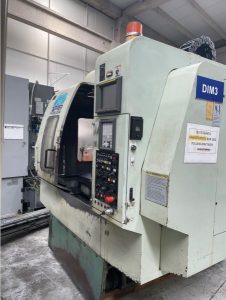
What Industry Experts Recommend Before Purchasing a Pre-Owned, Second-Hand, Surplus, Used Hyundai Wia LV450R CNC Vertical Turret Lathe made in South Korea
When considering purchasing a pre-owned, second-hand, surplus or used HYUNDAI WIA LV450R (CNC Vertical Turret Lathe) made in South Korea, industry experts recommend a thorough inspection and multi-factor checklist to minimise risk and ensure value. Here’s a detailed guide of what to check, ask and evaluate before you commit.
Pre-Purchase Checklist & Expert Recommendations
1. Machine identity, usage history & provenance
- Verify the exact model (e.g., LV450R), serial number, and manufacturer’s build date.
- Obtain usage history: operating hours, heavy-duty duty versus light duty, workpiece types, and load profiles.
- Ask why the machine is being sold: relocation, upgrade, shutdown, or end of contract. A reason tied to performance failures can be a red-flag.
- Inspect service records: maintenance logs, major overhauls, spindle rebuilds, control replacements, alignment verifications.
2. Mechanical condition & structural integrity
- Check spindle health: run-out, vibration, warm-up behaviour, noise under power. Hyundai WIA’s LV450 series is described as “high rigidity bearing structure” for heavy duty cutting.
- Evaluate guideways, turret indexing, ball screws/backlash, especially in the X/Z slideways and turret axis: check wear, scoring, or corrosion.
- Examine the turret (vertical or horizontal turret on the lathe) for tool station wear, indexing accuracy, tool-holder condition, clamping mechanism.
- For this vertical turret lathe: check large components such as chuck/clamp system, table/travel surface, column stability, bed/plate condition.
- Inspect hydraulics, motors, drive systems, and all motion axes under load if possible.
3. CNC-control, software & interface
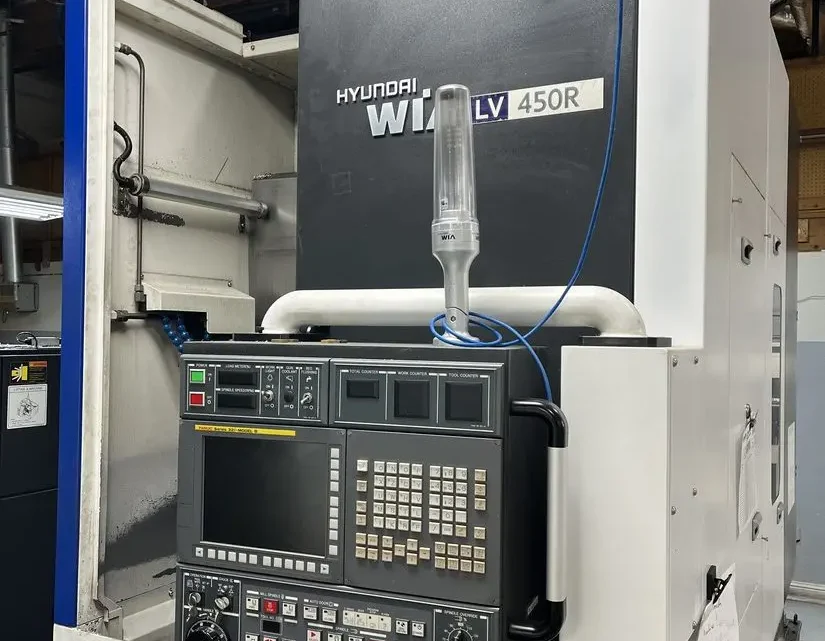
- Identify the control system (often a FANUC or HYUNDAI WIA proprietary system) and confirm it works correctly (panel, programmability, fault history).
- Verify software version, available backups, and whether any key modules (servo drives, spindle drives) have been replaced or updated.
- Confirm availability of spare parts for the control system and drives in your region.
4. Accuracy & performance test
- If feasible, request a demonstration or trial run: machine turning some typical workpiece, and measure key dimensions, surface finish, tool accuracy, repeatability, and chatter.
- Inspect finished work for signs of chatter, thermal growth, or inconsistent finish — these can hint at spindle, bearing or rigidity issues.
- Use a test piece or inspect how old workpieces turned on this machine turned out — check whether the machine maintained tolerances over its lifetime.
5. Environment, installation & adaptation
- Confirm that your floor location and facility can handle the machine: LV-series vertical turning centres often have substantial physical and power requirements. For example, the LV450 series machines have large structural elements including roller LM guideways.
- Check transport, rigging, installation cost, and whether the machine has been moved/refurbished previously (which might affect geometry/alignment).
- Review power supply (voltage, phase), hydraulics, coolant system, chip conveyor/tray, chip disposal system, and whether these will match your facility.
6. Spare parts, maintenance history & support
- Ask about spare-parts history: availability of spindle bearings, turret components, guideway kits, control boards.
- Confirm whether major components (spindle, guideways, ball screws) have been replaced recently or are near end-life.
- For a Korean manufacture machine like HYUNDAI WIA: check whether the vendor still supports the model in your region or whether independent support is required.
7. Remaining useful life & total cost of ownership
- Estimate remaining useful life: given hours of use and workload, how many more years of reliable service can you expect? More use → increased risk of major service.
- Beyond purchase price, calculate installation, releveling, re-alignment, CAM programming, tooling change, transportation and commissioning.
- Factor in downtime risk, especially if the machine forms part of a production critical line.
8. Documentation & compliance
- Ensure manuals (mechanical, electrical), wiring diagrams, parameter sheets, maintenance history are available.
- Check compliance requirements in your region: e.g., safety signage, CE-marking (if importing to Europe), power compliance, removal of custom restrictions.
- Ask for an alignment or calibration certificate if available — this can support claims of accuracy.
9. Contracts, warranties & inspection rights
- Negotiate inspection rights: ideally have the machine under power at seller’s site, or at least video demonstration of full operation under load.
- Include conditional clauses: e.g., acceptable run-out/accuracy, or right to withdraw if hidden defects found.
- Clarify in writing what comes with the machine: tooling, fixtures, programs, zero-points, chuck, software licences.
Specific Considerations for Vertical Turret Lathe (VTL) like the LV450R
- Because turret lathes often rotate large masses and use heavy clamping, check chuck clamping surfaces and wear on chuck jaw assemblies.
- Check torque and spindle drive components — heavy duty turning loads can degrade bearings, coupling, and drive belts/gearboxes.
- Confirm whether the machine is suited for your workpiece size: the LV450R (for example) lists max turning diameter around Ø465 mm (≈18.3″) and turning length around 465 mm.
- Check the turret station capacity and tool sizes: more stations and larger tool capacity may be better for high-mix production.
- For a second-hand machine, check whether the chuck, jaw plates and turret tooling were recently replaced, as these are wear items in VTLs.