Smart Buyer’s Guide: How to Choose the Right Pre-Owned, Used, Secondhand, Surplus CNC Equipment Before Purchasing Piranha HD510 CNC Plasma Cutting System
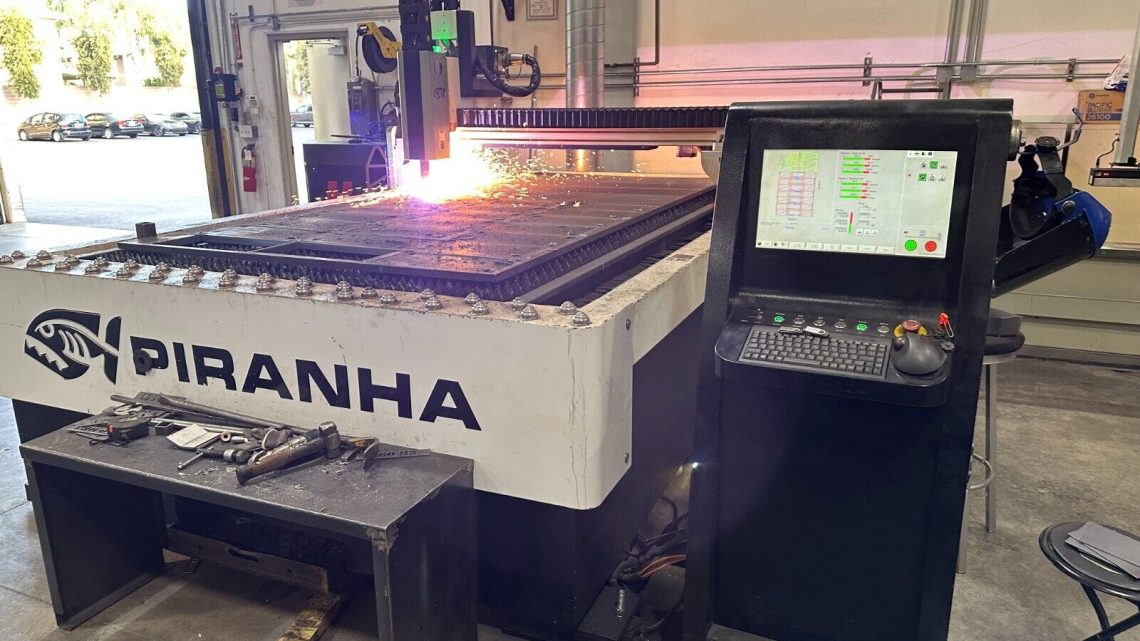
Here’s a Smart Buyer’s Guide for evaluating a pre-owned / used / surplus Piranha HD510 (or equivalent “HD-series” CNC plasma cutting table) or any industrial CNC plasma system. Because plasma tables combine mechanical motion, CNC control, plasma power, gas systems, exhaust, and consumables, you need to check many subsystems carefully to avoid hidden costs or failures. I’ll first summarize key specs for the Piranha HD510 (to set expectations), and then walk you through what to look for, test, and negotiate.
0. Key Specs & Baseline Features of Piranha HD510
Before you inspect, know what “healthy” looks like. The HD510 is a higher-end “HD” (High Definition) plasma system from Piranha / Arclight (Piranha HD series). Below are some published specs (which help you judge how far a used unit may have drifted).
| Spec | Published Value / Range | Notes / Source |
|---|---|---|
| Cutting area (effective) | 63″ × 122″ (≈ 5′ × 10′) | This is the working envelope where the torch can reach |
| Maximum material thickness (mild steel) | 2″ (50 mm) | For plasma cutting, thickness is a limiting factor |
| Maximum rapid (gull speed) | 787 in/min (≈ 20 m/min) | The traverse speed when not cutting |
| CNC / controller | Hypertherm MicroEdge Pro (or Edge Connect) | The OEM control used on HD series |
| Drive / motion mechanics | Dual side drive on X (gantry each side), rack & pinion in X & Y, Z as ball screw | Expect high rigidity and alignment for HD quality |
| Torch height control / arc sensing | Hypertherm sensor-based arc voltage control | Critical for cut consistency |
| Torch protection / breakaway | Pneumatic breakaway mounting | To protect torch from crashes or misalignment |
| Exhaust / dust / downdraft table | Zoned downdraft table (6 zones) | Helps with fume/dust removal and cut quality |
| Material cut speeds (examples) | • 1/4″ MS at ~ 150 in/min @ 130A • 3/8″ MS ~110 in/min @ 130A • 1/2″ MS ~80 in/min @ 130A etc. | Use these as a reference to check actual performance |
These values are what the OEM promises in new condition; a used unit will typically degrade somewhat. When inspecting, you should judge how close the machine can still get to these targets.
1. Pre-Inspection / Information Request from Seller
Before visiting the site or sending an inspector, ask the seller for:
- Serial number, build year, revision / version of firmware and hardware
- Full maintenance / service history (torch replacements, plasma power source changes, alignment, repairs)
- Operating hours (motion hours, cutting hours) or usage schedule
- List of retrofits, modifications, nonstandard parts or added accessories
- Copies of mechanical, electrical, wiring, pneumatic / gas, exhaust, and parts / BOM drawings
- CNC program backups, controller backups, configuration files, parameter backups
- Details of plasma power source(s) (make, model, current installed amperage, age)
- List of included tooling, consumables, spares (nozzles, electrodes, plasma consumables, torch parts)
- Photos / videos of machine in motion: gantry motion, torch height changes, table rotation (if any), exhaust system functioning, control boot-up
- Whether the machine is currently functional, when last used, and whether it has been stored indoors / under cover
Having this information gives you a baseline to plan what tests you’ll need, what spares to bring, and what red flags to watch.
2. Physical / Mechanical Inspection Checklist
When you or your inspection team arrives on-site, systematically evaluate all mechanical and motion subsystems:
A. Frame, Gantry & Structure
- Inspect the base frame, gantry beams, connections, welds, brackets for cracks, distortion, repairs, or bending.
- Check that the machine bed is flat and level (if possible, use a straightedge or reference bar).
- Ensure that support braces, cross-members, and alignment features are intact and not fatigued.
B. Motion Guides / Rails / Bearings / Rack & Pinion
- Move the gantry in X / Y axes (no torch affixed), slowly and moderately, and feel for smoothness, binding, stick-slip, or “dead spots.”
- Check both sides of the gantry (if dual drive) to see if one side is lagging or binding.
- Inspect rack & pinion on X and Y axes: look for wear, chipped teeth, misalignment, backlash.
- Inspect linear bearings / rails / guides: look for wear, corrosion, dirt, damage.
- Check for scrapers, wipers, covers: Are way covers intact, do wipers work to remove debris?
- Verify backlash in axes (move small amounts forward/backward) with a dial indicator.
C. Z-Axis / Torch Height Mechanism
- Move the torch up/down (Z motion) at several speeds; check for smoothness, dead zones, sluggishness, stiction.
- Inspect the ball screw (if used) or whatever vertical drive mechanism for wear, binding, backlash.
- Check the mechanical support of torch carriage: guide rods, bushings, bearings.
- Evaluate whether the torch height system still tracks accurately under motion (test with a flat reference).
D. Table / Work Surface & Support System
- If the table or surface has slats, water-mesa, or downdraft zones, inspect slats for wear, damage, misalignment.
- Check the flatness of the table or ensure the machine’s reference surface is still level and undamaged.
- Inspect ash, slag, debris, or damage to the table bed that could obstruct movement or accuracy.
- Inspect the downdraft / exhaust zones: are the partitions, grates, or hoods intact? Any restriction or leakage?
E. Torch / Torch Mount, Breakaway Mechanism
- Inspect the torch mounting: is the breakaway mechanism functioning and not damaged?
- Inspect torch leads, gas lines, wiring, and mounting brackets.
- Check for wear, bending, deformation, or damage in torch holder components.
- Examine torch lead routing: any kinking, twisting, worn insulation, connector condition.
F. Gas / Air / Cooling / Plumbing
- Inspect all gas / air lines (plasma gas, shielding gas, compressed air) for leaks, damage, corrosion.
- Check fittings, valves, filters, regulators, and moisture traps.
- If the machine uses water cooling, inspect cooling lines, pumps, reservoirs, heat exchangers.
- Examine pneumatics if used (e.g., for torch breakaway, pneumatic clamps).
- Check gas pressure stability under load (if possible).
G. Exhaust, Dust / Fume Collection, Filter Systems
- Inspect exhaust ducts, fans, filters, dampers, blowers.
- Check whether the downdraft system zones function (e.g., whether the fan / blower draws air uniformly across zones).
- Inspect filters or collector cartridges (if present) for wear, clogging, damage.
- Check for leaks or cracks in ducting, missing seals, or poor airflow paths.
3. Electrical, Control & CNC Inspection
The control, drives, and electronics for plasma tables must be in good condition, with reliable communication and safety. Here’s what to check:
- Power up the control and watch boot sequences, error messages, alarms, and ensure the controller initializes properly.
- Check the condition inside control cabinets: dust, water ingress, corrosion, burnt boards, discoloration, loose wiring.
- Inspect wiring harnesses, labeling, strain relief, shielding, connectors.
- Check servo motor controllers / drives (X, Y, Z) for signs of overheating, discoloration, faulty cooling fans, or error codes.
- Inspect the cables (power and encoder / feedback) for damage, shielding integrity, correct routing, strain relief.
- Confirm feedback devices (encoders, sensors) are present on axes and check their connectors and wiring.
- Test I/O modules, interface boards, limit switches, safety circuits, E-stop buttons, interlocks.
- Verify that the controller has parameter backups, software license transfers, and that configuration or parameter files are intact.
- Test communication ports (USB, Ethernet, serial, network) to upload / download programs / backups.
- Check for “locked” or proprietary controller states where the OEM control is hardened or inaccessible.
4. Functional / Performance Testing
This is where you see whether the machine can still cut acceptably. Be prepared with test parts, quality measuring instruments, and safety protocols.
- Motion / Jog Tests
– Jog axes (X, Y, Z) across full travel at different speeds. Watch for smooth behavior, no hesitation, no jitter.
– Approach limits, test reversal, detect “dead zones.” - Torch Height / Arc Sensing Test
– Move to a reference plate or test block, lower torch, sense arc voltage, and see whether the controller maintains consistent distance during motion.
– Test how well torch height responds to changes in plate surface height. - Cut Test on Known Material
– Cut a simple test geometry (e.g. squares, circles, slits) in a material thickness the machine claims to support (e.g. ½″, 1″).
– Inspect cut quality: edge smoothness, dross, bevel, squareness, kerf, edge consistency.
– Compare the speeds achieved vs expected (from spec sheet).
– Run multiple cuts in succession to see if performance degrades (heat, drift, slag accumulation). - Dimensional Accuracy & Repeatability
– After cutting, measure critical features (e.g. hole diameters, edge straightness, offset) to see positional accuracy.
– Run repeated motions / re-cuts on the same part to test repeatability.
– After a warm-up period, repeat cuts to detect thermal drift. - Torch Crash / Fault Recovery / Interruption Tests
– Induce a minor collision or intentional misalignment (in a safe way) to verify whether the breakaway or protective systems work.
– Pause / stop a cut mid-cycle, then resume, and check whether the system recovers correct position and offset.
– Interrupt power / restart controller, then test whether parameter memory, homing routines, and references restore correctly. - Exhaust / Fume Behavior Check
– During cutting, observe whether fumes, smoke, sparks are adequately drawn away by exhaust.
– Check whether downdraft zones are working: any visible turbulence, back-drafting, smoke in work area.
5. Spare Parts, Consumables & Support Lifespan
Even if the used machine passes mechanical and functional tests, your long-term success depends on parts and support.
- Ensure the seller provides or includes manuals (mechanical, electrical, pneumatic, control manuals), wiring diagrams, parts lists / BOMs, control software, parameter backups.
- Request the plasma power source documentation, plasma consumable types, torch parts, nozzles / electrodes, and whether those are still available.
- Check the age, usage, and condition of the plasma power supply: if it’s near end-of-life, replacement may be costly.
- Ask about availability / lead time / cost of spare parts: rack & pinion segments, drives, encoders, torches, wiring, control modules, breakaway parts, filters, exhaust fans.
- Determine if the controller / drives / electronics are obsolete or have third-party support or modern retrofits.
- Check whether Piranha / Arclight (or authorized service in your region) still supports HD series machines or parts.
- Evaluate whether consumables (plasma nozzles, shields, electrodes) are standard (Hypertherm or common) or proprietary, and how easy it is to source them in your region.
6. Risk / Cost Budgeting & Decision Factors
As with any used industrial equipment, your purchase decision should weigh risks, hidden costs, and projections for lifetime.
| Risk / Cost Factor | What to Estimate / Question | Impact |
|---|---|---|
| Refurbishment / repair cost | How much to realign the machine, replace damaged rails, drives, rails, torch parts, exhaust systems? | If refurbishment cost approaches 20–30 % of price, risk is high |
| Consumable & plasma source replacement risk | The plasma power supply or consumable wear might bring future costs; if the supply is old or failing, replacement is expensive | This can dominate long-term running cost |
| Parts and support obsolescence | Are key control modules or drives obsolete or hard to source? | If one key part fails and cannot be replaced, the system may become unusable |
| Calibration, alignment, installation cost | After shipping, you’ll need to realign rails, squareness, torch height calibration, exhaust alignment | Include this in your overall cost-of-ownership estimate |
| Transportation, rigging, installation cost | The plasma table and gantry can be heavy and bulky; disassembly, packing, crane, reassembly, leveling, and utility hookups cost money | Underestimate at your peril |
| Downtime / integration / control tuning | Time required to reprogram, test, integrate with nesting software, train operators | Budget buffer days/weeks |
| Accuracy degradation over time | The machine may already have lost some accuracy or have wear-induced drift | Ensure that margin is acceptable and can be maintained or repaired |
| Alternative / newer machine comparison | Compare cost + risk of used machine vs a new or refurbished plasma table with warranty and up-to-date electronics | Sometimes paying more upfront reduces long-term risk significantly |
A conservative rule often applied in used machinery purchases is to budget 20–30 % (or more, especially for complex machines) of the purchase price for refurbishment, calibration, transportation, spare parts, and commissioning.
7. Contract, Negotiation & Safeguards
To protect yourself when buying a used plasma cutting system, include clauses and safeguards in your purchase agreement:
- Acceptance / Performance Test Clause: final payment is contingent on the machine passing your predefined tests (cutting quality, repeatability, motion, exhaust).
- Hold-back / Escrow: withhold a portion of the payment until after successful commissioning.
- Warranty on Key Subsystems: negotiate limited warranty (e.g. 30–90 days) for the plasma source, motion drives, control electronics, torch mount, breakaway parts.
- Spare Parts & Consumables Package: require the seller include a kit of critical consumables / spare parts (torch parts, filters, nozzles, etc.) or discount accordingly.
- Transport / Damage Liability: clearly assign responsibility for damage during shipping, disassembly, or reassembly.
- Documentation & Software / License Transfer: ensure the complete transfer of manuals, wiring diagrams, parts lists, control software license, backups.
- Latent Defect Clause: define how to handle defects discovered post-installation (repair, replacement, partial refund).
8. Red Flags & Deal-Breakers to Watch For
Some issues should raise immediate suspicion or cause you to walk away unless major discount or repair commitment is made:
- Gantry / rails have severe wear, binding, chipped rack teeth, or backlash beyond correction.
- Z-axis / torch height mechanism is jerky, misaligned, or fails to maintain stable height under motion.
- Torch mount or breakaway mechanism is bent, damaged, or fails to operate reliably.
- Plasma power supply is aged, showing signs of failure (arcing troubles, instability, overheated internals).
- Excessive corrosion, rust, or contamination on frame, rails, structural parts.
- Control cabinets show water damage, burnt boards, missing modules, or heavy corrosion.
- Electronics, drives, encoders are missing, heavily modified, or unrepairable.
- Exhaust/downdraft system is nonfunctional, blocked, missing major parts, or has poor airflow.
- Gas / air plumbing is poorly maintained, leaky, improperly routed, or of low quality.
- Consumable parts (torches, electrodes, nozzles) are missing or custom and unsupportable.
- The used machine cannot cut test parts within acceptable tolerances or cannot sustain consistent cuts.
- The seller refuses full tests, disallows full access, or has no documentation or history.
- The quoted price is very close to a refurbished / new machine’s cost — leaving little cushion for risk.