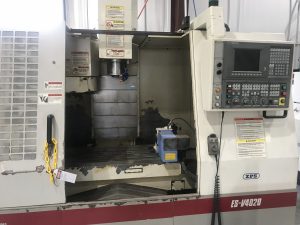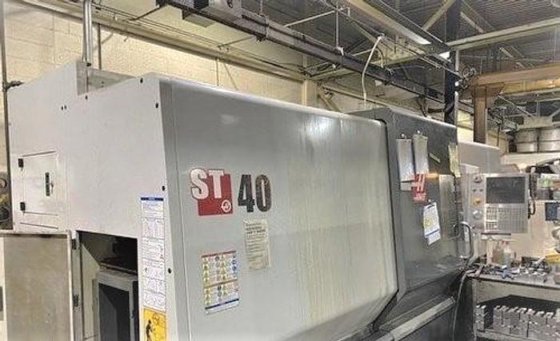
From Factory Floor to Your Workshop: Evaluating a Pre-Owned , Used , Secondhand, Surplus CNC Machines Before Purchase Haas ST-40 CNC Lathe made in USA
Here’s a detailed, practical playbook (with lots of cautionary points) for evaluating a pre-owned / used / surplus Haas ST-40 CNC lathe (or similarly sized heavy CNC lathe) before you commit. The goal is to help you avoid nasty surprises and make an informed negotiation.
1. Know the baseline: what is an ST-40 spec-wise
Before you walk into a shop, you should know what the original machine is supposed to be capable of. That way, you can compare against reality.
Key published specs for the Haas ST-40 (from Haas documentation) include:
- 15″ chuck size, 4.0″ bar capacity
- Maximum spindle speed: 2,400 rpm via 2-speed gearbox
- Spindle motor: 40 hp (vector drive) standard; optional higher power version exists
- Work envelope: max turning over bed, cross slide, etc (swing, travel axes, cutting length)
- Turret: 12-station bolt-on turret, hydraulic chucking, rigid tapping, etc
- The machine is built for rigidity and thermal stability in heavy turning work
Also note that there are published pre-installation guides (e.g. power, footprint, foundation, coolant/piping, electrical) from Haas for the ST-40.
If the seller’s machine deviates significantly from these specs (for instance, much lower spindle power, lower accuracy, missing turret stations, etc.), it may have been heavily modified or abused.
2. Pre-inspection planning: what to have in hand and what to ask
Before going to the site, prepare a checklist and bring basic tools. Also ask the seller for documentation.
What you should request in advance:
- Service / maintenance records — how well it was maintained, what parts have been replaced, periodic overhauls.
- Machine serial number and build year — to check parts availability, revisions, design changes.
- Spindle run hours / “on time” (if the control tracks it)
- Usage history / material profile — what kinds of materials was it cutting (aluminum vs hardened steels)?
- List of options / modifications / retrofits — live tooling, C-axis, high pressure coolant, chip conveyor, etc.
- Photos / videos showing the machine running from multiple angles, including inside enclosures, covers off, etc.
- Electrical / power requirements and layout drawings (so you know if your shop can accept it).
- Warranty, startup, or performance guarantee (if offered)
What you should bring / prepare to bring with you:
- Precision measuring tools (gauge blocks, indicator, dial test indicator, etc) to test alignment and accuracy.
- A cut test program (simple shape or calibration piece) prepared in advance.
- A checklist (mechanical, electrical, control) so you don’t miss anything.
- A technician or machinist who knows CNC lathes (if possible)
Also inspect the site ahead of time (floor, access, cranes, foundation) to ensure it’s feasible to move and install the machine in your workshop.
3. Visual inspection & “smell test”
When you arrive at the seller’s premises, start with broad, non-powered checks:
- Exterior condition: Look for rust, pitting, paint wear, damage to covers, missing panels, signs of repair.
- Enclosures and guards: Are they intact? Are seals, windows, covers, doors present and functioning?
- Signs of coolant leaks, chip accumulation, corrosion inside and under base.
- Bolts, covers, fasteners: missing or mismatched bolts, evidence of welding or patching.
- Cleanliness / upkeep: a neglected exterior often correlates with neglected internals.
- Check leveling screws / foot pads: are they uniform and adjusted?
- Check base / foundation cracks or shifts.
- Inspect hydraulic lines, hoses, fittings — leaks, chafing, aging rubber.
- Check lubrication systems / oil reservoirs — is the oil clean or foul? Are filters changed?
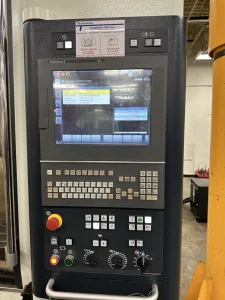
- Control panel & display: buttons, switches, screen clarity, labels still present.
If the machine looks abused, sloppy, or poorly maintained externally, that can hint at deeper issues.
4. Mechanical & structural condition
This is where you dig into whether the internal structure, motion systems, and heavy parts are still serviceable.
Spindle & bearings:
- Run the spindle (both forward and reverse) at various speeds and listen. Any grinding, growling, squealing, or vibration is a red flag.
- Try tapping the spindle nose lightly and see if the spindle moves or shows play/wobble.
- Check for heat: after a short run, feel whether housing or bearings are abnormally hot.
- Inspect the spindle taper / nose for wear, damage, nicks, chipping.
- If possible, measure run-out on the spindle with a dial indicator or test shaft.
- Ask whether spindles or bearings have ever been replaced.
Turret & toolholding:
- Check that all turret positions engage and lock properly.
- Try indexing the turret repeatedly, see if there is backlash, hesitation, or misalignment.
- Inspect tool pockets for wear, proper fit, looseness.
- Check hydraulic cylinders, solenoids, and seals in the turret.
- If live tooling / driven tooling is present, test its operation (rotation, torque, run-out).
- Check for tool change operation, any collisions, or misalignment.
Guideways, linear motion & axes:
- Manually (in jog mode) move X and Z (and any other axes) slowly through full travel. Are there “sticking” areas, binding, rough patches?
- Use an indicator to check for straightness and parallelism along the bed, cross slides, etc.
- Look for scoring, scratching, wear marks, pitting, flaking along guideways.
- Check backlash in each axis — measure how much movement before motion begins.
- Inspect ball screws, lead screws, nuts, anti-backlash mechanisms: for wear, backlash, looseness.
- Check lubrication: are ways oiled, is there a proper automatic lubrication system? Are oil lines clogged or leaking?
Tailstock, steady rests, quills:
- If present, test tailstock quill movement, check for run-out, alignment.
- Inspect steady rests (if used) for wear on contact surfaces.
- Check that tailstock is firmly locked and aligned when in use.
Chip conveyor, coolant, pumps:
- Run chip conveyor (if present) — look for jams, alignment, wear on belt chains, rails, guides.
- Inspect coolant pumps: are they functioning, are seals good, is flow strong?
- Check coolant tank: is it clean, rusted, full of chips or sludge?
- Inspect coolant nozzles, piping, filtration, and high pressure systems (if installed).
- Check for leaks in all fluid systems (coolant, hydraulic, lubrication).
5. Electrical, control, and automation
Even if all the mechanical parts are OK, a broken control or bad wiring can cripple the lathe.
Control & CNC interface:
- Power up the machine and watch for error codes or alarms on startup.
- Test all operator panel buttons, emergency stops, switches, soft keys, jog wheels — see if any are flaky or nonresponsive.
- Test all input/output signals, limit switches, sensors (home switches, reference sensors)
- Load and execute a sample NC program — see whether the axes move as expected.
- Test interpolation, canned cycles, rigid tapping, if available.
- Check memory, backup, and look for any fault logs stored.
- If possible, inspect or ask about servo drives, control boards: are there spare parts, model numbers, condition?
Wiring, cables, and harnesses:
- Inspect wiring insulation, connectors, shielding. Are wires frayed, brittle, patched?
- Check for proper cable management, strain reliefs, fixed routing.
- Follow cable drag chains (if any) — check for wear, slack, broken links or mounting.
- Inspect power cables, incoming main lines, breaker panels in the machine.
- Look for smoke damage, overheated terminals, discoloration in connectors.
- Test continuity (with meter) for suspect circuits.
Safety features & interlocks:
- Test safety interlocks on doors, covers, guards. Does the machine stop (or lock) if a door opens?
- Check E-stop circuits (press E-stop, confirm axes immediately stop).
- Confirm all safety relays, safety circuits are present and functional (if applicable).
- Check for missing or bypassed safety covers or switches (a red flag).
Fluid / pneumatic systems:
- If there are pneumatic systems (for clamping, tool changes, etc.), test them under pressure.
- Check for air leaks, worn tubing, poor pressure retention.
6. Accuracy, repeatability, and test cutting
This is where the real “proof is in the pudding.” Nothing beats a real test cut to see how the machine behaves under load.
Geometric / alignment tests:
- Use gauge blocks, test bars, indicators to test straightness, flatness, squareness, concentricity across axes.
- Measure backlash in each axis over its full travel range.
- Perform repeated moves (to the same position) and see whether it consistently returns to within tolerance.
- Use a known part or test piece (e.g. turning a cylinder, making a bore) and measure deviations across runs.
Test cut / sample program:
- Run a test program cutting a known shape (for example turning a simple cylinder, drilling, facing) under representative loads.
- Measure surface finish, diameter, taper, concentricity, roundness.
- Run the program several times; remeasure to see drift or variation.
- Try more demanding cuts (within safe machining limits) to stress the machine.
- Observe tool dwell times, chatter, thermal drift, stability under continuous cutting.
Thermal stability / warm-up behavior:
- Run the machine under load for a while and check for dimensional drift as the machine warms.
- Re-measure parts cut early vs later in the cycle to see whether heat-induced errors develop.
- Check that coolant and temperature control systems (if present) are working to reduce thermal distortion.
7. Ancillary issues & total cost of ownership
Beyond the machine’s “as-is” condition, you must assess everything else you’ll need (and the hidden costs).
Parts & service support:
- Is Haas (or authorized agents) still supporting this model? Are spare parts (bearings, turrets, control boards) readily available?
- Are there known common failures on ST-40s (and what is the cost of repair)?
- How many aftermarket repair shops are in your region that can service this machine?
Upgrades / retrofits / compatibility:
- If the machine has been upgraded (live tooling, C-axis, high pressure coolant, automation interfaces), verify those upgrades actually work.
- Confirm compatibility of retrofit components with the existing control.
- If you want to add future enhancements, is the machine’s architecture compatible?
Transport, rigging, foundation, and installation:
- The ST-40 is a heavy machine. Rigging, disassembly, transport, and reassembly costs may be high.
- Does your shop have adequate floor strength, crane, power, foundation requirements?
- Check the Haas pre-install documents (power, air, coolant, mounting) to ensure you can meet them.
- Ask who is responsible for shipping, leveling, calibration, and where liability lies during transit.
Warranty / acceptance period:
- Can you negotiate a short acceptance/test period during which you can reject the machine if it fails to perform?
- Is there any warranty or guarantee on major components?
- Will the seller help with re-leveling, calibration, or training?
Downtime & opportunity cost:
- Consider potential downtime if repairs are needed.
- Ensure you have spare tooling, consumables, and spare parts (belts, o-rings, filters, sensors, etc).
- Factor in time to re-qualify the machine, align and verify it before production use.
Resale / salvage value:
- Determine how easy it will be to resell or refurbish the machine later.
- Does the machine retain value? Are there comparable ST-40s for sale?
- If parts become unpopular, salvage value might drop.
8. Negotiation strategies & pricing buffers
Given all the uncertainties, here are tips to help you negotiate:
- Always discount for risk. Even if it looks decent, there’s always unknown wear or latent defects.
- Request a “walk-away” clause if performance after installation doesn’t meet promised tolerances.
- Allocate a margin for spare parts / repairs / reconditioning in your offer.
- Ask the seller to bring the machine to “as good as new” in certain respects (e.g. new way wipers, refurbished bearings, alignment certificates) as part of the deal.
- Stage the payment: partial on deposit, remainder upon acceptance.
- Get the agreement in writing. Document as many as possible of the findings you observed during inspection and make them contingent.
- If possible, visit multiple ST-40 examples to compare what’s normal vs what’s poor.
9. Red flags (deal breakers or serious warnings)
Here are things that should make you walk away (or deeply discount):
- Excessive spindle noise or vibration
- Significant play in spindle or turrets
- Major wear / gouging / pitting on guideways
- Control failures, dead axes, or questionable drives
- Missing or bypassed safety systems
- No service records or history
- Seller unwilling to allow a full test or demo
- Components that appear to be patched or poorly retrofitted
- Foundation or base damage beyond repair
- Incompatible power, shop constraints you cannot resolve