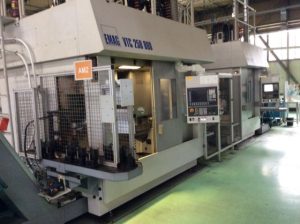
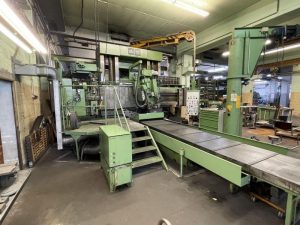
From Factory Floor to Your Workshop: Evaluating a Pre-Owned , Used , Secondhand, Surplus CNC Machines Before Purchase CME FS-3 CNC Bed Type Milling Machine with Rotary Table 4th Axis made in Spain
Here’s a tailored evaluation guide for a pre-owned / surplus CME FS-3 CNC bed-type milling machine (made in Spain, with a rotary table / 4th axis option). Use this as your inspection roadmap, from initial screening through on-site testing to decision/negotiation.
Background & Reference Data for CME FS-3 (with 4th Axis Option)
Before you inspect, you need a reference to benchmark seller claims against known or plausible values.
From the CME FS Series spec sheet:
| Parameter | Spec for FS-3 | Notes |
|---|---|---|
| Longitudinal (X) travel | 2,500 mm | FS-3 is the 2,500 mm X variant in the FS Series spec sheet. |
| Transverse (Y) travel | 1,200 mm | FS series spec sheet lists 1,200 mm for Y in the FS models. |
| Vertical (Z) travel | 1,500 mm | The spec sheet gives Z = 1,500 mm for all FS models. |
| Table size | 2,600 × 1,000 mm | According to spec sheet for FS-3 (Table surface for FS-3) |
| Max table load | ~ 6,000 kg | Listed in spec sheet for FS-3. |
| Rapid feed (axes) | 20,000 mm/min (20 m/min) | In spec sheet for FS series. |
| Spindle power (nominal) | 24 kW (S1) / 30 kW (S6) | As in FS spec sheet. |
| Spindle taper / mount | ISO-50 / DIN 69871 | Spec sheet mentions ISO-50 as standard. |
| Spindle speed | 50 – 4,000 RPM (standard) | Spec shows 4,000 rpm standard, 5,000 optional. |
| Rotary table / 4th axis | Pre-installation for 4th axis, option for rotary table | The spec sheet shows “pre-installation for 4th axis (without drive)” and “rotary table 4th axis horizontal / vertical” as options. |
Other real-world listing data (from used machine ads) often show:
- A CME FS-3 listing: table 2,700 × 1,000 mm, travels X = 2,500 mm, Y = 1,200 mm, Z = 1,500 mm, rpm 20–4,000, load table 7,000 kg, in 2007 model.
- A CME FS-3 listing: X/Y/Z = 2500 / 1000 / 1,400 mm, table 2,500 × 850 mm, load 6,000 kg, spindle 4,000 rpm, ~22 kW, weight ~16,000 kg, control Heidenhain.
Use these as reference ranges. If the machine you inspect claims wildly different specs (e.g. X = 4,000 mm, rpm 12,000) without proof or upgrade documentation, that’s a red flag.
Pre-Screening & Documentation (Before On-Site Visit)
Before you go, gather as much as possible in writing or photos. That helps you screen out bad offers cheaply.
Ask / request:
- Nameplate / ID plates
– Photo of the mechanical nameplate (model, serial, year)
– Electrical cabinet plate (voltage, phase, current rating) - Specification sheet / manual
– The original or variant FS-3 spec sheet
– Control manual, wiring diagrams, servo / drive documentation - Control system / CNC details
– Brand & model of control (Heidenhain, FANUC, etc.)
– Software version, parameter backups, tool / macro libraries - Operating / usage history
– Hours logged, cutting / load hours vs idle hours
– Type of work done (heavy roughing, fine finishing, material types) - Maintenance / major repairs / rebuilds
– Spindle overhauls, guideway repairs, ball screw replacement
– Any retrofits or upgrades (e.g. adding the rotary table, 4th axis drive) - List of accessories / tooling / spares included
– Rotary table / 4th axis (if installed)
– Collets, clamping fixtures, spare electronics, tool holders - Photos / video in operation
– Rotating the spindle, axis moves, tool changes, rotary table engagement
– Close-up photos of slides, spindles, cabling - Reason for sale
– Is the machine failing, going idle, being replaced, or surplus due to relocation? - Shop / environmental information
– Was the environment clean, dusty, heavy chips, coolant contamination, etc. - Logistics / installation info
– Machine weight, footprint, crane / rigging access, floor strength
If seller is evasive about these, it’s a danger sign.
On-Site Inspection & Mechanical / Structural Checks
Bring proper measuring instruments, and if possible someone familiar with heavy mills. Work systematically from external to internal and from static to dynamic.
1. Visual / Structural / External Inspection
- Check the machine’s bed / base / frame for cracks, repairs, or distortion
- Inspect guideways / linear rails / slides in X, Y, Z axes: watch for pitting, scoring, corrosion, uneven wear
- Inspect way covers / bellows / guards: any damage or missing covers is a concern
- Examine the spindle head, milling head (incl. tilt, indexer), rotary table mounting zones
- Look for signs of coolant / oil leakage, dried buildup, seepage along slides
- Examine cable management: wiring, conduits, cable chains—look for splices, damaged insulation
- Inspect the 4th axis / rotary table (if present): mechanical integrity, bearings, backlash
- Check tool changer / magazine if installed
Try to move or lightly jog components (where safe) to detect binding or rough spots.
2. Backlash / Axis Motion / Kinematic Inspection
- Jog axes (X, Y, Z) slowly through full travel—feel for smooth motion, or zones of drag / stiction
- Use a dial indicator to measure backlash / lost motion in each axis (push-pull) in different positions
- Reverse direction near endpoints to detect hysteresis / deadband
- Check ball screws, nut play, couplings, bearings for looseness or slop
- Jog in slow feed mode and watch for inconsistencies (jerks, step changes)
- Cycle any tool indexing, head tilt / pivot, rotary table indexing multiple times to see if alignment or repeatability degrade
3. Spindle, Head / Milling Components, 4th Axis
- Run spindle at multiple speeds (low, mid, up to 4,000 rpm or higher if optional) — listen for bearing noise, vibration, roughness
- Use a test bar + dial indicator to measure runout at spindle nose / along length
- Check spindle acceleration / deceleration behavior
- Inspect the milling / indexing head for backlash, pivoting movement, mechanical play
- Test the rotary table (if installed) under no load: rotate, index, reverse, check for backlash or slop
- If the 4th axis rotates under load, test that too (if allowed)
4. Control / Electrical / Electronics / Cabinet Inspection
- Open control / power cabinet: inspect wiring, fuses, relays, driver modules
- Look for signs of overheating: discolored insulation, melted wire, burnt connectors
- Inspect servo / drive boards, interface modules, cable connectors
- Check cable routing, shielding, strain reliefs
- Power up the control: test all buttons, knobs, E-stops, limit switches, interlocks
- Navigate CNC menus: verify parameter sets, tool tables, backup memory, alarm logs
- Test safety interlocks: opening doors or guards should disable movement
Operational / Load Testing (Live Operation)
If seller allows, this is where you see hidden flaws.
- Perform a dry / air run of a sample machining program: tool changes, axis movement, head indexing, rotary table indexing
- Execute a test cut on a known material: evaluate surface finish, chatter, dimensional accuracy
- Run a sustained machining cycle (30–60 min) under moderate load and remeasure key axes / features before/after to detect thermal drift
- After warm-up, recheck backlash, runout, alignment to see if things shifted
- Cycle the tool changer, 4th axis indexing repeatedly to detect degradation
- If possible, run a 4th axis under load (e.g. finish a radius or contour) to see dynamic behavior
Precision / Metrology & Accuracy Verification
- Use gauge blocks, test bars or precision artifacts to check straightness, squareness, alignment
- Check repeatability / reversal error: move to reference, retract, return, measure deviation
- Inspect workpiece roundness, concentricity, tolerance deviations on the test cut
- After extended running, recheck dimensions to detect drift
- Compare measured tolerances to your part requirements and to published spec (±0.005 mm typical in spec sheet)
Infrastructure, Installation & Practical Concerns
- Confirm floor load capacity; these are very heavy machines
- Check crane / rigging / access, door heights, overhead obstructions
- Validate power supply (voltage, phase, capacity) in your workshop
- Ensure coolant system, filtration, chip removal, ventilation, and maintenance access are adequate
- Plan proper leveling, foundation, anchoring, alignment
- Confirm spare parts / service support availability from CME for FS-series machines
Post-Inspection Evaluation & Decision Criteria
Once you have your test data, visual observations, and dimensional measurements, use this to decide or negotiate. Here’s a decision matrix:
| Category | Good / Acceptable | Red Flags / Potential Deal Breaker |
|---|---|---|
| Spec compliance | Travels, spindle rpm, table size, load close to spec sheet values | Big deviation in travel, spindle rpm, or claimed features not present |
| Mechanical condition | Slight wear, smooth movements, no binding | Severe wear on rails, binding, gouges |
| Backlash / motion precision | Backlash within reasonable limits, repeatability stable | Large backlash, inconsistent motion, hysteresis |
| Spindle / head / 4th axis health | Quiet, low runout, stable operation | Vibration, noise, slop, misalignment, overheating |
| Control / electronics | Clean wiring, stable operation, no alarming errors | Burnt wiring, bad drives, corrupt control modules |
| Operational test success | Good surface finish, dimensional control, stability | Chatter, poor finish, drift during cycles |
| Thermal stability | Minimal change post warm-up | Large drift or shift after hours of operation |
| Repair / refurbishment cost | Known parts, manageable repairs | Obsolete parts, major refurbishments needed |
| Support & spares | CME provides spare parts and support | Parts unavailable, limited service support |
| Warranty / guarantee | Seller backs performance, test-cut guarantee | “As is” sale, no recourse for hidden defects |
In negotiation, use any mismatch or defect (e.g. worn ways, missing drive modules, noisy spindle, etc.) to reduce price or demand that spare parts or performance guarantees be included.