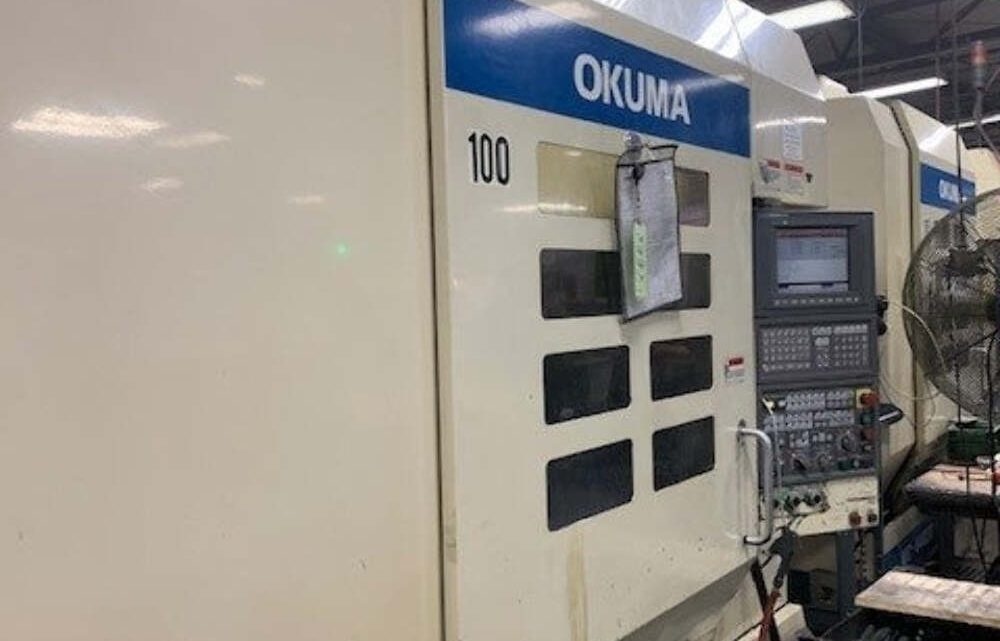
From Factory Floor to Your Workshop: Evaluating a Pre-Owned , Used , Secondhand, Surplus CNC Machines Before Purchase Okuma MC-4020 CNC Vertical Machining Center made in Japan
Below is a detailed “factory floor → workshop” style checklist and guide for evaluating a pre-owned / used / surplus Okuma MC-4020 (or MC-V4020 / variant) vertical machining center (made in Japan). Use it to catch hidden defects, validate specs, and decide whether to buy or walk away.
Typical / Reference Specs & Model Context
Before inspection, you should know what “normal” looks like for the MC-4020 (or “MCV-4020” / MC-V4020). Use these as benchmarks or red-flag thresholds.
| Parameter | Typical / Published Value | Notes / Sources / Observations |
|---|---|---|
| X Travel | ~ 40″ (≈ 1,016 mm) | listing: X = 40″ |
| Y Travel | ~ 20″ (≈ 508 mm) | |
| Z Travel | ~ 17.7″ (≈ 450 mm) | e.g. “17.72″ Z” in listings |
| Table size | ~ 48″ × 20″ | Used listing shows table 48″ × 20″ |
| Maximum table load | ~ 1,500 lb (≈ 680 kg) | |
| Spindle taper | Usually CAT / BT 40 / #40 | Some listings show “#40 / 40 taper” |
| Spindle speed range | Up to ~ 8,000 RPM | A 2004 listing shows 8,000 RPM spec |
| Rapid traverse / feed | ~ 1,417 IPM (X / Y) & ~ 1,181 IPM (Z) | From the MC-V4020 spec in listings |
| Control | OSP / E100 / E100M / E100L / P200M variants | Many machines are sold with OSP E100 / E100M control |
| Approx weight / footprint | ~ 15,000 lb (≈ 6.8 tonnes) | One listing: weight = 15,000 lbs |
| Spindle motor / horsepower | ~ 20 HP (≈ 15 kW) for many units | In Prestige listing: 20 HP |
These are “ballpark” numbers; actual machine you inspect might differ slightly (due to options, retrofits, or variant models). But if someone claims double travel, double spindle speed, etc., demand proof.
Pre-Visit / Pre-Screening Steps
Before going to inspect personally, collect as many details and documents as you can. This filters out bad offers early.
Request from seller:
- Nameplates / ID plates
- Photos of mechanical nameplate (model, serial number, build year)
- Electrical cabinet plate (voltage, phase, current ratings)
- Specification sheet / brochure / manual
- Original Okuma spec sheet for the particular variant
- Control manual, wiring diagrams, servo / amplifier manuals
- Control & software details
- Which CNC / control (OSP, E100 / E100M / E100L, P200M, etc.)
- Software version, parameter backup, tool library, macro usage
- Usage / runtime history
- Power-on hours vs actual cutting / load hours
- Type of work done (materials, duty cycles)
- Maintenance / repair logs
- Spindle rebuilds, bearing changes, guideway regrinds, chip damage repairs
- Any major part replacement or retrofits
- Modifications / options / extras
- High-speed spindle, thru-spindle coolant, 4th axis, probing, toolchanger upgrades
- Spare parts, extra tool holders, backup electronics
- Photos / videos in operation
- Spindle running, axes moving, tool changes
- Close-ups of critical areas (guideways, spindle nose, tool changer)
- Reason for sale
- Is it being replaced, idle, broken, or part of a plant shutdown?
- Facility / environmental conditions
- How “clean” was the shop? Dust, coolant sludge, chip buildup, vibration, etc.
- Logistics information
- Machine weight, footprint, rigging plan, access constraints
If the seller is evasive or lacks many of these, treat that as a warning.
On-Site Inspection & Mechanical / Structural Checks
Bring measurement tools (dial indicators, test bar, micrometers, surface plates) and, if possible, someone experienced with Okuma machines.
1. Visual & Structural Examination
- Inspect the base / column / casting for cracks, welds, distortions, repairs
- Check the guideways / linear rails (X, Y, Z axes): look for pitting, corrosion, scoring, uneven wear
- Inspect way covers, guards, bellows: tears or missing covers allow contamination
- Examine the spindle head, spindle nose, tool changer housing for damage or looseness
- Watch for signs of coolant / oil leaks around seals, sliding surfaces, pump areas
- Inspect wiring, conduits, cable carriers, junctions: look for patched wires, exposed insulation, splices
- Inspect the automatic tool changer mechanism: arms, grippers, magazines, movement smoothness
2. Manual / Motion Checks & Backlash
- With power off or in safe mode, move each axis manually (or slowly jog) to feel for any binding, stiff spots, or jerkiness
- Using a dial indicator, measure backlash or lost motion in X, Y, Z axes (push-pull test) in multiple positions
- Reversals near endpoints to detect hysteresis / deadband
- Inspect ball screws / nuts / couplings for looseness or wear
- If possible, jog at a slow feed and observe consistency of motion (no jumps or hesitation)
- Cycle tool changer several times to see if it indexes cleanly, no hesitation
3. Spindle, Tooling, and Drive System
- Run the spindle at different RPMs (low to higher) and listen for bearing noise, rattling, vibration
- Use a test bar + dial indicator to measure spindle runout at nose, and ideally along some length
- Observe whether the spindle remains quiet and stable under moderate runtime
- Check spindle nose surface, taper, and clamping area for wear or damage
- If the spindle has thru-spindle coolant, inspect its seals, plumbing, and whether it holds coolant pressure
- Operate the tool changer under command: tools should load/unload smoothly, with correct seating
4. Control, Electrical & Cabinet Inspection
- Open the electrical / control cabinets: examine wiring, terminal blocks, relays, driver modules, fuses
- Look for any overheating signs: discolored insulation, burnt connectors, melted parts
- Inspect servo amplifiers, interface cards, control boards for corrosion or damage
- Check cable routing, shielding, strain reliefs
- Power-up: test all switches, buttons, override knobs, E-stop, limit switches / interlocks
- Navigate the control menus, examine alarm logs, parameter sets, tool tables
- Test safety interlocks and ensure any protective cover or guard opening stops motion
Operational / Functional Testing (Live Testing)
If the seller allows, carrying out live tests under motion and load is critical.
- Run a dry / air program (no machining) to check coordinated axis motion, sequencing, tool changes
- Execute a test cut on a known material to evaluate surface finish, dimensional accuracy, chatter
- Run extended continuous cutting (30–60 min) under moderate load; then remeasure key axes to detect thermal drift
- After warm-up, repeat earlier tests (backlash, runout) to see if behavior changes
- Cycle tool changes many times to identify wear or mis-indexing over time
Metrology, Accuracy & Drift Checks
- Use calibrated artifacts (gauge blocks, test bars) to verify straightness, squareness, alignment
- Test repeatability: move to a reference point, retract, return, and measure deviation
- Inspect the machined test workpiece for concentricity, runout, geometric accuracy
- Re-check dimensions after warm-up or extended runs to detect drift
- Compare measured tolerances vs what your parts require
Infrastructure, Installation & Practical Concerns
- Confirm your shop floor’s load capacity (the machine is heavy)
- Check rigging access, crane capacity, door clearances for moving and installing the machine
- Validate your workshop’s power availability (voltage, current, phase)
- Ensure your coolant, filtration, chip removal, ventilation, and maintenance access are adequate
- Plan for proper leveling, foundation, anchoring, and alignment
Post-Inspection Evaluation & Decision Criteria
Once you’ve collected measurements, observations, and test results, assess whether to proceed, walk, or renegotiate.
Evaluation criteria / red flags:
| Aspect | Acceptable / Good | Red flag / Deal breaker |
|---|---|---|
| Alignment / geometry | Small deviations within tolerance, stable over time | Large drift, inconsistent accuracy, shifts after warm-up |
| Backlash / motion quality | Backlash within spec, smooth motion | Excessive backlash, inconsistent motion, binding spots |
| Spindle health | Quiet, low runout, stable under load | Bearing noise, vibration, high runout, heating issues |
| Tool changer / tool seating | Reliable, consistent indexing, no dropouts | Tool mis-index, slippage, gripper failure |
| Control / electronics | Clean cabinet, proper wiring, operational CNC | Burnt wiring, failing boards, unreliable control behavior |
| Test-cut performance | Good finishes, dimensional fidelity, no chatter | Poor finish, chatter, defects, dimensional drift |
| Thermal stability | Minimal shift after warm-up | Significant drift or changes over time |
| Repair cost & parts availability | Key parts (spindles, drives, boards) available | Obsolete or long-lead parts, hidden modules failing |
| Warranty / condition agreement | Seller offers minimal performance guarantee, proof of functionality | “As is” sale, no recourse, hidden defects |
Negotiation leverage: use any discrepancies or defects (e.g. worn guideways, spares missing, noisy spindle) to demand discount, spares, or a guarantee.