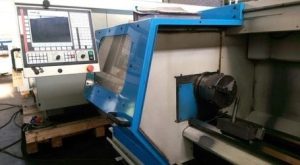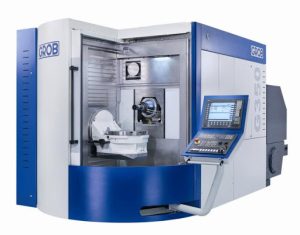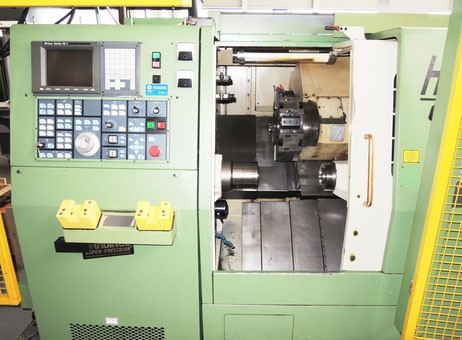
From Factory Floor to Your Workshop: Evaluating a Pre-Owned , Used , Secondhand, Surplus CNC Machines Before Purchase HARDINGE CONQUEST T 42 SP CNC Lathe made in USA
Here is a robust, field-tested checklist and guide you can use when evaluating a pre-owned / surplus HARDINGE Conquest T-42 SP CNC lathe (made in the USA). Because this is a sophisticated machine (often equipped with sub-spindle, live tooling, etc.), you’ll want to examine mechanical, electrical, control, and performance aspects carefully.
I also include known reference data for the T-42 / T42-SP variant to help you spot deviations. Use this as your “from factory to workshop” roadmap.
Reference Spec / Model Context (Hardinge Conquest T-42 / T42-SP)
Before you walk into the factory, it helps to know what the T-42 / T-42 SP is supposed to deliver. That way you can compare what the seller claims vs reality. Some reference data:
| Spec | Typical / Published | Notes / Source |
|---|---|---|
| Max swing over bed | ~21.2″ (~538 mm) | Many used listings for T42-SP use 21.2″ swing |
| Max turning diameter | ~9″ (~228 mm) | |
| Z-axis / distance between centers | ~13.9″ (~353 mm) (for collet version) | Some versions have variations depending on turret / attachments |
| X-axis travel | ~5.31″ (~135 mm) | |
| Spindle bore / through-hole | ~1.625″ (~41 mm) | |
| Max spindle RPM | ~5,000 RPM (main) | Some live tooling or sub-spindle may have different RPM ranges |
| Control type | GE Fanuc 18T is a common control in listings | Manual for T42 mentions Fanuc 18T control and absolute encoders |
| Turret / live tooling / sub-spindle | The “SP” suffix suggests Sub-Spindle or live tooling capability. One listing: 12 station turret (6 live) + sub-spindle option |
These reference figures help you know when a seller is exaggerating or when a machine has been heavily modified.
Pre-Screening (Before Visiting)
Before going to the site, collect as much information as possible. A machine with poor documentation or missing history is higher risk.
Ask / Request:
- Nameplate photos — both the main plate and electrical cabinet plate
- Serial number, build year, model variant (T-42, T-42 SP, etc.)
- Control / CNC details — which control is installed, software version, backup of parameters
- Operating hours / duty records — run hours, cutting hours vs idle
- Maintenance / service history — spindle rebuilds, turret overhauls, control repairs
- List of included tooling / accessories / spares — collets, chucks, live tool heads, spare electronics
- Photos / video of machine in motion (if possible) — spindle running, axes moving, turret indexing
- Reason for sale — is the machine failing, being replaced, or simply surplus?
- Factory / environment info — was it in a harsh or dirty environment? Any exposure to coolant slurries, chip accumulation, etc.?
- Shop layout / rigging constraints — weight, dimensions, crane access, floor strength
If the seller is unable or unwilling to supply many of these, that is a red flag.
On-Site Inspection & Mechanical Assessment
Bring measuring tools (dial indicators, test bar, micrometers), and if possible, a machinist / technician. Proceed methodically from external to internal, then to functionality.
1. Visual & Structural Checks
- Inspect the bed, base, and frame for cracks, weld repairs, distortions, or signs of settlement
- Examine way surfaces / guideways (on Z, X axes): look for pitting, scoring, corrosion, uneven wear
- Check way covers, bellows, guards: torn or missing covers allow contamination
- Inspect spindle housing, collet closer area, turret housing, tooling mounts for damage
- Check for oil leaks, hydraulic leaks, coolant leaks around seals and covers
- Inspect wiring, cable carriers, conduits, junction boxes for signs of splices, worn insulation, loose connections
- Examine turret, turret face, tool mounting surfaces for wear or damage
- For sub-spindle modules (if present), check mounting, alignment, and mechanical interface
Try to move slides by hand (with machine powered off or in safe mode) to feel for binding or grit.
2. Backlash / Axis Motion Tests & Kinematics
- Jog axes (X and Z) slowly through full travel—feel for consistent smooth motion or spots of drag / stickiness
- Use a dial indicator to test backlash / lost motion in both axes, at multiple positions, in both directions
- Reverse direction at travel extremes to detect hysteresis or deadband
- Inspect ballscrews / leadscrews, nuts, couplings for looseness, play, wear
- Command slow feed moves to see if the axes track smoothly without steps or hesitation
- For the turret: index through all stations multiple times; listen / watch for hesitation, mis-indexing, tool misalignment
3. Spindle / Collet Closer / Tooling
- Run the main spindle at various RPMs—listen for bearing noise, vibration, roughness
- Use a test bar + dial indicator to measure spindle runout at the nose and along length
- Monitor bearing / spindle temperature under short runs
- Examine collet closer mechanism (hydraulic or mechanical) for signs of wear, leakage, or slack
- If sub-spindle or live tooling is present, test its rotation, alignment, stability
- Inspect the taper, tool seating surfaces for wear, nicks, or misalignment
4. Control / Electrical / Cabinet Inspection
- Open the electrical / control cabinet: inspect wiring, connectors, terminal blocks, fuses, relays
- Look for signs of overheating: discolored insulation, melted wiring, scorched terminals
- Check cable routing, shielding, strain reliefs
- Power up control panel: test all buttons, switches, override knobs, emergency stop, interlocks
- Navigate CNC menus; examine parameter sets, tool tables, alarm history, offset tables
- Test limit switches, door interlocks, safety circuits
- Check grounding, electrical noise suppression, power stability
5. Operational / Load Testing
If allowed, perform live tests (these are often the most revealing):
- Do a dry / air run of a sample part motion or program, verifying axis coordination, turret motion, sequencing
- Execute a test cut (on known material) to evaluate surface finish, chatter, dimensional control
- Run a longer cycle under moderate load (30–60 minutes), then recheck key dimensions (backlash, runout, alignment) to detect thermal drift
- After warm-up, re-measure backlash, runout, alignment to see if performance degrades or changes
- Cycle turret indexing repeatedly to test reliability
- If sub-spindle / live tooling is present, test those under load as well
Metrology & Accuracy Checks
Because these machines are expected to deliver precision, perform measurements:
- Use calibrated test bars, gauge blocks, or artifacts to check straightness, squareness, alignment
- Test repeatability: move to a reference point, retract, return, measure deviation
- Check concentricity / runout of machined or test workpieces
- After extended running, re-check dimensional accuracy to detect drift or error growth
- Compare measured performance vs what you require (tolerances) and vs spec ranges
Infrastructure, Installation & Practicalities
- Confirm whether your workshop’s floor supports the machine weight and dynamic loads
- Check crane / rigging access, clearances, machine movement path
- Ensure your power supply (voltage, service, phase) is adequate
- Confirm coolant systems, chip removal, filtration, ventilation, maintenance access
- Prepare for proper leveling, foundation, anchoring
- Assess spare parts availability for Hardinge T-42 series (spindles, controls, turret modules, electronics)
Post-Inspection Decision Criteria & Negotiation
After inspection, collate your observations and use them to make your decision and negotiate.
Key Criteria to Evaluate:
| Area | Good / Acceptable | Warning / Reject Conditions |
|---|---|---|
| Mechanical integrity | Slight wear, smooth motions, good alignment | Severe wear on ways, binding motion, misalignment |
| Backlash / axis precision | Backlash within acceptable limits, consistent performance | Excessive backlash, inconsistent or variable lost motion |
| Spindle / collet health | Quiet, low runout, stable under load | Bearing noise, vibration, high runout, slack or wear in collet mechanism |
| Turret / tool handling | Reliable tool indexing, correct seating, no mis-index | Turret hesitations, mis-index, tool jamming, misalignment |
| Control / electronics health | Clean wiring, operational control, no alarming errors | Burned wiring, failing modules, corrupted control logic |
| Test cut performance | Good surface finish, dimensional stability, no chatter, repeatability | Poor finishes, chatter, drift during run |
| Thermal stability | Dimensions maintain after warm-up | Shift / drift in dimensions after hours of operation |
| Repair / refurbishment cost | Issues are known and parts are available | Unknown or unavailable parts, extreme repairs needed |
| Parts & support availability | Hardinge support or aftermarket parts are possible | Obsolete modules, long lead times, unsupported variants |
In negotiation, use all observed defects or deviations as leverage:
- Ask for spare parts (electronics, tool holders, controls, spindle modules) included
- Request a short-term performance guarantee (e.g. “cut-to-spec for 30 days”)
- Ask seller to cover part of dismantling, transport, leveling or reinstallation costs
- Ensure everything is documented (photos, measurements) to protect against hidden defects
If too many critical problems exist, or the cost of reconditioning plus purchase is close to a new or better machine alternative, walk away or push hard on discounts.