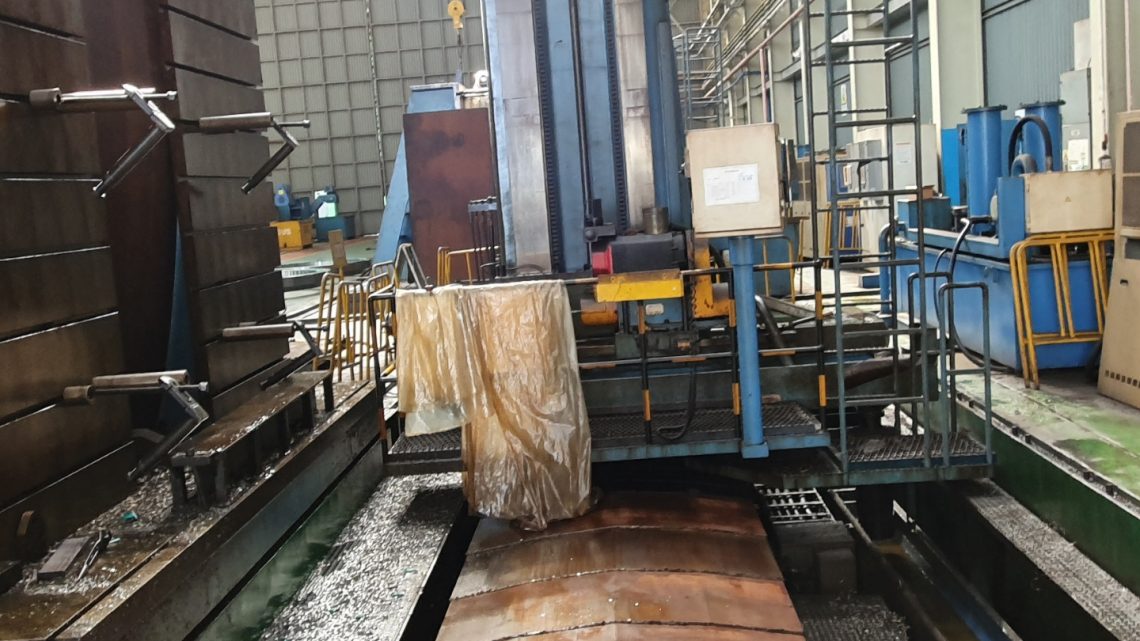
Before You Buy: Essential Criteria for Evaluating a Used, Second-Hand, Pre-Owned, Surplus Dae-Yang ENG Co. DMBC-1000CNC Deep Hole Drilling Length 6 Meters made in South Korea
Here’s a detailed, tailored pre-purchase checklist and guide for evaluating a used / surplus Dae-Yang DMBC-1000CNC deep hole drilling machine (6 m length / 6,000 mm deep-hole capability, or whatever the seller claims). These deep-hole drilling / BTA / gun-drilling machines are very exacting machines; small defects or misalignments can be extremely costly or impossible to fully correct.
I’ll also intersperse what is publicly known about the DMBC-1000 to help you calibrate your expectations. (For instance, Dae-Yang advertises the DMBC series as column-transfer deep hole / BTA + gun drilling machines. )
What We Know / Reference for the DMBC-1000
Before diving into the criteria, here’s what is publicly available about the DMBC-1000, which is useful as reference when comparing what the seller claims vs reality:
- The DMBC series by Dae-Yang is designed as a column-transfer type deep drilling machine, supporting both gun drilling and BTA drilling functions.
- A listing describes the DMBC-1000 specifying: “120 mm max drilling diameter, 6,000 / 3,000 / 1,000 mm XYZ travels” (though “travel” framing in deep-hole machines can mean different axes / offsets)
- A used-listing states that a DMBC-1000 (2010) is a BTA-type CNC deep hole drilling machine, with specs such as “drilling dia 16 ~ 80 mm, X travel 4000 mm, Y travel 2000 mm, Z travel 1000 mm, spindle motor 30 / 37 kW.”
- The Dae-Yang corporate site places its address in Yangsan, Gyeongnam, Republic of Korea, confirming the origin and manufacturer location.
- The DMBC series is floor worktable (table-type) not limited by workpiece weight / shape (i.e. large parts can be mounted) and allows for angle plate installation for tube sheet drilling.
Thus, any used DMBC-1000 you inspect should approximate these capabilities (within tolerances) unless it has been heavily modified.
Key Areas & Criteria for Evaluation
Below is a systematic checklist of critical subsystems, tolerances, and caution flags. Bring your measuring instruments (dial indicators, test bars, alignment tools), and insist on inspection under power and under load if possible.
1. Structural / Static Integrity & Frame
These machines must remain rigid over the long drilling travel. The structural integrity of the frame, column, transfer mechanism, and base is fundamental.
- Frame, base & column
• Inspect for welds, repairs, patch plates, crack repairs around high stress zones (column base, guide supports, table mounting)
• Look for distortion, bowing, misalignment, or bending of the column or transfer assembly
• Check for corrosion, pitting, chemical attack, coolant damage, especially near chip paths or coolant sumps - Guide / transfer rails & support structure
• For the column-transfer type, the rails (for the moving column or transfer carriage) must be straight, clean, and free of scoring
• Check that support beams, crossmembers, and reinforcement members are intact and not cracked - Mounting surfaces, covers & guards
• Flatness and alignment of mounting surfaces (for fixtures, plates, angle plates) must not be warped
• Guards, covers, chip shields, protective wipers should be in place and functional to prevent ingress of chips / coolant
If the structural skeleton has drift or damage, alignment and geometric accuracy will be compromised indefinitely.
2. Guideways, Slides, Transfer Mechanism & Linear Axes
Deep-hole machines often have long slideways, transferring columns, and linear axes that must move precisely over long distances.
- Smoothness and continuity
• Jog or move the linear axes (X, Y, Z or whatever the transfer / column axes are) and feel for binding, stick-slip, jumps, grit, or changes in friction over travel - Wear, scoring, pitting, corrosion
• Visually and with feel, detect worn or damaged surfaces: scratches, chatter “rings,” pitting, surface discoloration - Backlash, play, lateral wiggle
• Use a dial indicator to check for sideways motion (perpendicular to the axis) and measure backlash (reversal error) - Gib / adjustment surfaces
• Examine gibs or shim surfaces; if heavily shimmed or at extreme adjustment, it suggests that guideways are worn - Way protection / scrapers / wipers
• Evaluate whether scrapers / wipers / covers / bellows are present, intact, and functioning; if they are missing or damaged, chips or coolant may have degraded the guideways over time
Because long travel axes magnify small errors, any nonlinearity or wear can be highly detrimental to drilling accuracy (especially over 6 m lengths).
3. Spindle(s), Drilling Head, Chuck / BTA / Gun Drilling Mechanism
The spindle / drilling head subsystem is the heart of the machine. It must maintain precision, rigidity, and smoothness when drilling long holes.
- Spindle rotation & smoothness
• Rotate the spindle (slowly, ideally under control) and listen/feel for roughness, uneven drag, noises, or friction variation - Radial & axial runout / play
• Using a precision bar or test piece, measure radial runout and axial play (end play). For deep hole drilling, tolerances are tight. - Bearing condition / history
• Inspect seals, housing, lubrication ports. Ask the seller when the bearings were last replaced, and whether they were original or upgraded
• Signs of coolant ingress or contamination are red flags (bearing compromise) - Drilling head alignment & coaxiality
• Check that the drilling head’s axis is aligned and coaxial with the transfer / column axis over the full travel - Chuck, clamping, BTA / Gun drill interface
• Check the interface (gun-drill head, BTA head, tool holders) for wear, alignment, damage, match to the spindle
• Clamping mechanisms, coupling surfaces, locking surfaces, seals must be intact and precise - Coolant / feed / return / chip removal paths
• Inspect coolant supply lines, filters, seals, return lines, coolant pumps. Any leaks, blockages, or contamination in the coolant path can degrade accuracy
• Chip removal / flushing paths must be clear and functional (especially in deep holes)
Deep-hole machines are extremely sensitive to minute deviations in spindle and head alignment — even slight wear or play can cause hole straightness or surface finish issues.
4. Motion Accuracy, Geometric & Drilling Performance Tests
Simply having axes move is not enough — you must validate that the machine still meets its promised accuracy under real conditions.
- Backlash / reversal test
• For each axis (transfer, column, spindle feed), approach a reference point from both directions and measure the reversal “dead zone” - Linearity / straightness / drift over travel
• Over full travel (especially 3,000–6,000 mm), use a straightedge, calibration bar, or laser to measure straightness or deviation - Repeatability / return accuracy
• Move to a location, retract, return, and measure repeatability over multiple cycles - Drill a test hole
• If possible, drill a test hole (in a representative workpiece, at light cut) and inspect for straightness, burrs, surface roughness, taper, or deviation - Combined axis motion / interpolation behavior
• In some machines the head or feed axes may combine motions (e.g. offset drilling). Test a composite path if possible - Thermal drift / stability
• Let the machine run or settle; re-measure alignment or geometry to detect drift with temperature - Extreme positions / boundary tests
• Test at extremes of travel to see if any binding, alignment shift, or abnormal behavior arises near limits
If performance in these tests deviates beyond your tolerances, the machine’s value may degrade significantly.
5. CNC / Control System, Motors & Electronics
The control, drive, and electronic systems often represent a hidden source of failure or obsolescence. They must be fully functional.
- Control / CNC unit & HMI
• Power up (if seller allows) and check for alarms, error logs, parameter settings, diagnostics
• Test the responsiveness of the control interface, menus, file access, parameter changes - Program / parameter memory / calibration data
• Confirm that tooling tables, offsets, calibration maps, compensation data, backup files are present and retrievable - Drive amplifiers / servo drives / motors
• Inspect drive modules, servo amplifiers, motor wiring, cooling fans, heatsinks, cleanliness, discoloration (heat damage) - Feedback devices / encoders / sensors
• Verify that encoders, linear scales, position sensors operate without dropouts or errors - Limit switches / interlocks / safety circuits
• Test all limit switches, home switches, safety interlocks, guards, emergency stops - Wiring / cable carriers / connectors
• Check for chafing, insulation degradation, ad hoc repairs, loose connectors, strain reliefs, cable management - Power supply, cooling, cabinet condition
• Inspect for water ingress, dust, overheating, corrosion, signs of prior electrical faults
Because deep-hole drilling often requires sustained, high-precision operation, even slight control problems can translate into drift, error, or inconsistent finishes.
6. Accessories, Tooling, Spares & Documentation
A machine is only as useful as what comes with it (or what you can reliably source later).
- Drill heads / BTA / Gun drill tooling / adapters / jigs
• Check whether multiple drill heads, BTA heads, gun drilling tooling, adapters, backups are included, and in usable condition - Clamping fixtures / angle plates / workholding hardware
• Such items are often expensive and custom. Having them included is a big bonus - Coolant / filtration / chip handling systems
• Confirm coolant pumps, filters, reservoirs, plumbing, and chip removal devices are included and functional - Spare parts inventory
• Motors, bearings, seals, couplings, sensors, encoder modules, cables — any spare kit helps mitigate downtime risk - Manuals, schematics, wiring diagrams, calibration / alignment records
• These are crucial for maintenance, troubleshooting, rebuilding, and control parameter tuning - Calibration / tooling offsets / compensation data backups
• Ensure the seller can deliver the machine’s calibration maps, compensation tables, or prior baseline measurements
If critical tooling or calibration data are missing, the machine’s usability and cost of commission increase dramatically.
7. Demonstration, Test Drilling & Operational Verification
You must see the machine work (ideally under load or at least a light cut) to uncover hidden issues.
- Run the axes (transfer, column, spindle feed) under controlled motion, observing smoothness, repeatability, noise, binding
- Perform a test drilling cycle (if possible) in a representative workpiece. Evaluate entry, chip formation, surface finish, straightness, burrs
- After warm-up, re-check key alignments or runout to look for thermal drift
- Run repeated cycles (e.g. multiple drill cycles) to see if error or drift accumulates
- Move to extremes of travel and test performance at ends of travel
- Observe coolant behavior, chip flushing, coolant return, filtration action
- If possible, vary feed rates / drill depths / speeds to test robustness under different drilling conditions
If the machine cannot reliably drill even simple test holes, that indicates serious defects.
8. Maintenance History, Usage & Provenance
Knowing how intensively the machine was used, how well it was maintained, and if it had any damage history is essential to assess risk.
- Ask for operating hours or cycles (how many holes, feed cycles) if available
- Request maintenance logs, service records, bearing replacement history, alignment reworks
- Ask whether the machine ever had a crash, coolant contamination, misuse, or repairs
- Ask for reasons for sale (upgrade, underuse, breakdown) — this often reveals hidden issues
- Inquire about any upgrades / retrofits (e.g. newer spindle, control conversion, axis refurbishing)
- Request references or see photos of similar machines sold by the same vendor
A machine with well-documented service and minimal trauma is far lower risk.
9. Logistics, Installation & After-Sale Risks
Even a perfect machine can become a burden if logistics, installation, or support are poor.
- Transport, rigging & packing
• Deep-hole drilling machines are heavy, long, and delicate in alignment. You’ll need careful crating, shock mitigation, crane or gantry load, proper leveling and anchoring on site - Foundation / floor strength
• The machine (and workpiece load) will often demand a strong, stable floor, proper anchoring, vibration damping - Space & clearance
• Will the machine fit through your doors / passages? Are ceiling heights, crane capacities, and floor plans appropriate? - Utilities
• Electrical (voltage, phases, current, grounding), coolant supply and return, compressed air, exhaust, drainage, chip handling - Commissioning, alignment & calibration cost
• After installation you’ll need precision alignment, geometry checks, calibration of axes, compensation maps — this may require outside metrology services - Spare parts & support availability
• Verify whether Dae-Yang or their representatives support that model today in your region. Older machines can suffer from obsolete parts - Control / software obsolescence
• If the CNC or controller is old or unsupported, obtaining spare modules or updating firmware may be difficult - Depreciation & life expectancy
• Consider how many more years of reliable service the machine has, especially for wear parts (bearings, spindles, slides) - Resale potential
• Deep-hole drilling machines are niche; consider whether demand is sufficient to re-sell or repurpose it later
10. Red Flags & Warning Signs
Watch for these as you inspect — each one can significantly reduce the machine’s value or usability:
- Structural cracks, welds or repair patches in critical load zones
- Badly worn or damaged guideways, scoring, pitting or deformation
- Binding, roughness, or jumps during axis moves
- Excessive backlash or play in axes or transfer mechanisms
- High spindle runout, axial play, or vibration beyond acceptable limits
- Coolant leakage or coolant contamination evidence inside spindle / bearing housings
- Control errors, missing calibration tables, corrupted memory, or nonfunctional CNC
- Damaged or missing wiring, burned components, signs of overheating
- Missing critical tooling, drill heads, BTA heads, adapters, or fixtures
- Incomplete or missing documentation (manuals, schematics, maintenance logs)
- Seller unwilling to allow a full test drilling demonstration, or restricts movement range
- Evidence of abuse, overloading, misuse, or crash history
If multiple red flags appear, either walk away or require a major discount to cover repair risk.
11. Onsite Decision / Acceptance Checklist
Here’s a compact (printable) checklist you can carry on site to aid decisions. You can mark Pass / Marginal / Fail for each:
| Item | Acceptable Condition | Action or Concern if Failed |
|---|---|---|
| Spec conformity | The claimed 6 m drilling depth, diameter capacity, travels, spindle power roughly match documentation or nominal spec | Discrepancies may indicate modifications or misrepresentation |
| Frame integrity | No major structural repairs, cracking, or distortion | Structural defects compromise precision |
| Guide / transfer axes | Smooth motion, minimal play, no binding | Wear could require expensive refurbish |
| Spindle & drilling head | Smooth rotation, low runout, no axial play | Bearing or spindle failure risk |
| Drill head alignment | Coaxiality over full travel | Hole straightness will suffer |
| Coolant / chip removal systems | Functional, no leakage or blockage | Drill quality and safety impacted |
| Control & CNC | Operational, memory intact, no alarm faults | Control failure is high risk |
| Motion / accuracy tests | Backlash, repeatability, straightness within tolerances | May exceed your acceptable error |
| Test drilling (if allowed) | Good hole, surface finish, no chatter | Real-world performance test |
| Tooling & parts package | Required heads, adapters, fixtures included | Missing tooling may reduce usability |
| Maintenance / history | Logs, records, credible usage, no known trauma | Unknown wear is a risk |
| Installation feasibility | Can transport, install, align, support | Hidden costs may outweigh machine value |
If the machine passes most or all items (or minor deficiencies manageable), it’s a serious candidate. If many critical checks fail, treat with caution or walk away.