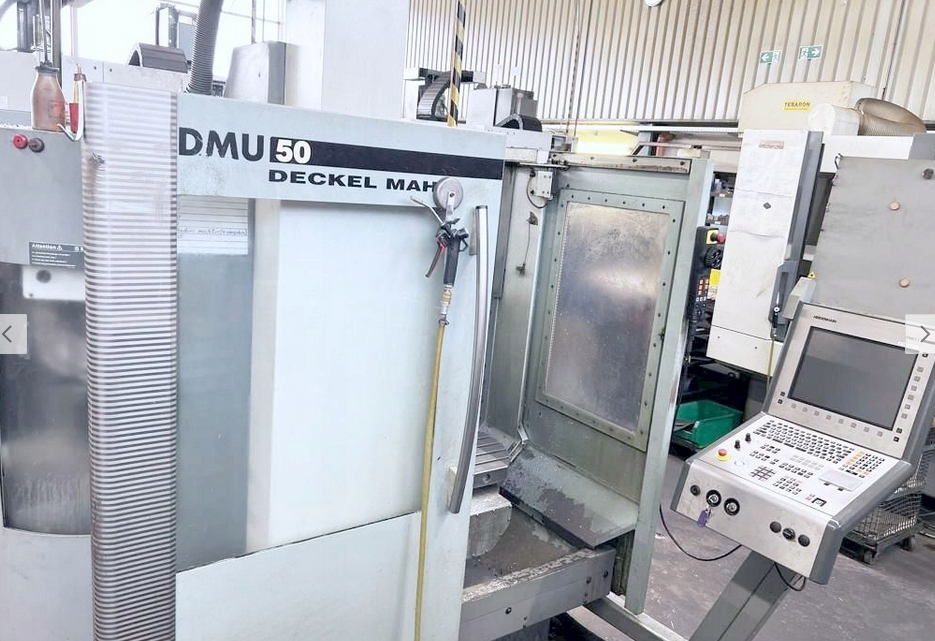
Before You Buy: Essential Criteria for Evaluating a Used, Second-Hand, Pre-Owned, Surplus DMG DMU 50 CNC Vertical Machining Center 5 Axes Simultaneous made in Germany
Here is a detailed, structured checklist you can use when evaluating a used / surplus DMG DMU 50 5-axis simultaneous vertical machining center (Germany / DMG MORI). Because 5-axis machines are mechanically and electronically complex, there is a higher risk of hidden wear, calibration drift, or control obsolescence. Doing a disciplined assessment is essential.
Preparation & Spec Baseline
Before visiting the machine, get as much documentation and information from the seller as possible, and compile a “target spec sheet” to compare against.
Key things to ask / collect in advance:
- Exact model / variant (for example, “DMU 50 eVolution 5 axis”, “DMU 50 third gen”, etc.)
- Serial number and year of manufacture
- Spindle type and speed (e.g. up to 18,000 rpm typical in used listings)
- Table / rotary table / B-axis / C-axis ranges, torque, encoder resolutions
- Travel in X, Y, Z axes
- Tool magazine / tool changer capacity and type (SK / HSK / CAT, etc.)
- Control system version (Heidenhain, Siemens, DMG / Mori proprietary, etc.)
- Any retrofits, rebuilds, or modifications done
- Maintenance / calibration records if available
As a reference, many used DMU 50 machines list:
- X ~ 500 mm, Y ~ 420 mm, Z ~ 380 mm
- Spindle up to ~ 18,000 rpm for many used DMU 50 5-axis units
- Rotary / swivel (B / C axes) capabilities: e.g. B ~ 0–180° or –5/+110°, C full 360°
- Tool changer sizes (32, 60, etc.)
Having those expected figures allows you to detect exaggerations or compromises.
1. Structural / Mechanical Condition & Build Integrity
The machine’s rigidity, alignment, structural soundness, and resistance to drift are foundational to precision.
- Frame, base & castings
• Look for cracks, weld repairs, patch plates or structural modifications on the base, column, ram, or saddle.
• Inspect for warpage, bent surfaces, or misalignment in large cast mating faces.
• Look for corrosion, pitting, coolant damage, or chip damage on exposed structural elements. - Guideways, slides & linear axes
• Inspect X, Y, Z linear guide rails (or ball screw / linear way interfaces) for scoring, scratches, dents, or wear marks.
• Manually jog axes (if powered) and feel for binding, sticky zones, grit or irregular friction over the full travel.
• Use a dial indicator to check for side play (lateral wiggle) or vertical play when the carriage is pressed sideways.
• Check gibs, adjustment screws, shims — if over-shimmed or fully adjusted, that can indicate heavy wear.
• Verify that protective covers, scrapers, wipers, and bellows are intact — broken or missing covers may have allowed chips/coolant to damage ways internally. - Swivel / rotary axes (B / C axes or rotary table)
• Check for play or backlash in the rotary (C) and tilt (B) axes.
• Rotate the table or spindle head manually (if safe) and listen/feel for irregular resistance or sudden changes.
• Inspect the bearings, seals, and housing of the B / C axes — look for leakage, damage or looseness.
• Verify the mechanical locks, brakes or clamping mechanisms (if present) function properly without slop.
If structural integrity is compromised, it often cannot be corrected easily or cheaply — the machine’s geometric precision suffers permanently.
2. Spindle, Drive & Tooling Subsystems
The spindle and tooling systems are critical to accuracy, surface finish, and usable life.
- Spindle rotation & smoothness
• Rotate (slow jog) the spindle and listen/feel for roughness, noise, friction variation, or “dead” spots.
• Use a precision test bar or indicator to measure radial runout and axial (end flange) play. Tolerances should be tight. - Spindle bearings & history
• Inspect seals, front and rear housing, lubrication or oil supply lines, and oil / grease condition.
• Ask the seller when bearings were last replaced (if ever) and whether original or upgraded.
• Look for signs of coolant ingress or contamination in the spindle housing or bearing enclosure. - Tool interface & tool changer
• Examine the tool holder interface (HSK / SK / etc.) for wear, damage, deformation, or corrosion.
• Examine the tool magazine / tool changer mechanism for smooth motion, accurate indexing, misfeeds, or hesitation.
• If possible, run a few tool changes to see mechanical behavior under actual cycling conditions.
• Evaluate maximum tool length, overhang, weight limits, and whether they are appropriate for your intended work. - Drive systems (motors, gearboxes, couplings, encoders, ball screws)
• Inspect drive motors (axis servo motors) and amplifiers, cooling, wiring, couplings for signs of overheating, damage, or repair.
• Examine ball screws / linear actuators for pitting, wear, backlash, or noise.
• Check couplings, shafts, gearboxes for looseness, broken keys, gear tooth wear, or misalignment.
• Verify encoder feedbacks and sensors are present, correctly aligned, and have no obvious damage.
Failures or wear in the spindle or drive systems can be among the most expensive repairs on a 5-axis machine.
3. Motion Accuracy, Interpolation & Geometric Testing
Because 5-axis machining relies on precisely coordinated motion of multiple axes (X, Y, Z + B, C), you must test geometric integrity and interpolation accuracy.
- Backlash / reversal error
• On each linear axis, approach a reference point from both directions and measure the “dead zone” (backlash). - Linearity / straightness / slope drift
• Over the full travel of each axis, use a straightedge, test rod, or laser system (if available) to detect curvature, slope, or deviation from straightness. - Repeatability / return accuracy
• Move to a reference point, retract, and return, multiple times — measure how closely the machine returns. - Squareness / orthogonality
• Check perpendicularity of X–Y, X–Z, Y–Z axes. Also verify alignment of the rotary / tilt axes with respect to linear axes. - Simultaneous motion / interpolation tests
• Execute combined multi-axis motion (e.g. tilt + linear movement, or contouring in 5-axis) and measure deviations from expected path. - Thermal drift / stability
• Let the machine warm up, then re-measure key geometric references or indicator positions to see if drift has occurred. - Extreme / boundary positions
• Move axes to ends of travel and test for binding, misalignment or irregular behavior near limits. - Test cuts / machining trials
• If permitted, perform a modest test machining operation (5-axis contour, surface finish pass) and measure resulting accuracy, surface finish, and detect chatter or irregular motion.
Because 5-axis machines combine motion, even a small error in one axis can magnify in finished part shape — these tests are critical.
4. Control, Electronics & CNC Systems
The control electronics, software, and signal systems in a 5-axis DMG machine are as vital as the mechanical subsystems.
- Control unit / CNC / HMI
• Power up (if allowed) and verify boot sequences, error logs, diagnostics, parameter settings, and overall responsiveness.
• Navigate menus, test editing, tool tables, offset tables, calibration screens. - Memory / parameter / calibration data
• Check that tool tables, offsets, calibration maps, compensation data, and backup files are present and readable.
• Ask whether a backup or parameter dump is available. - Servo drives, amplifiers, wiring
• Inspect the servo drive modules, amplifiers, cooling fans, wiring harnesses, connectors, and observe for heat damage, discoloration, or repairs. - Feedback devices / encoders / absolute scales
• Verify all encoders or linear scale feedback devices are intact, connected, and producing stable signals (no dropouts). - Limit switches / home switches / interlocks / safety systems
• Test all limit switches, home references, safety interlocks, guard doors, emergency stops. - Cable carriers, wiring harnesses
• Inspect cable carriers for wear, broken links, chafed wiring, loose connectors, or makeshift repairs. - Power supply, cabinet health
• Check for dust, coolant contamination, signs of water ingress or corrosion inside electrical cabinet.
• Look for previous repair marks, burned areas, or overheated components.
In a 5-axis machine, control and feedback errors directly degrade machining accuracy and can be costly to repair or replace.
5. Accessories, Tooling, Fixtures & Spares
Having the right accessories and spares can significantly affect the value and usability of the machine.
- Fixtures, workholding, clamps, vises, angle plates
• Are these included, and are they well made, accurate, and in usable condition? - Probes, tool setters, spindle probes, touch-off systems
• These are especially important in 5-axis work — check if included and functioning. - Tooling inventory (holders, collets, adapters, extension bars)
• Having compatible, good quality tooling helps immediately use the machine. - Spare parts / replacement modules
• Extra servo modules, encoder modules, couplings, drive belts, sensors, etc. are valuable, especially for older machines. - Manuals, schematics, wiring diagrams, calibration reports
• These are indispensable for maintenance and troubleshooting later on. - Safety covers, enclosures, chip conveyor, coolant systems, filters
• Check whether these are present and functional.
Absence of critical accessories may reduce the machine’s effective utility or demand extra cost to complete its setup.
6. Demonstration, Run-In & Sample Machining
A static inspection is insufficient — seeing the machine in operation is crucial for uncovering hidden defects.
- Run all axes through their full travel (X, Y, Z, B, C) and look/hear for any irregular motion, binding, or hesitation.
- Perform tool changes, rotary / tilt motions, and check for smooth action, indexing accuracy, or mis-alignment.
- Execute a sample 5-axis machining pass (e.g. a simple contour, free-form surface, or reference block) and check resulting dimensions, surface finish, and look for chatter, deviation, or motion lags.
- After warm-up and steady state, re-check critical reference points or indicator readings to detect thermal drift.
- Run repeated tests (e.g. multiple identical passes) to check for consistency or creeping errors.
- Take the machine to extreme positions to test behavior near exceeding travel.
- If possible, test maximum permissible feed rates, accelerations, and measure if the machine keeps accuracy under load.
If the machine fails to hold contour or shows instability under live motion, that is a serious red flag.
7. Maintenance History & Provenance
Knowing how the machine was used, serviced, and possibly abused is essential for gauging remaining life.
- Ask for operating hours (both on the machine and per-axis / spindle if available).
- Request maintenance logs, repair history, spindle rebuild dates, axis / drive refurbishing, calibration records.
- Ask about any accidents, collisions, overload events, or periods of neglect (e.g. chip accumulation, coolant contamination).
- Ask why the seller is disposing of it (upgrade, underuse, breakdown).
- Ask for documentation of any retrofits, upgrades, or part replacements (and who did them).
- If possible, check consistency among past calibration data, warm-up drift logs, or before/after metrics.
- Verify that spare parts and module support are still available in your region, especially for control modules, drives, spindle parts, and encoders.
A well-documented machine with a known service history is far lower risk than one with no record.
8. Logistics, Installation & After-Sales Considerations
Even if the machine is mechanically solid, many practical considerations determine whether it is a viable purchase.
- Transport / rigging cost: 5-axis machines are heavy, delicate, and may require specialized crating, shock absorption, leveling, and careful disassembly.
- Floor strength & foundation: Ensure your shop floor can support weight, and that you can anchor and level the machine precisely.
- Space / clearance / access: Check doorways, ceiling height, crane or gantry capacity, and ability to get the machine into its final location.
- Utilities & infrastructure: Electrical power (voltage, phases, current, grounding), coolant, air supply, chip disposal, ventilation, waste, etc.
- Commissioning / calibration cost: After installation you’ll need precision leveling, calibration of multi-axis geometry, compensation map setup, test cuts, and possibly external metrology help.
- Upgrade / spare parts / obsolescence risk: For older DMU 50 machines, spares or control modules may be obsolete. Ensure parts, firmware updates, or alternative modules are available.
- Depreciation / remaining life in wear items: Estimate how many years left in spindles, bearings, guides, motors, etc.
- Resale / residual value: 5-axis VMCs are capital-intensive; consider how easily this model can be resold or repurposed later.
9. Red Flags & Warning Signs
During inspection, watch especially for these warning signs — each is a cause for serious concern or discounting.
- Excessive play, backlash, or slop in linear or rotary axes
- Binding, jumps, gritty motion in axes
- High spindle runout, vibration, axial play beyond acceptable tolerance
- Frequent mechanical repairs, welds, patches, or structural modifications
- Control issues: corrupted parameters, malfunctioning drives, missing backups
- Damaged wiring, burnt components, or repair patches in control cabinet
- Toolchanger misfeeds, mis-indexing or mechanical noise
- Absence of calibration or maintenance documents
- Missing or non-working accessories (probes, tooling, covers, coolant systems)
- Seller refuses a full live test / refuses you to run 5-axis motion or test machining
- Drastic discrepancy between claimed specs and measured / tested values
- Evidence of coolant ingress into electrical cabinets or spindle housing
If multiple red flags appear, the repair risk may exceed the value of the machine.
10. Onsite Decision / Acceptance Checklist
Here’s a format you can use on site. Mark each item Pass / Marginal / Fail and take notes:
| Check | Pass / Marginal / Fail | Notes / Observations |
|---|---|---|
| Spec match (travels, spindle rpm, axis ranges) | ||
| Structural integrity (no cracks, distortions) | ||
| Guideway & slide condition | ||
| Rotary / tilt axes play & smoothness | ||
| Spindle runout & axial play | ||
| Tool changer / magazine function | ||
| Drive systems (motors, couplings, screws) | ||
| Motion / interpolation accuracy test | ||
| Control & electronics health | ||
| Accessories & tooling present | ||
| Demonstration / sample machining | ||
| Maintenance history & parts availability | ||
| Logistics / installation feasibility | ||
| Overall risk vs offered price |
If most items are “Pass” or “Marginal” (with known fixable issues), you have a strong candidate. If many are “Fail” or unknown, you need to demand steep discounts, contractual testing periods, or simply walk away.