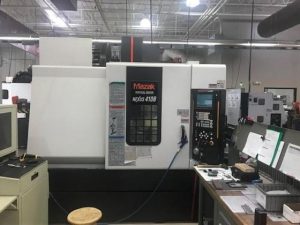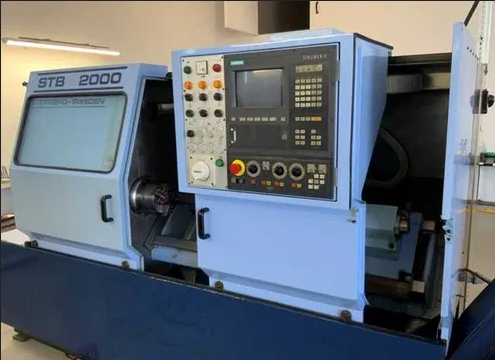
Before You Buy: Essential Criteria for Evaluating a Used, Second-Hand, Pre-Owned, Surplus Storebro STB 2000 CNC Lathe made in Sweden
- Turning diameter (over bed): 240 mm
- Turning length (Z travel / between centers): 675 mm
- Tool changer: 12-station turret (revolver)
- Spindle bore: 55 mm
- Swing over cross slide: 240 mm
- Swing over bed: 510 mm
- Machine dimensions: ~ 2800 × 1600 × 1800 mm
- Weight: ~ 4,400 kg
Use those as a rough baseline, but expect some variation (rebuilds, modifications, wear). Always ask the seller for their spec sheet or original documentation.
Below is the inspection checklist, broken down by subsystem and risk category.
1. Structural & Mechanical / Static Inspection
These checks are about the “bones” of the machine. If the structure is compromised, no amount of tuning will fully recover precision.
a. Bed, Base, Castings & Frame
- Examine the bed, base, headstock bracket, saddle support, and any welded or bolted assembly for cracks, weld repairs, patch plates, or reinforcing plates. A repaired crack often signifies a severe past overload or crash.
- Look for distortion, misalignment, or bending—especially if the machine has been moved multiple times.
- Check for corrosion, pitting, or coolant damage—areas around chip trays, coolant splash zones, or drainage regions are especially suspect.
- Inspect mounting surfaces (guard mounts, covers, brackets) for unevenness, warpage, or shifting as that may suggest structural settling or damage.
b. Guideways, Slides & Gibs
- Inspect the X (cross) slide / carriage ways, Z-axis bed slide, and any other sliding surfaces for wear, scoring, scratch lines, chatter marks, dings, corrosion, or pits.
- Manually move both axes (if you have power or in jog mode) and feel for binding, stick-slip, grit, rough patches, or jumpiness.
- Use a dial indicator to check for side play or wiggle perpendicular to axis motion (i.e. axis “looseness” sideways) and axial backlash when reversing direction.
- Check gibs, adjustment screws, shim stacks: see whether compensation is excessive (indicating heavy wear). If the gib screws are bound or over-corrected, that may be a sign that the ways are close to end of life.
- Verify that wipers, scrapers, covers, and bellows protecting the guides are present and in good condition. Missing or damaged way covers easily allow chips / coolant to damage sliding surfaces.
c. Spindle, Nose & Bearings
- Slowly rotate the spindle (if possible) and feel for roughness, noise, or friction changes through the rotation.
- Check for radial runout and axial (end) play using a test bar or dial indicator. Excessive wobble or play indicates worn bearings or a compromised spindle shaft.
- Confirm that the spindle bore and internal passage are not damaged (e.g. no internal dents or scoring).
- Check the spindle nose (mating surfaces) for wear, damage, thread integrity, and fit with tooling.
- Inspect spindle lubrication / oil lines, seals, and whether the spindle is clean (no particle ingress). Any cooling or lubrication leaks into the spindle housing are a red flag.
- Ask for records of the last bearing replacement (if any). Bearing work on lathes is expensive and time-consuming.
d. Turret / Tool-Changer / Tool Holding Mechanism
- Check the turret indexing / revolver mechanism for play, slop, or hesitation. Locking should be firm, with minimal backlash.
- Run (or request) several tool change cycles if allowed — observe mis-indexing, delays, sticking, or inaccuracies.
- Inspect the tool pockets, clamping surfaces, adapters, and tooling collets for wear or deformation.
- Inspect turret drive cams, locking pins, motor couplings, and actuation mechanisms for evidence of wear, broken parts, or misalignment.
- If live tooling (rotary / milling tool turret) is present, test spinning and check for vibration, runout, and smoothness.
e. Tailstock / Steady Rests / Support Devices
- If the lathe includes a tailstock, check its movement, locking, alignment, and whether it can be adjusted cleanly and precisely.
- Check quill alignment, slide fit, and play in the tailstock.
- If a steady rest or support collet devices are present, check for correct alignment, movement smoothness, and locking.
f. Lead Screws, Nuts, Drive Train & Couplings
- Examine the lead screws / ball screws for scoring, wear, rust, or damage.
- Check anti-backlash nuts or half-nut mechanism for play or loose adjustment.
- Inspect coupling connections, shafts, gearboxes, belts or chain drives, and intermediate shafts for misalignment, wear, broken teeth, loose couplings, or unusual play.
- Check lubrication of these systems and whether lubrication lines are intact and clean.
2. Motion, Accuracy, Geometric & Kinematic Testing
These checks validate whether the machine can still hold precision. Bring measuring gear (dial indicators, test bars, gauge blocks) to execute.
- Backlash / reversal error: Approach a reference point from both directions on each axis and measure the “dead zone” or slack.
- Linearity / straightness: Use a straightedge, test bar, or laser (if available) to verify that axis movements are linear over full travel.
- Repeatability / return accuracy: Move to a set point, retract, then return—and measure how closely it returns each time.
- Squareness / orthogonality: Verify that X vs Z axes are truly perpendicular and the spindle axis is aligned correctly.
- Thermal drift / stability: Let the machine run warm, then re-check reference geometry to see if drift has occurred.
- Extreme positions / near end-of-travel: Move axes to the extremes and check whether binding or alignment errors emerge near the limits.
- Turning / cut test: If allowed, conduct a cutting pass on a known material at representative parameters and check for chatter, dipping, runout, and surface finish. Turn a test bar and measure roundness, straightness, taper, and cylindrical accuracy.
Discrepancies beyond acceptable tolerances (for your intended use) may require expensive rework or limit the utility of the machine.
3. Control System, Electronics & CNC Components
The control electronics determine usability, reliability, and whether the machine can be integrated into your workflow.
- Power on the machine (if allowed) and check for error codes, alarms, diagnostics, memory integrity, and control responsiveness.
- Inspect the CNC / control cabinet: cleanliness, wiring, fan operation, dust / coolant ingress, signs of heat damage or corrosion.
- Check that program memory, tool tables, offsets, parameter backups, and calibration files are present, intact, and retrievable.
- Test communication (USB, network, DNC ports) to ensure file transfer works.
- Inspect servo drives, motor amplifiers, transformers, and cabling for signs of overheating (discoloration, burnt insulation, odd smells).
- Verify all limit switches, home switches, interlocks, safety circuits, emergency stops, and door interlocks are functional.
- Inspect wiring harnesses, connectors, cable carriers for chafing, wear, loose connectors, or patched repairs.
- If any sensors, encoders, linear scales, or feedback devices are present, test for signal stability, dropouts, or malfunctions.
Electronics faults or obsolete control systems can be showstoppers — replacement or retrofit may cost more than the machine itself in some cases.
4. Accessories, Tooling & Documentation
What comes with the lathe is often just as important as the lathe itself.
- Chuck(s), collets, jaw sets, adapters — check whether included, functional, and in good condition.
- Tool holders, tool posts, live tooling, boring bars, etc. — check condition and compatibility.
- Support devices — steady rests, tailstock, fixtures — verify inclusion and condition.
- Bar feeders, part loaders, automation gear — very helpful if included.
- Probes / tool setters / workpiece measurement devices — important for advanced or precise operation.
- Spare parts inventory — any extra motors, module boards, couplings, belts, gibs, nuts, etc. is a big plus.
- Manuals, electrical schematics, wiring diagrams, parameter sheets, calibration logs, maintenance records — essential for future servicing and diagnosing.
- Safety covers, guards, chip conveyor, coolant systems, enclosure doors — these are often overlooked but essential.
Missing or damaged accessories often reduce the practicality and increase your cost significantly.
5. Demonstration & Test Cut / Operation
Static inspection can’t catch everything. Insist on dynamic tests.
- Run all axes (X and Z) through full travel (if permitted), listening/opposing motion for any roughness, binding, or irregularities.
- Cycle tool changes, turret indexing, and check smoothness, hesitation, or mis-indexing.
- Execute a sample cutting program or turning pass (light to moderate cut) to test actual cutting performance. Evaluate the surface finish, chatter, vibration, and deviation.
- Warm up the lathe; after stable temperature, re-check reference geometry to see if alignment changes (thermal drift).
- Move axes to extremes to detect anomalies near travel limits.
- Perform repeated cycles to check for creeping drift or error accumulation.
6. Maintenance History, Usage & Provenance
To assess risk and residual life, understanding how the machine was used matters a lot.
- Ask for operating hours (spindle hours, axis hours) if available.
- Request maintenance logs, repair history, major overhauls (especially bearing replacements, guideway refurbishments, turret rebuilds).
- Ask whether it ever suffered crashes, overloads, coolant contamination, flood or aggressive environment exposure.
- Inquire about any modifications, retrofits, or changes made (e.g. spindle swap, control upgrade).
- Ask why the machine is being sold (redundancy, upgrade, failure) — sometimes that can hint at hidden defects.
- If possible, get references or inspect other machines sold by that vendor to assess their buyer support or honesty.
A well-documented machine is much less risky and more valuable.
7. Logistics, Installation & After-Sale Considerations
Even a perfect lathe can become a burden if logistical or support issues are ignored.
- Transport & rigging: A machine weighing ~4,400 kg (per listing) will require proper packing, rigging, and shock-protection.
- Foundation & floor loading: Verify that your shop floor can support the mass and that you can properly anchor, level, and grout the machine.
- Space & clearance: Check door sizes, overhead crane capacity, and space to maneuver the machine into place.
- Electrical / utilities: Confirm your voltage, phase, current capacity, grounding, coolant supply, chip disposal, etc.
- Commissioning / calibration cost: After installation you’ll need alignment, leveling, geometry checking, calibration, and test cycles.
- Spare parts & support: Ensure critical parts (bearings, couplings, motors, control parts) are still available or can be sourced.
- Control / software obsolescence: If the control is old, backup modules, spare boards, or updates may be hard to obtain.
- Depreciation / useful life: Be realistic about how many more years the machine can reliably run before parts wear out.
- Resale / trade-in potential: Consider whether the model is in demand locally or regionally for resale.
8. Red Flags & Warning Signs
These are the “deal killers” — if you see many of these, you should strongly reconsider or negotiate steep discounts:
- Excessive play, backlash, or slop in axes or turret locking.
- Chatter, vibration, or irregular motion during spindle rotation or axis movement.
- High spindle runout or axial play beyond acceptable tolerances.
- Evidence of major past repair: heavy welds, thick patch plates, structural modifications.
- Control or electronics faults: error codes, memory corruption, missing parameters.
- Missing or damaged wiring, burnt components, makeshift repairs in the control cabinet.
- Turret mis-indexing, failed tool changes, tool pockets misalignment or damage.
- Missing critical tooling or accessories (chucks, collets, fixture, manuals).
- Seller refuses testing, running cuts, or full-axis demonstrations.
- Excessive wear or gouges / pitting on guideways; missing way covers.
- Signs of coolant leakage into sensitive bearings or control cabinets.
- No documentation or maintenance history.
9. Onsite Decision Checklist (Quick “Go / No-Go” Tool)
Here’s a compact checklist you can use on site (mark pass / fail / marginal) to help you decide whether to proceed or walk away:
- Spec compliance — Do measured travels, spindle bore, turning diameter, turret count etc. roughly match the seller’s spec or documented spec?
- Axis motion — Are X & Z axes smooth, free from binding, minimal play, no rough spots?
- Spindle quality — Does the spindle rotate smoothly, with low runout and axial/radial play within acceptable tolerance?
- Turret / tool change — Turret indexing is accurate, tool changes work reliably, no hesitation or misalignments.
- Control & electronics — CNC powers on cleanly, memory intact, no critical errors, wiring and electronics visibly healthy.
- Accessories & tooling — Chucks, collets, holders, fixtures, manuals, etc. are present and usable.
- Test cut / demonstration — Sample turning pass yields good surface finish, no chatter or vibration.
- Maintenance history — Seller provides credible logs, no known abuse, bearing or guideway overhaul records.
- Logistics & installation feasibility — You can move, install, level, connect, and commission the machine within your shop.
- Risk vs price — Any deficiencies are manageable, cost of repairs is acceptable relative to the discount.
If the machine clears most of these with manageable issues, it can be a viable candidate to pursue deeper negotiation and off-site checks. If too many red flags appear, you should walk away or require very strict contract terms (e.g. inspection period, acceptance under load guarantee).