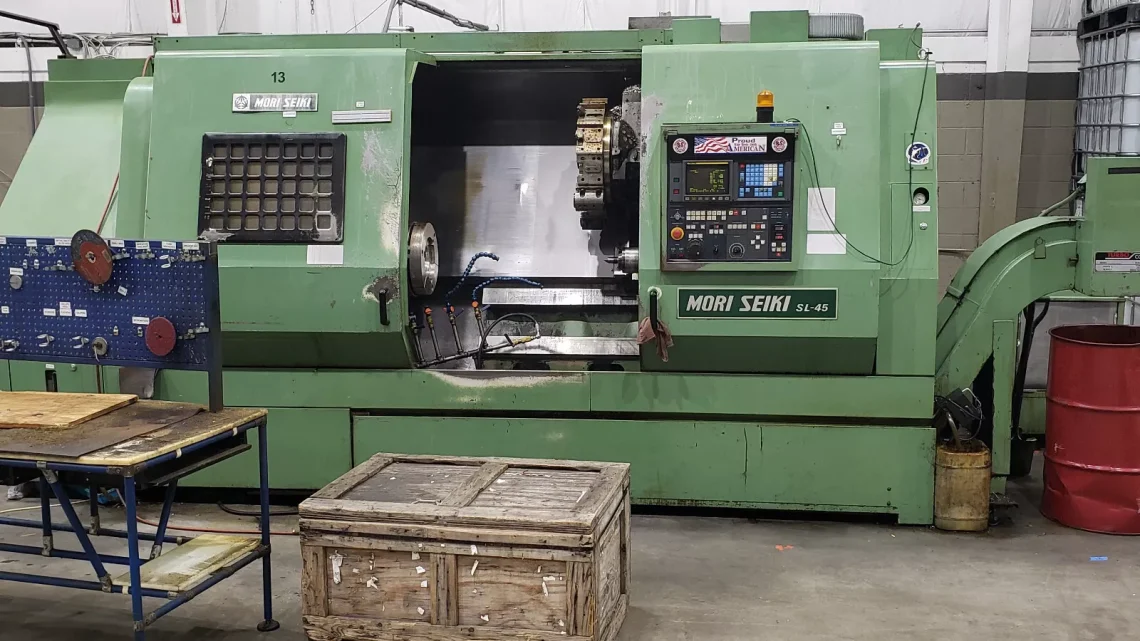
Avoid Costly Mistakes: Professional Tips for Purchasing a Pre-Owned / Surplus / Second-Hand / used MORI SEIKI SL-45/1500 CNC Lathe made in Japan
Here is a detailed checklist / professional-tips guide to help you avoid costly mistakes when buying a used / surplus Mori Seiki SL-45/1500 (or similar) CNC lathe. Many of these tips apply generally to used CNC lathes, but I’ll highlight what is particularly relevant to a Japanese brand like Mori Seiki and a model such as SL-45/1500.
Why you must be extra careful
A used CNC lathe is a complex machine. Even if the seller claims “works fine,” hidden wear, control obsolescence, undocumented repairs, or compatibility issues can turn your bargain into a money pit. The purchase price is only a part of the total cost (refurbishment, spares, transport, retrofit, downtime). A more thorough evaluation up front can save you tens of thousands in surprises.
Pre-Purchase Preparation & Research
- Gather all available documentation / history in advance
- Ask for the machine’s service and maintenance records (lubrication, alignments, spindle rebuilds, crashes)
- Request electrical schematics, wiring diagrams, ladder logic, control manuals
- Ask for OEM parts lists, operator manuals, parts catalogs
- Previous modification / retrofit records (e.g. upgraded spindle, added axes, control upgrades)
- Verify model and specification consistency
- Confirm the model is really SL-45/1500 (make, series, year) and matches its nameplate ratings
- Clarify the lathe’s swing, distance between centers, spindle bore, turret type, tailstock, etc.
- Confirm the installed controller version / CNC system (e.g. Mori Seiki’s control variant)
- Research whether parts/support are still available for that control system in your region
- Check market comparables & pricing
- Look for other SL-45/1500 or similar Mori Seiki lathes currently for sale (domestic and abroad)
- Compare asking price to “as is” machines of similar age and hours, adjusting for shipping, refurbishment, and spare parts
- Beware of “too good to be true” pricing — it may hide latent defects
- Plan logistics & facility requirements ahead
- Check your shop’s floor load capacity, foundation requirements, crane / rigging access
- Ensure your electrical supply (voltage, phase, power capacity, frequency) matches the machine
- Ensure you have climate control / temperature stability (CNC precision is sensitive to thermal drift)
- Plan for coolant, chip handling, air and filtration systems
- Engage experts / third-party inspection if needed
- If you (or your team) don’t have deep experience with CNC machinery, hire an independent inspector or machinist who specializes in used machines
- This “due diligence” often pays for itself many times over
On-Site (or Remote, via Video) Inspection Checklist
When you (or your inspector) visit the machine, do the following checks systematically.
1. Visual / Exterior Inspection
- Look for surface rust, corrosion, pitting, especially on guideways, bed, ways, exposed surfaces
- Check for cracks, weld repairs, distortion, dents in the frame or headstock
- Look for missing covers, guards, fasteners, or panels
- Inspect all enclosures, doors, windows, seals, gaskets
- Check the condition of coolant lines, hoses, filters, pumps
2. Spindle and Bearings
- Run the spindle at all speeds. Listen for unusual noises, hums, whines, or grinding
- After running, feel for heat build-up in the spindle housing (overheating is a bad sign)
- Check for axial and radial play / runout by applying test indicators to the spindle nose
- If possible, inspect or request records of any spindle rebuilds
3. Guideways / Ways / Carriage / Cross Slide / Turret
- Move all axes (X, Z, perhaps Y if present) through full travel, both directions, at slow, medium, and rapid speeds
- Listen/feel for binding, stiction, roughness, backlash, vibration
- Check for scoring, grooves, uneven wear on the bed ways
- Check lubrication — is the way lubrication system intact and functional?
- Check backlash and repeatability (e.g. reverse direction, use a test indicator)
4. Ball Screws / Lead Screws / Nut Wear
- Examine the ball screws or lead screws for wear, pitting, or chatter marks
- Manually jog axes and detect unusual play near screw ends
- If there is backlash compensation or software compensation, check how much is being used
5. Servo Motors / Drive System / Cables
- Listen for noise from servo motors, check motor temperatures after running
- Inspect all cables for wear, frayed insulation, proper strain relief
- Check connectors, junction boxes, terminal panels, and make sure no wiring modifications are shoddy
6. Control Panel / CNC System / I/O / Logic
- Power up the control and check for startup errors, alarms, and initial diagnostics
- Confirm that all console buttons, switches, indicators, touch screens, displays function
- Request a demo run of a few simple programs (e.g. a basic turning part)
- Test communications: USB, serial, Ethernet, DNC file transfer
- Check memory status, whether any system upgrades or patches were installed
- Verify all I/O (limit switches, probes, interlocks, safety inputs) function
7. Electrical Cabinet / Power Supply / Transformers
- Inspect inside for cleanliness, dust, corrosion, burn marks
- Verify fuses, circuit breakers, relays, contactors intact
- Check transformers, power supply units, distribution wiring
- Inspect grounding and shielding
8. Auxiliary Systems
- Check coolant pump, sump, lines, filtration, chip conveyors
- Inspect hydraulic systems (if present), lubricators, oil pumps
- Inspect tailstock, steady rests, chucking devices, tool holders
- Confirm that accessories (tool turret, live tooling, subspindle, tooling kit) are present and functional
9. Test Cut / Accuracy Check
- Run a test piece (cylindrical turning, facing, threading, etc.) to check dimensional accuracy, surface finish, repeatability
- Use test bars and indicators to measure runout, positioning accuracy, repeatability
- If possible, measure across full travel range and check linearity
- Test for thermal growth (e.g. run a part for a while, measure drift)
10. Check for Crash / Abuse Evidence
- Look for repaired welds, repainting in odd areas, patched sections
- Look for “crow’s feet” cracks near turret, carriage, headstock
- Ask the seller: Has the machine had collisions, tool crashes, or emergency stops?
Questions to Ask the Seller / Warranty Provisions
- What is the total power-on hours and spindle hours (if separately tracked)?
- What is the machine’s usage history (what type of parts, continuous vs intermittent work)?
- Has the machine been retrofitted or upgraded (spindle, control, motors)?
- Why is the machine being sold (closing shop, upgrade, problem)?
- When was its last major service or overhaul?
- Are there spare part kits or consumables included (tool holders, belts, encoders, etc.)?
- Can the seller provide a guarantee / “as-is” inspection window / return period?
- Can they assist with installation / commissioning or warranty support post-shipment?
- Are there OEM contacts or support in your region (for parts, service) for Mori Seiki / its control?
Specific Risks / Pitfalls with Older Japanese CNC Lathes (e.g. Mori Seiki)
- Control obsolescence / parts scarcity — older Mori Seiki controls or circuits may no longer be supported locally
- Dropping of Japanese to English translation or custom modifications — custom in-house modifications may not be documented
- Spindle or servo system fatigue — Japanese precision is high, but they tend to be pushed hard in factories
- Wear hidden by compensation software — compensation software may hide mechanical error until compensation limits are exceeded
- Import / shipping damage — large lathes are heavy, disassembled, and reassembled — risk of damage during transit
Negotiation / Pricing Strategy
- Use your inspection findings as negotiation leverage (e.g. “needs new spindle bearings”, “ball screw wear”)
- Factor in refurbishment costs, spare parts, shipping, installation, downtime
- Require that the seller bear (or share) the cost of rigging / installation / commissioning
- Ask for a period of guarantee or “burn-in test” after installation
- Be wary of deals that lack full open inspection or guarantee — demand transparent access
After Purchase / Commissioning Checklist (for when it arrives)
- Re-align / relevel the machine precisely
- Re-verify all geometry: squares, parallelism, straightness
- Remove and inspect spindle one more time
- Perform a full “break-in” run and remeasure parts
- Ensure proper lubrication, coolant system flushing / purification
- Install spare parts and spare electronics for critical components
- Create or incorporate full maintenance schedule
- Back up all control programs, ladder logic, configurations