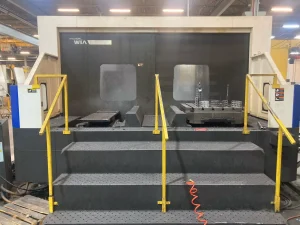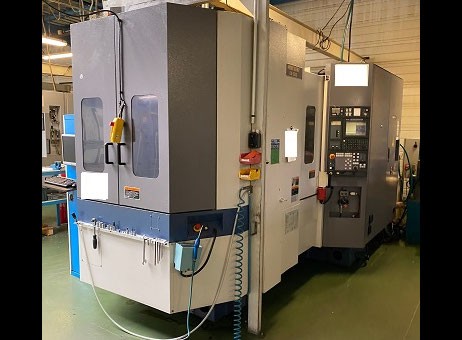
Avoid Costly Mistakes: Professional Tips for Purchasing a Pre-Owned / Surplus / Second-Hand / used Mori Seiki SH503/40 CNC Horizontal Machining Center made in Japan
Here is a detailed “checklist” and set of professional tips to avoid costly mistakes when buying a pre-owned / surplus / used Mori Seiki SH503/40 (or similar horizontal machining centers). While many of these apply to any used CNC, I’ll also point out model-specific nuances for the SH503/40 where known. Use this as a negotiation & inspection guide.
Background: What you should know up front about the SH503/40
Before you even inspect a candidate, get good baseline specs and expectations so you know “red flags.” Some known spec references for the SH503/40 / SH503 class:
| Feature | Typical / published value |
|---|---|
| X / Y / Z travels | ~ 630 mm × 600 mm × 650 mm |
| Pallet / Table size | ~ 500 × 500 mm (≈ 19.7″ × 19.7″) |
| Number of pallets | 2 in many listings; some 3 in variants |
| Tool magazine / ATC | 60 tools is common in published spec sheets |
| Spindle / speed / power | 12,000 RPM is common spec; motor power and taper (BT/ISO 40) are also in the spec sheets |
| Rapid traverse / feed | e.g. ~32 m/min (or equivalent) is cited for X, Z axes in one listing |
| Weight / footprint | Very heavy (many tons) and large footprint; you must account for floor loading, crane/transport, etc. |
By knowing what a “healthy” unit should roughly deliver, you can more easily spot deviations during inspection or negotiation.
Key Risks / Cost Traps to Watch Out For
These are the “pitfalls” that can turn what looks like a bargain into a money pit:
- Spindle / Bearing condition
The spindle is usually one of the most expensive components to repair or replace. If the bearings are noisy, misaligned, or worn, you may face huge costs.- Listen for unusual noise at various RPMs.
- Ask for vibration analysis if possible.
- Ask how many hours the spindle has run, and whether it’s been rebuilt.
- Ball screws / linear guides / axes wear
As the machine accumulates hours, wear accumulates in its motion system. Excess backlash, looseness, or out-of-spec accuracy on axes can plague your operations.- Move each axis slowly, visually inspect for wandering or “stick/slip.”
- Use a dial indicator or laser measurement to check straightness, repeatability, and backlash.
- Look at the condition of the way covers, way wipers, and protective guards: torn or damaged covers often indicate poor past maintenance.
- Control / electronics / drives / wiring
The CNC control and drive electronics may be obsolete or difficult to source spares.- Ask the seller for the model/version of the controller (e.g. MSG-502, MAPPS, etc.)
- Check the number of alarms/faults in the memory (error history).
- Inspect wiring, connectors, cable harnesses, and look for signs of repairs, tape, mismatched parts.
- Check servo drives: whether they function properly under load, whether they overheat, etc.
- Hydraulics / pneumatics / coolant / spindle lubrication systems
These “auxiliary systems” often get neglected. Failures here are not trivial.- Confirm the machine has a working coolant-through-spindle (CTS) as listed in specs.
- Check if high-pressure coolant, chip conveyor, pumps, filtration, oil/grease systems, hydraulic clamping systems are still functional.
- Check hoses, seals, leaks, reservoir cleaness.
- Pallet systems / indexing / rotary axes (B axis, etc.)
For a horizontal machining center with pallets, the pallet changer and indexer systems are critical. If they are misaligned, worn, or failing, operational cost is high.- Test the pallet swap under load; check whether indexing is accurate.
- Check mechanical backlash or drift in the rotary axes.
- Confirm maintenance of pallet hydraulics, clamp/unclamp systems, seals, etc.
- Structural integrity & past damage
The casting and frame must be sound. Cracks, repairs, collisions, or misalignments can severely degrade accuracy.- Visually inspect for cracks, weld repairs, corrosion, or modifications.
- Check machine leveling and foundation; subsidence or floor settling could have misaligned things over time.
- Look for signs of “crash repairs” — e.g. plates welded over parts, repairs to spindle nose, etc.
- Documentation, parts availability, support
Even a mechanically sound machine can become unusable if you can’t get parts or support.- Demand service / maintenance logs, repair history, parts replacement history.
- Confirm whether original manuals, wiring diagrams, parts lists, CNC software media (backup files) are available.
- Try to verify the availability of consumables, replacement parts (bearings, ways, electronic modules) for the control type.
- Ask whether the seller has spares or offers support.
- Power supply & site readiness
Don’t forget the cost of getting the machine into your facility and making it work.- Check your site’s power availability (voltage, phase, amperage).
- Check whether additional wiring, transformers, breakers, cabling are needed.
- Check crane / rigging, floor loading, foundation, flood cooling, exhaust, chip disposal, ventilation.
- Factor in commissioning, alignment, calibration, and training.
Inspection / Test Run Protocol
When you or a technically competent inspector are on site, here’s a sequence & checklist to follow to reveal hidden problems:
- Preliminary visual check (cold)
- Look over general condition: cleanliness, signs of neglect, leaks, corrosion.
- Inspect way covers, guards, covers, seals, limit switches, cover plates.
- Inspect the spindle taper, tool changer (magazine), tool holders, and tooling.
- Inspect wiring, cable trays, power panels—look for burned areas, sloppy repairs, mismatched wires.
- Jog / axis movement
- With power on, jog each axis slowly. Listen for roughness, binding, unusual noises, humming sounds.
- Move over full travel. Observe whether any portion of travel has a “dead zone” or odd friction or vibration.
- Reverse direction and check for backlash, hysteresis. Use a dial indicator or measurement tool to quantify backlash.
- Spindle test
- Run the spindle through its entire speed range; hear how it behaves at low, medium, and high RPM.
- Stop abruptly (M5 or equivalent) and check the braking behavior if built-in (if the design includes braking). Many experienced buyers spin up to full speed and drop to zero to test spindle bearings / brakes.
- Under a light cutting load (if possible) check runout, chatter, and vibration.
- Tool change / ATC tests
- Cycle through the full tool magazine: check each slot, loading/unloading.
- Measure the tool change time and see if it’s consistent.
- Try worst-case positions (slots at extremes).
- Inspect the magazine for wear, misalignment, damage.
- Pallet / indexer / rotary axes
- Command pallet swaps under normal load conditions. Measure timing, observe alignment, check for error codes.
- Check indexing accuracy: rotate B-axis, shift workpiece, measure consistency.
- Operate the pallet hydraulics or clamping mechanism while loaded to see if any drift, slippage, or misalignment occurs.
- Cutting / load test (if possible)
- Best test: make a real part under typical cutting parameters, and check results (surface finish, dimensional accuracy).
- Try different directions, heavier cuts, ramping, rapid moves.
- If you can’t cut, run some “air moves” or high speed moves to test feeddrive performance, acceleration, deceleration, jerk, stability.
- Alarm / diagnostics & history
- Access the CNC control’s diagnostic history / alarm logs. Take screenshots or logs.
- Enter diagnostic mode, check servo status, encoder counts, command vs feedback, error margins.
- Check auxiliary systems: coolant, pumps, hydraulics, filtered systems, chiller, spindle lubrication.
- Alignment / calibration checks
- Use test bars, gauge balls, precision indicators, laser interferometry (if you have the tool) to verify squareness, orthogonality, geometric accuracy.
- Check that the machine can hold its tolerance over motions.
- Moving and reinstallation
- Confirm how the seller plans to dismantle, transport, and reassemble the unit.
- Understand tolerances for releveling, alignment.
- Check for missing mounting plates, leveling feet, anchors.
- Negotiate cost for shipping, rigging, relocation, alignment, and electrical work.
Negotiation & Contracting Tips
- Start with “as-is but tested” language: Insist that your price accounts for observed flaws.
- Include inspection allowance: You may want a clause that you can back off or renegotiate if post-inspection reveals hidden problems.
- Hold back funds / escrow until after acceptance and test runs at your site.
- Include support / training / spare parts in your deal if possible.
- Reserve a maintenance / repair budget — even good used machines often require parts or adjustments in the first few months.
Red Flags That Should Make You Walk Away
- Excessive spindle noise or bearing hum.
- Major backlash or free play in axes beyond what you’re willing to accept.
- Missing or severely degraded way covers or guards.
- Control system version so old that replacement parts or support are essentially unavailable.
- No documentation, no spare parts, no schematics.
- Signs of major crashes, structural repairs, or welds in critical regions.
- A seller refusing any trial run or test cut.
- The cost of transporting, reinstallation, and commissioning outweighs the machine’s benefits.