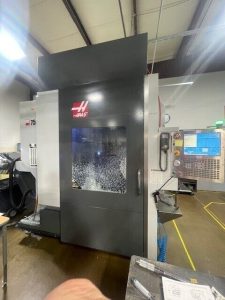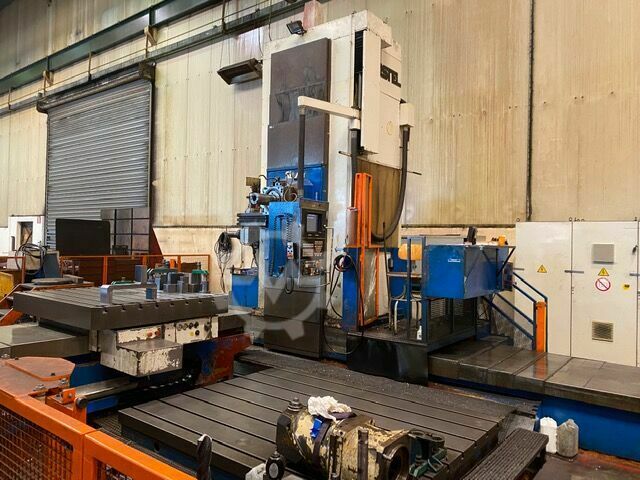
Avoid Costly Mistakes: Professional Tips for Purchasing a Pre-Owned, Surplus, Second-Hand, Used FPT Industrie S.p.A. CASTEL SILVER LINE CNC Table Type Horizontal Boring Machine made in Italy
f you’re considering purchasing a used FPT Industrie / CASTEL “Silver Line” CNC table-type horizontal boring machine, the stakes are high — these are heavy, precision machines, and even small defects or oversights can cost tens of thousands in repairs, downtime, or alignment. Below is a deep, professional-grade “avoidance of costly mistakes” guide / checklist. Tailor it to your shop’s tolerances, workload, and future demands.
What is “CASTEL / Silver Line” — Context & what to expect
Before inspection, it helps to understand what you should expect from a machine of this lineage so you can spot deviations or red flags.
- CASTEL is the line of horizontal boring / milling machines under FPT Industrie S.p.A., Italy.
- FPT and CASTEL machines are marketed with robust structural design, high rigidity, and integrated column / saddle structures.
- A listing for the CASTEL “horizontal column type, 4-axis” machine gives indicative travels such as X = 2,500 or 5,000 mm, Y = 1,500 / 2,500 mm, Z = 2,000 / 3,000 mm, and spindle quill travel (W) of 800 / 900 mm.
- The CASTEL is described as manufactured in the “up-to-date FPT premises near Venice (Italy)” in the FPT’s own documentation.
- The “Silver Line” designation is less documented in the public domain (there is no clear, detailed specification for a “Silver Line” in my search), which suggests it might be a variant, custom line, or regional branding variant of CASTEL horizontal machines.
Given that, the inspection should treat it as a high-end CASTEL / FPT extrusion, with the usual precision, rigidity, and complexity expectations.
Inspection & Due Diligence Checklist: What to Scrutinize (and Why)
Here is a detailed, systematic checklist you (or a hired machine-tool inspector) should walk through. For each point, I also note “why it matters” and what counts as a red flag / rejection or negotiation lever.
| System / Area | What to Inspect / Test | Why It Matters / Failure Risks | Red Flags / Deal-Breakers / Tolerances |
|---|---|---|---|
| Machine history, documentation & configuration | • Ask for all service logs, maintenance records, repair history, rebuilds, and any structural modifications. • Request the “as-delivered” alignment / geometric certification from FPT / CASTEL. • Get the machine’s full option list, serial number, configuration sheet, and any retrofit records. • Ask if “Silver Line” is a variant, and demand specification sheets. | A missing or contradictory history often hides recurring or serious problems. Modified machines may not be easily serviceable or match available spare parts. | If the seller cannot produce credible documentation or refuses to disclose modifications, that’s a major red flag. If the “Silver Line” designation cannot be traced or is inconsistent, treat with suspicion. |
| Spindle / Quill / Drilling / Boring head | • Run the main spindle and quill (forward and reverse) through full speed range while listening for noise, vibration, and observing temperature rise. • Use a test bar or gauge to measure spindle runout at different points (taper, nose). • Inspect quill bore, seals, lubrication, and check for scoring or wear. • Apply load (boring or drilling test) and see whether the spindle holds accuracy under torque. • Inspect internal lubrication / oil feed / cooling to spindle / quill system. | Spindle or boring head problems degrade tool life, accuracy, cause chatter, or even cause catastrophes during heavy boring operations. Repairing or reconditioning large spindles is expensive and troublesome. | Excessive runout, vibration, overheating, leakage, or refusal to run under torque are strong deal-breakers. |
| Linear / Rotary axes / Slides / Guideways / Bearings | • Jog all axes (X, Y, Z, W) through full travel, both directions; observe smoothness, acceleration, deceleration, any fluctuations in speed. • Perform full-speed rapid traverses and reversals to detect backlash, stiction, “kicks,” or nonlinearity. • Remove covers (if possible) and inspect guideways, slide surfaces, gibs, lubrication lines. Look for scoring, rust, embedded chips, wear. • Check ball screws or feed screws for wear, pitting, play. • If there’s a rotary table or B-axis, rotate it through full angles, check angular accuracy, backlash, clamping behavior, encoder readings. | Wear in axes or guide systems will reduce precision, introduce chatter, degrade finish, and may require costly realignment or regrinding. | Any binding, jerkiness, significant backlash, visible scoring, or servo alarms during movement are red flags. |
| Table & fixture systems | • Check the table surface, T-slots, flatness, and whether the table has sustained damage or repair. • For table-type boring machines, verify the table’s travel, load capacity, and clamping performance. • Inspect for warp, cracks, or misalignment in table surfaces. • For rotating tables (if equipped), inspect bearings, encoder, clamping and rotation motor. | Table integrity is central to part accuracy; any deviation or damage limits usable work envelope and precision. | A warped or damaged table, missing or worn T-slots, structural cracks, or table movement in service are critical issues. |
| Tool changers, head changers, additional heads | • If the machine has automatic tool changers (for milling heads, boring heads) or head exchangers, cycle them repeatedly through all tool / head positions. • Inspect actuators, grippers, sensors, magazine indexing, mechanical linkages. • Check repeatability and seating precision of each tool or head position. • Run a machining test using each head or tool to see whether changeovers maintain accuracy. | Faulty tool or head change systems are sources of crashes, misalignment, production loss, or downtime. | If the tool / head changer mis-indexes, hesitates, or introduces error, that is a major negative. |
| Coolant / lubrication / hydraulic / pneumatic systems | • Inspect pumps, filters, piping, seals, hoses, cooling circuits, valves. • Operate coolant system under full pressure / flow; check for leaks, pressure drop, clogged lines. • Inspect lubrication / greasing systems, automatic lubrication functioning. • If hydraulics or pneumatics are used (for clamping, slides, grips), test under load. | Poor coolant or lubrication leads to accelerated wear, heat distortion, tool failure, or breakdown. | Leaks, inadequate flow, clogged filters, nonfunctional lubrication or hydraulic systems are serious red flags. |
| Electrical, control & drives | • Power up the control; check boot-up errors, alarm logs, control panel behaviors. • Inspect control cabinet internals: circuit boards, wiring bundles, connectors, discolorations, corrosion, “field repairs” or patches. • Check servo drives, spindle drives, I/O cards for fault history, error lights. • Test limit switches, homing, E-stops, interlocks, I/O functions. • Upload / download sample NC code; test communication ports and CNC interfaces. • Verify that all licensed/capability options of the CNC (e.g. head changing, live tooling, probing, etc.) are intact. | Control and drive issues are often the most expensive and time-consuming to repair. Obsolete or proprietary modules may not be replaceable. | Burnt boards, loose wires, missing modules, error codes, disabled features, or undocumented control hacks are serious concerns. |
| Thermal stability & drift | • Let the machine run idle (or under light motion) for 30–60 minutes to warm to steady-state. • Re-check reference positions / geometric offsets to detect drift. • If the machine has thermal compensation systems, test their effect on drift. • Re-check key geometries after extended operation to see if alignment shifts. | Thermal distortion is a major source of inaccuracy in large boring machines. A machine that drifts over cycle time cannot hold tight tolerances. | If drift exceeds acceptable tolerances or thermal compensation fails, reject or heavily renegotiate. |
| Geometric accuracy & test parts | • Before cutting: mount reference/test artifacts (e.g. precision square, surface plate, gauge block) and measure deviation in alignment, squareness, straightness. • After cutting: perform a test machining job (boring, facing) and measure features against expected tolerances. • Use precision measurement tools (dial indicators, gauge blocks, portable CMM, etc.) to validate accuracy. • Check positional repeatability across full travel range (corners, extremes). | A machine may operate smoothly but not deliver required geometry under real loads — that means it fails its primary purpose. | If measured deviations exceed your tolerance expectations or manufacturer spec significantly, that’s a deal-breaker without strong discount. |
| Load / Production-type testing | • Run a simulated production program (or part of it) for an extended time (hours) under realistic loads. • Monitor for vibration, tool wear, surface finish consistency, stability, alarms, thermal drift. • Check that performance remains consistent over long cycles. | Many shortcomings only appear over extended use (drift, heat accumulation, loosening connections). | If errors or instability emerge during longer runs, that reveals deeper systemic flaws. |
| Foundation, leveling & base structure | • Inspect whether the machine is mounted on a proper foundation or base — check anchor bolts, leveling shims, footings, surface conditions. • Ask whether the machine has ever been relocated or re-leveled and whether alignment was redone. • Inspect base frames for warp, cracks, welds or repairs, corrosion. • Check base-to-column fit, rigidity, and whether structural integrity has been compromised. | A misaligned or damaged foundation leads to lasting geometric errors and expensive rework. | If the base is warped, cracked, or unlevel, that’s a major problem. |
| Spare parts, tooling & consumables | • Ask exactly which spare parts come with the machine (bearings, gears, control boards, sensors, bolts). • Check the availability and cost of critical spare parts (especially for large CASTEL / FPT components) in your region or via European supply. • Inspect the included tooling (boring bars, heads, holders, fixtures) for serviceability and compatibility. • Ask about obsolescence risk — whether parts or modules are discontinued. | Even a perfect machine is crippled if one key spare fails and can’t be replaced. | If critical parts are scarce, nonstandard, or expensive beyond reason, that greatly reduces machine value. |
| Contractual protection & acceptance | • Negotiate a conditional acceptance (e.g. final acceptance in your facility after installation and alignment). • Insist on a limited warranty (e.g. 30–90 days) on critical subsystems (spindle, drives, control). • Require the right to an independent inspection by a machine-tool metrology specialist before final payment. • Define clear “deal-breaker” conditions (e.g. backlash, drift, runout thresholds) in the contract. • Withhold a portion of payment until the machine passes acceptance criteria in your shop. | Without recourse, hidden defects become entirely your risk. | If seller refuses independent inspection, warranty, or acceptance in your facility, that is a high caution sign. |
| Transport, disassembly, reassembly & re-alignment risk | • Request rigging / lifting drawings, weight specs, alignment instructions, disassembly instructions. • Ask whether the machine has been moved before and whether it was re-aligned. • Budget enough time, skilled technicians, and alignment tools for reassembly and calibration. • Account for potential shock, misalignment, or damage during transport. | A poorly reassembled or misaligned machine can lose most of its precision and damage sensitive parts. | Underestimating reinstallation or alignment cost is a frequent hidden-cost trap. |
| Obsolescence / life-cycle risk of electronics & modules | • Check whether the CNC control system, servo drives, modules, firmware versions, and boards are still supported by FPT / CASTEL or third parties. • Ask when critical modules were last replaced or upgraded. • Determine if there are alternative, compatible replacements or retrofits for key electronics. • Confirm whether any special or proprietary control options are locked or non-transferable. | If a drive, board, or module fails and is obsolete, the machine may become unusable or incur exorbitant repair cost. | Indications that parts are at end-of-life, firmware issues, locked option modules, or proprietary modules with no supply source are serious red flags. |
Additional Strategic & Negotiation Advice
- Bring a specialist or a metrology geek: Someone familiar with large boring machines, structural alignment, metrology, or a trusted machine-tool inspector will catch issues that non-experts will miss.
- Define your tolerance & usage envelope in advance: Before engaging with the seller, codify what tolerances (flatness, positional accuracy, repeatability) you must get, and what load / bore sizes you will demand. Use these as your “go / no-go” criteria.
- Insist on production-style test cuts: Ask the seller to run a real or close-to-real job (boring, facing, side milling) in front of you so you can see surface finish, stability, chatter, temperature drift, tool wear.
- Staged payments & holdbacks: Retain a portion of payment until the machine is installed and accepted in your own facility. This gives you leverage if undiscovered defects emerge.
- Spare parts package: Especially for CASTEL / FPT machines, negotiate inclusion of a basic spare parts kit (bearings, seals, boards, sensors) in the sale or at cost.
- Budget generously for transport & setup / alignment: Large horizontal boring machines are heavy, delicate, and need precision realignment. The cost of moving & recalibrating often exceeds your initial estimates. Include travel, crane, surface plate time, metrology staff in your budget.
- Ask about previous usage: Heavy cuts vs light service, number of hours, whether it was part of a continuous production line or occasional use. Machines used continuously under heavy load wear faster and may have hidden damage.
- Check for custom modifications: Many used machines have been customized — for example, non-standard heads, non-OEM adapters, structural modifications. These can cause spare-parts mismatch, alignment unpredictability, or reduced resale value.
- Verify any software / control licensing: Make sure that all software modules (probing, head change, advanced features) are licensed and transferable, and are working.
- Check end-of-life risk: Ask the seller and the manufacturer (or local distributor) whether the control / drives / boards are still supported or whether replacements are becoming scarce.
- Negotiate on discovered defects: Any issue you uncover — e.g. worn axis, excessive backlash, worn table — use it to demand a price reduction or a repair concession.
- Plan a “cold start” test: After the machine has been powered off overnight (or as cold as possible), start it fresh and run basic movements to detect failures that only occur on cold start, not after warm-up.