21/09/2025
What Should I Pay Attention To When Buying a Second-Hand / used WILLEMIN W 418?
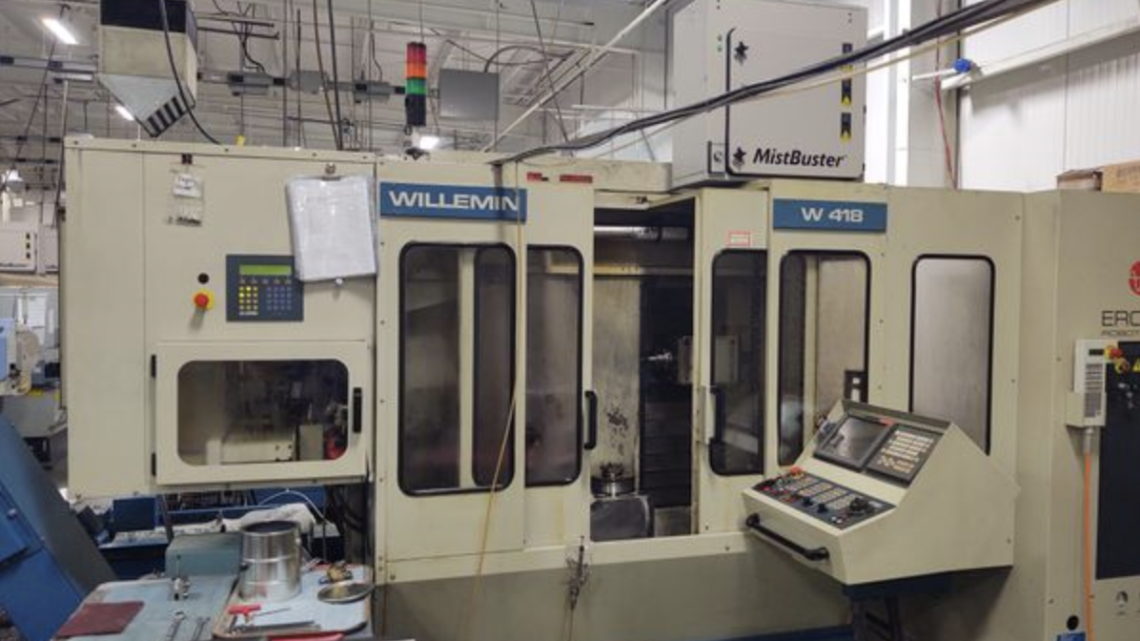
If you’re looking to buy a second-hand Willemin Macodel W 418 (5-axis machining center), here are the things you should absolutely check. I’ll include known spec ranges, common weak points, and questions to ask so you can see if a specific machine is a good deal.
Typical Specs & What Makes W 418 Special
Here are what the spec sheets often show for the W 418:
| Spec | Typical Values / Options |
|---|---|
| Axes | 5-axis (X / Y / Z + B-axis swivel + C-axis rotary) |
| Travels (X / Y / Z) | ~500 / 250 / 400 mm (or in some versions ~200 / 150 / 180 mm depending on model) |
| Spindle Speed | Up to ~18,000 rpm; in some versions much higher depending on spindle type, maybe up to 30,000 rpm (depends on the exact head) |
| Tool Holder | Usually HSK (e.g. HSK-A40) |
| Tool Magazine | Examples are 24 tool slots; in some listings maybe up to 48 |
| Controller | Variants seen include NUM 1050, NUM 1060, etc. |
Knowing the baseline helps you detect deviations that may be due to wear, modifications, or missing parts.
What to Inspect / Evaluate in Person
Here’s a checklist of what to examine thoroughly, with special attention for a 5-axis machine like the W 418.
| Component / Area | What to Inspect | What Problems Show Up If Not OK |
|---|---|---|
| Spindles | • Run at speed; feel for vibration, noise. • Check run-out (both axial & radial) on spindle nose and in the tool holding area. • Temperature rise over long runs. • Lubrication / cooling of spindle. | Wobble, bad finish, overheating, shorter life of tooling; if spindle bearings are worn, repair is expensive. |
| B & C Axes (articulation / rotary axes) | • Check backlash, play / looseness in the joints. • Swivel functions move smoothly at different speeds. • Check whether both axes hold positioning accurately under tool load. • Axis limits, any drift as machine heats up. | In 5-axis machining, misalignment or backlash here ruins precision; surfaces may be out of tolerance; complex parts suffer. |
| Guides, linear axes (X/Y/Z) | • Full travel test: does it move smoothly over full travel, no binding. • Inspect guide rails / bearings / linear ways for wear, corrosion. • Check alignment / squareness of axes and spindle. | Wear leads to drift, geometry errors, tolerance failures. If worn badly, refurbishment is expensive. |
| Control & Electronics | • What control type (NUM version or other), software version. • Error logs / alarm history. • Limit switches, sensors, interlocks working. • Wiring & connections: check age, insulation, cleanliness. | Old or failing control / electronics lead to downtime, random errors, parts availability issues. |
| Tool magazine & tool changer | • How fast tool-changes are; whether tools / holders are included. • Condition of tool holder seats; whether HSK taper is in good shape. • Magazine capacity and whether spare positions / potential interference in use. | If tool changer mis-indexes or is slow / worn, that slows production; worn holders cause vibration or poor surface finish. |
| Spindle / head attachments & tool interface | • Ensure correct tool taper (HSK or ISO) is present and not damaged. • Inspect any live cutting heads or attachments. Check whether they are balanced. • Check coolant supply through spindle, if available. | A damaged taper or imbalance causes vibration, shortened tool life, poor machining. |
| Condition of structure, enclosure & mounting | • Frame, column, base: any cracks, rust, distortion. • Enclosure doors, safety guards intact. • Whether the machine has been moved; after transport, was it re-leveled / aligned. • Floor vibration, foundation stability. | Wobble, poor precision, possible damage that isn’t visible at first glance. |
| Wear & usage history | • How many operating hours (on spindle, on live axes, etc.) • What kind of parts / materials were machined (hard metals vs soft) and how intensively. • Maintenance history: lubrication, coolant change, axis alignment, spindle rebuilds, etc. • Whether part-programs were heavy or light, rough vs finish work. | Heavy use without maintenance causes faster deterioration; wear may reduce lifespan significantly. |
| Accuracy / Test & Calibration | • Ask for measurement / calibration reports: geometry tests (squareness, repeatability, surface finish). • Run sample parts if possible; measure tolerances you care about. • Check spindle run-out. Check that B/C axes hold stated angles. | Without verified accuracy, you might buy something that won’t produce acceptable parts. |
| Auxiliaries & accessories | • Coolant system, filtration, coolant-through tool or spindle if needed. • Chip evacuation, conveyors, guards. • Tool probe or measuring probe (if included), work holding fixtures. • Manuals, spare parts, documentation. | Missing or broken auxiliaries reduce usefulness; spares or attachments can be expensive or hard to find. |
| Control options /Software / Upgradability | • Whether control features you need (5-axis simultaneous, high speed, interpolation, etc.) are present. • Software license / version; whether updates are possible. • Whether spare parts (fanuc / NUM / etc.) are available locally. | If control is old or no longer supported, repairs and software updates become costly. |
| Transport / Installation / Utilities | • Power supply: correct voltage / phases; stable power. • Cooling / lubrication utilities; environmental control (temperature, humidity, dust). • Move / installation: was it transported; was it re-leveled and calibrated after move. • Floor space and clearance. | Misinstallation or environment can degrade performance and accuracy significantly. |
Common Weak Spots for Willemin W 418
Based on marketplace info and user comments, these are areas that tend to cause trouble or extra cost:
- The spindle is often of high RPM and precision. If bearings or cooling are worn/neglected, repair is expensive.
- The B/C axes articulation often accumulates backlash or looseness. These need alignment; replacement of rotary axis bearings or seals can cost.
- Tool interface (HSK / spindle taper) wear: especially if users used worn holders or did tool changes improperly.
- Older control electronics (if original) may be harder to support or have spare parts delays. If the control version is Num 1050 vs 1060 vs later, that matters.
- Coolant / filtration / chip management: often neglected; build-up of swarf, poor coolant can lead to corrosion or wear.
- Documentation & spare parts: old machines may lack manuals or parts lists; some parts might be proprietary or long lead time.
Questions to Ask the Seller
To figure out whether a particular used W 418 is worth buying, ask:
- Operating hours: total hours, spindle hours, hours under full load vs idle.
- Condition of B/C axes: any play, backlash, maintenance history; have they been re-calibrated or reprobed?
- Spindle history: when was last bearing replacement; any vibrations or noise; if the spindle was overloaded.
- Control type and version: which CNC brand, which firmware/software version, any updates; error log history.
- Tool magazine & tool holders: do you have the holders; have they been kept in good condition; speed & accuracy of tool changes.
- Measurement / calibration reports: can you show sample parts, test reports showing geometry, accuracy, repeatability.
- Support equipment: coolant, filtration, chip conveyor, safety enclosure, work holding; condition of these.
- Transport and installation history: has machine been moved; was it realigned / leveled afterward.
- Availability of spare parts / manuals / documentation: are drawings, parts lists included; are parts still obtainable, what delivery lead time is.
- Environmental conditions: where has it been (dust, temperature, humidity, vibration); was it in a clean shop or harsh environment.
How to Decide If It’s a Good Deal
Finally, after gathering all that, compare:
- What tolerances and production you need vs what the machine is likely still capable of.
- What refurbishment or maintenance you’ll have to do (spindle, axes, control) and cost of those.
- Transport & installation costs, leveling, calibration after purchase.
- The price of similarly spec’d W 418 machines in your region or in Europe.
- The risk of downtime or parts delays.