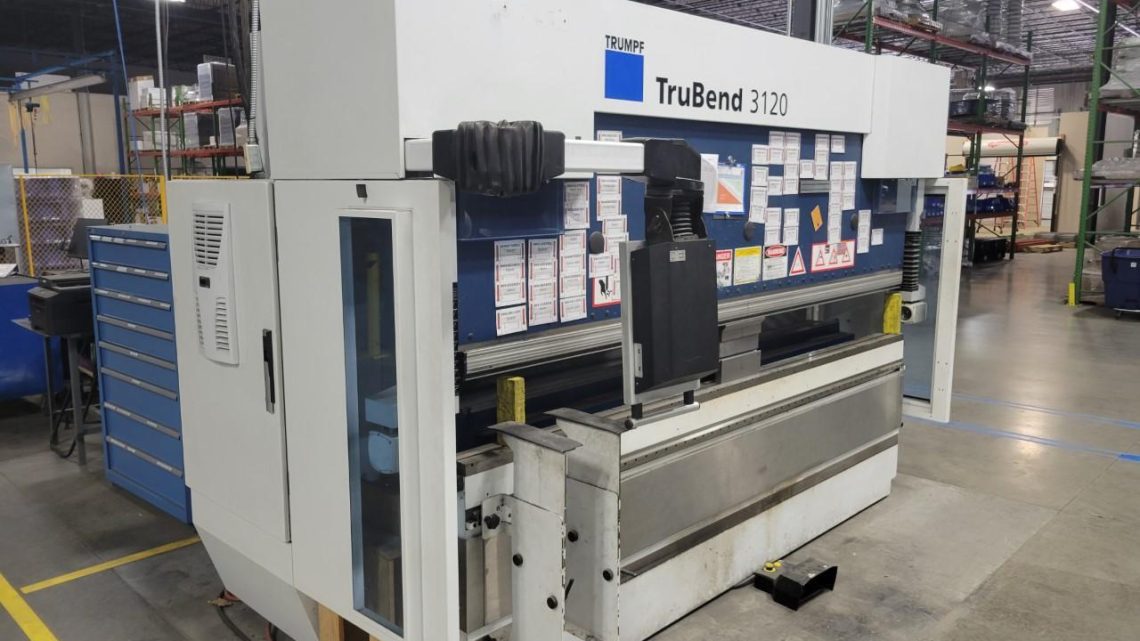
What Should I Pay Attention To When Buying a Second-Hand / used Trumpf TruBend 3120?
If you’re looking at a used TRUMPF TruBend 3120 press brake, there are many things you’ll want to check carefully. It’s a solid machine, but like any used CNC / hydraulic press brake, there are wear points, maintenance items, and “gotchas” that can significantly affect its usefulness, cost, and precision. Below are what to look for, what to test, questions to ask, red flags, and how to assess if it’s a good buy.
What a TruBend 3120 Should Be / Key Specs to Check
To know what you should expect and what to compare against, these are typical numbers / features for the TruBend 3120 (based on used-machine listings) so you can spot when something is off.
| Spec | Typical Value |
|---|---|
| Bending (press) force / tonnage | ~ 120-132 tons (≈ 1,200-1,320 kN) |
| Bending (working) length | ~ 3,100 mm (≈ 122 in) |
| Distance between columns (frame opening) | ~ 2,600-2,700 mm |
| Beam (ram) stroke | ~ 340 mm (depending on version) |
| Open height (max height under beam) | ~ 1,000 mm in many versions |
| Control type | Often Delem (e.g. DA-65 TW, etc.) control on used units |
| Hydraulics / drive | Hydraulic press, with multiple axes (Y1, Y2, X, R etc.) depending on model. |
Use these as benchmarks. If a machine is far from these (in stroke, force, open height etc.), it may mean it’s a lower spec version or has been modified, worn, or misrepresented.
What to Inspect / Test On-Site
Here are items and systems to inspect/test physically or under operation. The quality of your inspection here strongly affects what surprises you may face later.
| Area | What to Check / Test | Why It Matters / What Tends to Fail |
|---|---|---|
| Frame, Bed & Structure | • Check the overall frame for cracks, weld repairs, deformation. • Check that the uprights (columns) are not warped; measure for verticality and that the bed is straight. • Check the ram / beam for bending, twist, or wear. • Inspect distance between columns for consistent dimensions. • Check crowns or compensation systems if present (ram crowning) work properly. | Structural deformation leads to uneven bending, inaccurate angles, inconsistent parts. If frame/crowning is out, you may get twist or non-parallel bends. Repairing or re-aligning large frames is difficult and expensive. |
| Hydraulic System | • Check for leaks in cylinders, hoses, valves, seals. • Test the oil condition: clean? free of debris / water? • Check hydraulic pump operation: sound, pressure, smooth motion up/down. • Inspect the pump motors / drives; any overheating? • Check ram return speed, approach speed, if the hydraulic system maintains set pressure reliably. | Hydraulic problems degrade accuracy & speed. Worn or leaky seals cause slippage, loss of tonnage, irregular bending. Dirty oil causes damage to valves or internal parts. |
| Ram / Beam Movement & Alignment | • Move the ram through full stroke; check for uniform motion, binding or sticking near top / bottom. • Check beam / ram alignment with bed: is the ram parallel to bed at various stroke positions? • Check open height under ram: does it reach advertised height? Is there obstruction? • Measure deflection under load. • Check leveling of machine bed. | Misalignment causes variable bends, twist, inconsistent angles. If ram is not parallel, edges may be bent unevenly. Deflection under load reduces accuracy. |
| Back-gauge & Axes (X, Y, R, Z / Fingers etc.) | • Check back-gauge accuracy: move gauge in X/R (depth) and Y (height) axes; see if positions are accurate and repeatable. • Look for play, backlash in axes; test homing / referencing. • Check control of all programmed axes; whether limits/homing work correctly. • Inspect mechanical parts: guide rails, linear bearings, motors, gearboxes. • Check that the back-gauge fingers (if used) are in good condition (tips, alignment). | The back-gauge precision directly affects final dimensions. Worn axes or worn gearboxes introduce backlash, which causes positional errors. Malfunctioning gauge can cause mis-bended parts. |
| Control System / Electronics | • What control is it (manufacturer & model)? Is it up to date / supported? • Check the user interface: display, buttons, joysticks if any; look for dead pixels, screen faults. • Inspect drive electronics, motor controllers: temperature, condition; any visible damage. • Check software history, updates, error logs. • Ensure safety interlocks, emergency stops, guard systems are functional. | Old or poorly maintained control systems may have faults or be difficult to service. Software bugs or out-of-date firmware can create issues. Safety non-compliance is a legal and operational risk. |
| Tooling / Die & Punch / Clamping | • Check condition of punch/die tooling surfaces: wear, chipped edges etc. • Check clamping devices: are they tight, consistent? • Inspect the ability to adjust tools (punch height, die opening). • Check tool seating, alignment. • Examine tooling availability & compatibility. | Worn tooling gives poor edge quality, unclean bends. Clamping issues can cause tool slip, misbends. If special tooling is rare or expensive, that adds cost. |
| Working Hours / Usage History | • Ask how many hours or bending cycles the machine has done. • What kinds of materials have been processed (sheet metals, thickness, types)? • Any heavy duty or “abuse” use (bending thick or high strength steel frequently)? • Maintenance / service history: how often oil changed, seals replaced, alignments done. • Any history of crashes, overtravel accidents, mechanical damage. | Usage heavily affects wear: thick/high strength material makes more strain; neglect of maintenance causes seals, hydraulics, structure to degrade. Crash/damage may misalign structure invisibly. |
| Speed / Performance & Cycle Times | • Check working speed (bending speed) and return/approach speed. Are they normal / as spec? • Test time between bends / simple parts to see if you can get good throughput. • Observe lag in moving axes or delay in hydraulic response. • Under a sample bend (especially thicker sheet), check if machine can reach full tonnage without slowdowns. | Slow or sluggish response reduces throughput, increases production cost. Hydraulic lag, underpowered motor or worn systems may reduce actual capacity. |
| Safety & Guarding | • Are all guards, light curtains, safety devices present & working? • Emergency stop buttons accessible and functional. • Any modifications that compromise safety (missing covers, removed guards etc.). • Check compliance with local regulations & codes. | Safety features often are the first to be bypassed or degrade; legal / insurance issues may arise if safety is lacking. Missing guards also expose prone components to damage by chips or operator error. |
| Oil / Filter / Maintenance Items | • Check condition and cleanliness of hydraulic oil; presence of contamination. • Check condition of filters: hydraulic, lubrication, control, cooling. • Whether spare filters, oil, or maintenance tools are included. • Condition of seals, hoses, gaskets; any leaks. | Dirty or degraded oil causes wear in hydraulic valves / seals. Filter neglect shortens service life. Leaks degrade performance, make mess, may lead to unexpected failures. |
Questions to Ask the Seller
These will help you understand both condition and future cost. If seller can show documentation, better.
- What is the year & serial number of the machine; what version of control does it have?
- How many hours / bending cycles has it done? What materials have been bent (thickness, types)?
- What maintenance has been done: seal replacements, hydraulic oil changes, alignment / squaring, beam / ram service etc.
- Has the machine been relocated / shipped? Was it realigned / recalibrated after moving?
- Have there been any accidents / crashes / overtravel incidents? What damage resulted?
- Is the tooling (punches, dies, clamping sets) included or will you need to buy them separately? What condition are they in?
- Is the back-gauge fully functional? Does it hold repeatable positions accurately? Any backlash or looseness?
- Are safety devices all in place and functional? Guards, light curtains, emergency stops etc.
- Can I see the machine perform bending tasks with material similar to what I will use, to check angle accuracy, repeatability, finish, speed etc.?
- Are spare parts available (hydraulic seals, punches/dies, control parts etc.) locally; what is lead time & cost?
- What upgrades / options are included? E.g. crowning, lubrication / oil heating, angle measurement, extended axis etc.
Red Flags / Causes for Caution
If you observe any of these, either expect cost to fix or walk away unless price reflects them.
- Excessive leaks in hydraulic cylinders, or visible seepage around seals.
- Ram or beam not parallel to bed; twisting or uneven bend widths; beam sag.
- Back-gauge that does not track accurately or has loose axes.
- Control system with malfunctions, lags, or parts of UI / display missing or damaged.
- Tooling in bad shape; misaligned or worn dies / punches.
- Slow speeds, slippage, hydraulic pumps noisy or underpowered.
- Frame cracks or signs of structural fatigue.
- Safety guards missing or bypassed.
- Oil contamination / poor oil condition.
- Machine used far beyond intended material thickness or strength, likely causing overstress wear.
How to Judge Value vs Cost
When assessing whether a given offer is fair, factor in:
- What repair / reconditioning will be needed immediately (e.g. seals, oil change, tooling).
- Cost (and time) of getting the machine relocated, aligned, installed. These machines are heavy (~ 8-9 tonnes in many cases) and require solid foundations.
- Spare tooling or dies included (if not included, you may need to buy).
- The hours / usage: a 2007 TruBend 3120 with ~ 20,000 hours may have more life left if well-maintained; but heavy usage reduces remaining lifetime of hydraulics, seals etc.
- Availability and cost of spare parts locally, especially control, hydraulic valves, seals.
- Productivity / throughput: older machines may be slower or less efficient. If your parts require fast back-gauge movement, good control, etc., these may cost you in production time.