22/09/2025
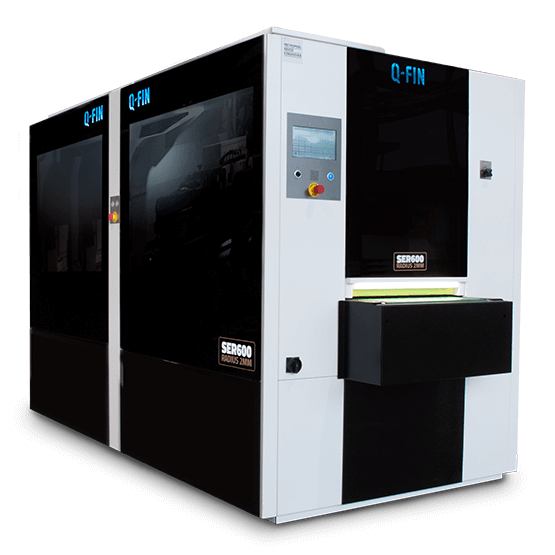
What Should I Pay Attention To When Buying a Second-Hand / used Q-Fin Quality Finishing Machines SER600 Edge Round Machine?
If you’re thinking of buying a second-hand Q-Fin SER600 “Super Edge Rounder / finish machine”, here are the things you should check carefully. This machine is quite capable, but a used one can have many wear points or hidden issues. Checking these will help you avoid surprises and estimate refurbishing / running cost.
What the SER600 Should Be Able To Do / Key Specs to Know
Before inspecting, know what the machine is supposed to do and what its limits are:
- It can apply a large edge‐radius (~R2 mm or more) to sheet metal up to ~ 600 mm width.
- Workpiece thickness range: approximately 4 mm up to ~ 40 mm.
- Minimum workpiece size; approx 50×50 mm (for ferrous, with magnetic support).
- 5 processing stations: 1 grinding belt + multiple brush stations (oscillating and round brushes).
- Conveyor belt speed adjustable from ~ 0.3 up to ~ 8 m/min.
- Magnetic support (for ferrous metals) to hold workpiece flat on conveyor.
- Power supply of machine around 400 V, 50 Hz, ~32 A, ~16 kW.
- Max workpiece height (thickness + possible “stacking” or protrusions) ~ 40 mm.
Knowing these, you can test whether what the seller offers matches what you need.
What to Inspect & Test in a Used SER600
Here are what to check, test, or verify when evaluating a used machine:
| Component / Feature | What to Check / Test | Why It’s Important / What Can Go Wrong |
|---|---|---|
| Grinding unit & grinding belt | Check belt condition: worn, torn, frayed; tension, tracking. Test whether grinding belt motor runs smoothly, power OK. Check wear in belt guides. Check the condition of the belt drive rollers, bearings. Inspect whether belt replacement is easy. | If the belt is worn or misaligned, grinding will be uneven; if motors/bearings are bad, operational costs rise and quality suffers. |
| Brush stations (oscillating + round brushes) | Inspect brushes: bristles worn, missing, damaged, deformed. Check oscillation mechanism: motion is smooth, no binding. Round brushes: check how well they spin, whether rotations are true, no wobble. Check motor power, speed control of brushes. | Brushes are consumables that wear; if they are in bad shape, they’ll need replacing. Poor brush action means poor rounding, inconsistent edge finish. |
| Conveyor / Product support (magnet or fixture) | Is conveyor belt in good condition (flat, not too worn)? Drive motor for belt: smooth, no slipping. Magnetic support (if machine has magnet) should hold parts flat reliably; check if magnetic field is uniform and strong. Check whether workpieces shift. | If workpieces shift or are not held flat, edges won’t be rounded properly; width / contour issues will result. Conveyor deterioration can cause tracking or alignment problems. |
| Height / Thickness Clearance | Test maximum thickness parts: does machine handle near the spec (~40 mm)? Is clearance enough at all stations (grinding, brushes)? Any interference or rubbing? | If the machine cannot accommodate the thicker workpieces, its usefulness is limited. If clearance is marginal, wear or mis-alignment may cause collisions. |
| Motor / Power / Electrical Systems | All motors (grinding, brush, conveyor) should run cleanly, without excessive heat, vibration or noise. Inspect electrical panels, switches, wiring. Are there safety interlocks, emergency stops? Check power draw under load. | Electrical problems are expensive to fix; worn motors or mis-wired controls may give intermittent failures or unsafe conditions. |
| Control Interface / HMI / Programs | Does the control screen respond? Are program settings for speed / belt speed / brush speeds / number of brush stations working? Can the operator change them easily? Are there saved programs? | Good HMI makes operation easier and reduces operator errors. If controls are old or unreliable, you’ll spend more time troubleshooting or operating manually. |
| Wear, Alignment, Mechanical Condition | Check frame, chassis for alignment; check grinding head alignment relative to belt; check whether brush heads are aligned with edge path. Bearings in moving parts should be clean and smooth. Check for vibration or wobble in brushes and grinding unit. | Misalignment or worn bearings lead to uneven rounding, inconsistent results across width or contour. Mechanical wear escalates over time. |
| Wear Parts & Consumables | Ask what spare brushes, belts, grinding wheels are included. How quickly they wear in previous use. Availability and cost of replacement parts in your region. Inspect condition of current consumables. | Consumables are a recurring cost; if spares are rare or expensive, operating cost goes up sharply. If the machine comes without many spares, initial investment will be higher. |
| Dust / Debris / Extraction System | Check whether dust / grinding debris / metal particles are properly removed / extracted. Are guards, protective covers in place? Is there an extraction or filtration system (especially for stainless steel or aluminium)? Check condition of filters, dust collection. | Poor extraction leads to buildup of dust, risk of fire or explosion (depending on metals), increased wear, operator hazards. It also affects finish quality. |
| Throughput & Speed Tests | Run sample workpieces of your expected size / thickness. Check speed: how fast belt moves; how many parts per hour can it handle. Observe whether finish is acceptable in a single pass. | Some machines may need two passes for your finish, doubling time. Speed matters for cost per piece. You want to test machine in “real production” conditions. |
| Edge Radius Consistency & Quality | Measure the actual radius achieved (e.g. R2 mm) on edges on both inner and outer corners. Check consistency across width of sheet, through the entire length. Check contour rounding for irregular shapes. | If edge radius is inconsistent, parts may fail coating / galvanizing or may have sharp edges left. Consistency is crucial for finishing quality. |
| Thickness Range / Material Types | Test on different materials you plan to use (steel, stainless, aluminium etc.). Some machines may struggle with certain materials. Thicker vs thin material: does machine handle thin without damaging parts? | Finishing thin sheets without warping requires careful support and magnet or fixture. Some materials wear brushes faster or create different debris. |
| Electrical Supply & Infrastructure Matching | Check whether the machine requires 400 V, 50 Hz, whether your facility has that. Check amp draw. Check footing / floor strength for the machine weight (~3560 kg). Check space, overhead clearance. | If your facility cannot support the machine’s power or physical requirements, you’ll need to invest additionally. Transport & installation cost can be significant. |
| Safety & Guards | Emergency stops should work. Guards around moving parts, grinding belts, brushes should be intact. Interlocks should stop machine if doors opened. Operator safety features. | Ensures safe use and code/regulation compliance. Missing or broken safety features can be extremely costly or dangerous. |
| History / Maintenance Records | Ask for how many operating hours, how many parts processed. Record when brushes or belts replaced. Whether motor bearings replaced. How often maintenance done: cleaning, lubrication, calibration. | A well-maintained machine will cost less in unexpected wear; if maintenance is neglected, hidden issues often appear. |
Red Flags & Deal Breakers
Watch these carefully; many of them greatly increase cost or risk:
- Grinding belt severely worn or torn, grinding unit misaligned.
- Brushes in poor condition (uneven wear, warping, missing bristles).
- Conveyor misalignment, weak magnet or support so workpieces shift.
- Motor or electrical system showing signs of overheating, smoke, noise.
- Extraction / dust removal missing or poor, leading to buildup of debris.
- Workpiece thickness limits exceeded regularly: if someone pushed beyond machine spec, more wear likely.
- Controls or interface malfunctioning, missing programs, unreliable adjustments.
- Safety guards missing or damaged.
- No spares / consumables available locally, long lead time for wear parts.
- Machine has been idle long without use (rust or drying of bearings).