What Should I Pay Attention To When Buying a Second-Hand / used Omax Maxiem 2040 Waterjet Cutting System?
If you’re looking at a used Omax / Maxiem 2040 (or similar) abrasive waterjet cutting system, there are a lot of moving parts, wear points, and operational costs to keep in mind. Below is a checklist: what specs you should verify, what to inspect/test in person, common failure points, and questions to ask. This should help you evaluate any used unit more confidently.
Key Specs & What Should Be True
First, make sure the machine you’re considering matches or comes close to what Omax publishes for the Maxiem 2040 or 2040X, so you know what its capabilities are:
- Cutting envelope (XY travel) approx 4.21 m × 2.00 m (≈ 13′10″ × 6′7″)
- Z-axis travel (motorized) ~ 304 mm (≈ 12″)
- Positional accuracy ~ ±0.003″ (≈ ±0.076 mm) and repeatability ~ ±0.001″ (≈ ±0.025 mm) in standard condition (at ambient ~22 °C)
- Pump pressure usually 50,000 psi in many Maxiem 2040s; motor power varies depending on configuration (HP), depending on cutting speed/material etc.
- Material support slats, tank & structural dimensions, electrical requirements (often 3-Phase, ~380-480 VAC, 50-60 Hz)
Having these baselines helps you check whether what the seller claims is accurate or optimistic.
What to Inspect / Test On-Site
When you go see the machine, you want to physically inspect or test:
- Pump & High-Pressure System
- What type of pump is installed (direct-drive, intensifier, etc.) and whether it’s original or has been rebuilt or replaced.
- Check hours on the pump (especially high-pressure side): seals, packing, plunger wear. Listen for unusual noises.
- Test pressure capability under load. Does it reach rated psi? Are there leaks? Are the hoses, fittings, valves OK?
- Cutting Head / Orifice / Nozzle / Mixing Tube
- Condition of the nozzle, mixing tube, orifice: wear here degrades cut quality and efficiency.
- Ease of replacement, availability of spare consumables.
- Check alignment of the head; whether the Z-axis (if motorized) moves cleanly and accurately.
- Axes (X, Y, Z) / Motion & Accuracy
- Move in X, Y across full travel range; test for binding, uneven motion, backlash.
- Repeatability test: move to a point, return, see how close you get.
- Check linear encoders or guides and covers; seals that protect them from abrasive slurry or garnet dust.
- Table, Slats, Tank & Material Support
- Slats: how worn are they? Replaced recently or heavily used. Slat condition affects how parts are supported, how much waste is generated.
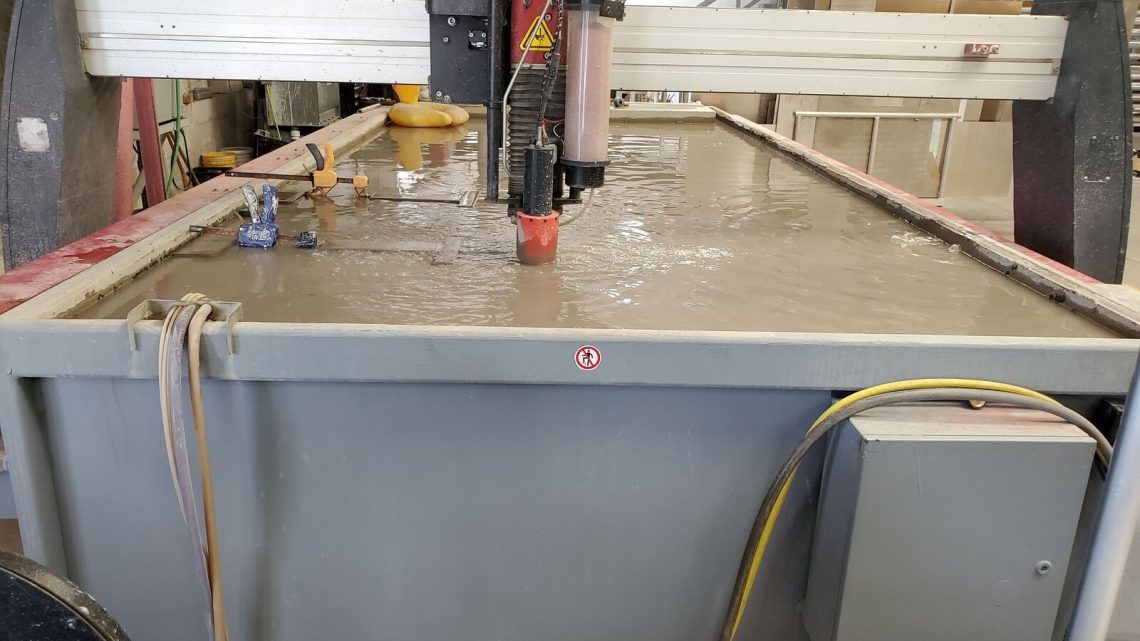
- Tank integrity: no cracks, leaks; check for rust or corrosion in water tank.
- Material supports / fixturing: are supports (clamps, fixtures) included or needed.
- Water / Abrasive Supply & Water Quality
- The source of water, filtration, cooling system, any water treatment. Poor water quality can degrade pump seals and cutting head.
- Abrasive delivery: bulk hopper or manual feed, condition of abrasive delivery system. Clogging or jamming are problems.
- Control System & Software
- Check the controller / PC / software version; find out if it’s maintained, whether licenses are valid.
- Operator interface: responsiveness, display condition.
- Error logs / alarm history.
- Wear & Maintenance History
- Annual hours of cutting vs idle. How heavily has the machine been used.
- Maintenance records: nozzle / mixing tube replacement, pump rebuilds, alignment checks.
- Whether any major failures have occurred (pump, structural, controller).
- Safety, Guards & Environment
- Safety interlocks, emergency stops working.
- Splash guards, debris guards. Pump and high-pressure lines should be well secured.
- Drainage, abrasive disposal, dust control.
- Operational Test
- Run sample cuts of material types & thicknesses you intend to use. Measure edge quality, taper, dross.
- Test at full plate size if possible, to see whether performance holds near edges—effects of gantry flex, etc.
- Utilities / Fit for Your Shop
- Power supply: correct voltage/phase/amp capacity.
- Floor strength / weight of the unit (with water in tank).
- Water supply and wastewater handling. Abrasive disposal.
- Height / access overhead for water supply lines, plumbing.
Common Failure Points / Wear Areas
These are parts that tend to wear or cause trouble on used Omax / Maxiem waterjets:
- Pump seals, plungers, packing, especially under very high pressure or with poor water quality.
- Nozzle, mixing tube wear. As these wear, cut quality deteriorates and cost per cut rises.
- Orifice wear or misalignment.
- Slat damage or severe wear—causes poor support and more wasted material.
- Z-axis issues: motorized Z-axis or tilting heads can develop play or failure. Some users report tilt-axis problems in not many years.
- Dust / garnet ingress to moving parts or guides if seals/way covers are worn.
- Controller / software / electronics aging, firmware or license issues.
- Abrasive delivery clogging or hopper issues.
- Tank leaks or corrosion; rust in tank can cause contamination.
Questions to Ask the Seller
Here are good questions to clarify condition and hidden costs:
- How many hours of cutting (actual cutting time) and how many hours total (machine on but idle)?
- What materials and thicknesses have been cut most frequently?
- Has the pump been rebuilt? When? What was replaced (plungers, seals, etc.)?
- How often are the nozzles, mixing tubes, orifice changed; are spare consumables included?
- What’s the condition of the slats; have they ever been replaced; how often?
- Is the machine under any maintenance contract; is software / controller fully licensed?
- Has Z-axis been maintained; are there any issues with leveling or tilt axes (if applicable)?
- Are there any known leaks (pump, tank, plumbing), or misalignment issues?
- What safety features does it have; are they all functioning?
- What is the cost / availability of parts / service locally?