21/09/2025
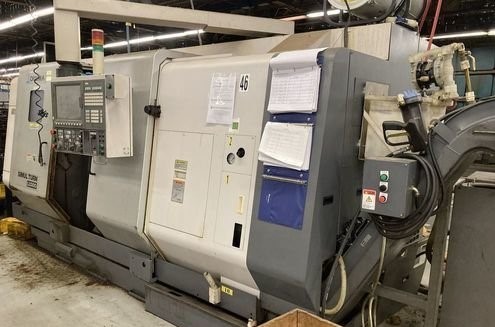
What Should I Pay Attention To When Buying a Second-Hand / used OKUMA LU 300 SIMUL TURN?
Here are things you should pay attention to if you are buying a second-hand / used Okuma LU-300 SimulTurn (or similar multi-tasking turning/milling machine). Use this as a checklist with the seller or during inspection.
What the Machine Is / What Matters
First, know what a SimulTurn LU-300 typically includes:
- Twin turrets (upper & lower), often with live tooling or milling attachments.
- Ability to turn, mill, drill, sometimes with C or Y axis, plus driven tools.
- CNC controller (Okuma OSP family) with simulation / interference check etc.
- Substantial size, weight, with electrical / hydraulic / coolant demands.
You need to match the machine’s capabilities with what your parts require (diameter, length, tool complexity, tolerances, cycle times).
Key Areas to Inspect & Evaluate
| Area | What to Check | Why It’s Critical / What Can Go Wrong |
|---|---|---|
| Spindles (main + live tooling) | • Check run-out, vibration, noise when running at various speeds. • Condition of bearings, seals, spindle taper. • For driven tools: torque, speed, whether tool holder is solid, any backlash or looseness. • Heat / temperature rise after long use. | Poor spindle condition kills accuracy, increases scrap, raises repair costs substantially. Live-tooling spindles are especially expensive if they need replacement. |
| Turret / Tooling Mechanisms | • Turret indexing accuracy; dwell time; backlash; • Condition of tool holders, tool shanks, alignment; • Are all driven/milling tool stations working? Are the tools included? Is the turret tight? Any wobble? | If turret is worn or mis-indexed, you’ll get wrong tool positioning, bad finishes, dimension errors. Replacing or refurbing turret mechanisms is expensive. |
| Axes (X, Z, possibly Y & C / Y / B etc.) | • Move each axis through full travel; check for smoothness, absence of binding; • Check for backlash, looseness, noise; • Check guides/ways for wear, scoring, rust; • Check for alignment (squareness, perpendicularity) of turret, spindle center, tailstock etc. | Worn axes degrade machining precision. Misalignment means taper or dimensional inaccuracy. |
| Control System & Software | • What model of controller (OSP-P100, P200 etc.) and its condition; • Are all control functions working? Error history; • Are the simulation or collision-avoidance features functioning correctly; • Are all CNC software modules/licences present (e.g. for live tooling, milling, probing etc.); • Is backup of parameters / machine configuration available. | If the software is old, unsupported or missing parts, adding them later can be costly. Also, the safety / collision features are important in multi-task machines. |
| Accuracy / Calibration | • Ask for test parts or calibration reports: turning & milling accuracy, repeatability, surface finish; • Measure key features like concentricity, roundness, straightness, flatness on milled surfaces; • Run a full-scale program if possible and measure produced parts; • Check temperature control / thermal stability. | Even a machine with good specs can drift out of tolerance. Calibration / alignment cost needs factoring in. |
| Wear & Usage History | • How many hours have the spindles / turrets / axes run? • What kind of work has been done (heavy cutting, long runs, intermittent use)? • Maintenance records: how often lubrication, cleaning, coolant / fluid changes etc. were done; • Any history of accidents, crashes, overloads. | Heavy use or misuse accelerates wear; hidden damage might show up later. Good maintenance history means likely fewer surprises. |
| Accessory / Peripheral Condition | • Condition of chuck(es), jaws, steady rest, fixtures etc; • Tailstock (if fitted)—does it align, move smoothly; • Coolant systems, chip conveyors working; hydraulic / pneumatic systems leak-free; • Safety enclosures, guards, sensors etc. | Missing or dysfunctional peripherals reduce productivity. Repairing or replacing them adds cost. |
| Rigidity & Structural Condition | • Inspect the machine body, bed, slideways: any distortion/cracks, rust, corrosion; • Turret / spindle supports stable, no looseness or vibration; • After transport, has it been re-aligned? Are all fasteners/bolts tight/still as built. • Evaluate machine anchoring, foundation condition. | Rigidity is essential to achieve precision, surface finish, repeatability. If the machine is loosely set up or its base is compromised, performance suffers. |
| Environment & Installation | • Power supply conditions: voltage stability, capacity, phase; proper grounding; clean power for electronics; • Cooling / lubrication systems functioning; environmental temperature control; cleanliness; • Ventilation, clearance, access for maintenance; • Transport history: has it been moved or shipped? If so, was it properly packed, re-leveled, recalibrated. | Environmental or installation problems can cause damage (thermal expansion, electrical faults, misalignment). Poor transport can result in hidden damage. |
| Consumables, Spares & Support | • Are spare parts (especially for spindles, turret, live tools, electronics) still available? • Are manuals, service documentation available? • Condition of filters, seals, tool holder inserts, coolant etc.; • Does the seller offer any warranty or guarantee of key components. | A machine is only useful if you can maintain it. If spares are rare or expensive, downtime and cost go up. |
| Cost of Ownership / Running Costs | • Electrical consumption, coolant/lubricant cost, maintenance frequency; • Cost of normal wear items (bearings, seals, turret parts etc.); • Skill level needed to operate and maintain (do you have trained people?); • Downtime risk. | Sometimes a cheaper purchase cost ends up costing more overall if running costs are high or reliability is poor. |
Questions to Ask the Seller
Use these questions to gather missing information:
- What is the model year, and how many operating hours on the machine (especially spindle hours)?
- What control version is installed; are all software functions / licences present and working?
- What is the condition of the live tooling (upper turret), including torque, vibration, speed; and has it been tested?
- Do you have calibration or test-part results (turning & milling) showing dimensional accuracy & repeatability?
- What is the turret history: maintenance, any rebuilds, wear to indexing mechanism or slides?
- What is the usage history: what materials have been machined; what kinds of operations (roughing, finishing)?
- Are all peripheral systems included (chuck & jaws, steady rest, coolant, conveyors, safety guards etc.)? Are they in good condition?
- Have there been any crashes or damage? Tailstock alignment, spindle alignment, turret alignment?
- What is the environment the machine has been used in (temperature stability, cleanliness, vibration)? Has it been moved recently, and was it re-aligned after move?
- Are spare parts manuals, schematics, hydraulic/pneumatic diagrams, software backups available?
Pitfalls / Hidden Costs
- Rebuilding a spindle or replacing its bearings can be a large cost.
- Turret wear (indexing, backlash) may not be obvious until in production.
- Software/firmware for older controllers can become obsolete; upgrading may be expensive or limited.
- Live-tooling spindles or driven tools failures are costly and sometimes lead time for replacement is long.
- Transport & installation: costs for moving, re-setting, alignment, calibration are often large and overlooked.
- False expectations of precision: the machine may appear good but may not produce the tightest tolerances without refurbishment.
- Downtime risk if spare parts or support are not locally available.