21/09/2025
What Should I Pay Attention To When Buying a Second-Hand / used Daewoo Puma 230MS?
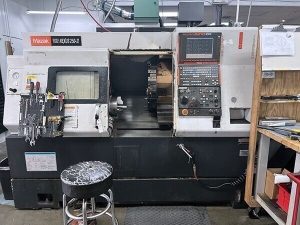
Here’s a guide for what to check if you’re buying a used Daewoo (Doosan) Puma 230MS lathe / turning-milling machine. Use this as a checklist during inspection or negotiation.
Basic Specs to Know
Knowing the machine’s specs helps you assess whether it meets your needs, and gives you clues about wear / value. Some typical specs of the Puma 230MS:
- Fanuc 18T / 18iTB control in many units.
- Max spindle speed ~ 4,500 rpm on the main spindle.
- Sub-spindle often included with various speeds (sometimes 6,000 rpm) and a live tooling station.
- Bar capacity ~ 65 mm.
- Turning diameter over bed ~ 290 mm. Swing over saddle somewhat less.
- Travel in Z ~ 580 mm in many units; X travel depends on configuration.
- 12-station (or more) turret, often with driven/live tooling and C-axis indexing.
What to Inspect & What to Ask
Here are detailed areas to check, and questions to ask, so you can discover hidden problems and judge whether the machine will perform well.
| Area | What to Inspect / Test | Key Questions to Ask |
|---|---|---|
| Spindle(s) | • Run at various speeds and listen for unusual noise or vibration. • Check run-out (axial and radial) and test for heat build-up. • Inspect spindle taper and bore for wear or damage. • For sub-spindle: check condition, alignment, whether it engages properly. | “Have there been spindle rebuilds? When was the last bearing replacement? Any spindle run-out / vibration issues?” |
| Control & Electronics | • Check controller model / version; make sure it is reliable and serviceable. • Run each axis; check servo responsiveness, backlash, encoder feedback. • Inspect limit switches, sensors, wiring, any intermittent faults or alarms. • Confirm all needed CNC functions (live tooling, C-axis, sub-spindle) are working. | “What control version is it? Any unrepaired electronic faults? Are drives / amplifiers / encoders in good shape?” |
| Turret & Tooling / Live Tooling | • Does turret index cleanly & accurately? Any wobble or play? • Check wear in tool holders, seating surfaces. • If live tooling: check driven tools’ speed, torque, vibration, coolant delivery. • Check tool changing mechanism, tool magazine (if present). | “How often has the turret been serviced? Are all live-tooling stations functional? Any missing or worn holders or tools?” |
| Axes & Structural Condition | • Move axes throughout full travel; see smoothness, consistency, look for binding, loose parts. • Inspect guide ways/slides for wear, scratches, pitting, corrosion. • Check frame integrity, sub-spindle mounting alignment. • Check whether machine has been reloaded / dropped / damaged. | “Has the machine ever been dropped or had any crashes? When were the axes aligned / adjusted / scraped / bed ways refurbished if ever?” |
| Accuracy & Calibration | • Request test parts or calibration data: dimensions turning, milling, concentricity, roundness. • Check repeatability over multiple cycles. • Run a part that uses full Z travel, full X travel, full turret usage. | “Do you have recent calibration / inspection reports? What tolerances has it historically held under production?” |
| Wear & Usage History | • Hours of operation: total and hours on spindle/live tooling etc. • What material types were machined (hard, abrasive, tough steels increase wear). • Maintenance records: lubrication, coolant changes, alignment checks. • How was it used — heavy cutting, light finishing? | “What are the total running hours? How heavily was it used? How often maintained?” |
| Drive / Feed / Interpolation Features | • C-axis indexing: does locking function work cleanly? • Any issues with interpolations (Y-axis if present, or other complex axes) • Rapid traverse rates vs actual movement under load. | “Are there any errors during C-axis / live-tooling interpolations? Rapid travel losses under load?” |
| Auxiliary Systems & Accessories | • Coolant system, chip removal (chip conveyor), bar feeder (if included), tailstock, steady rest etc. • Safety guards, enclosures, mist filters. • Condition of tooling, jaws, collets, holders. | “What accessories are included? Are they all working? Any expensive missing pieces?” |
| Environment & Installation | • Machine foundation, levelness, alignment after transport. • Power supply condition: stable voltage, grounding, adequate amps. • Cleanliness, dust, coolant maintenance, environmental control (temperature variations). | “Has the machine been moved recently? Was it re-leveled / adjusted? How has the environment been (dust, coolant quality etc.)?” |
| Consumables, Spare Parts & Support | • Are consumables (bearings, seals, filters, coolant pumps) still available? What’s the cost? • Manuals, parts catalogues, service documentation. • Support options (supplier / local service techs). | “Do you have service manuals, spare parts list? Can you source parts locally? What are common replacement needs?” |
Known Weak Spots / Common Failure Modes
Some issues that are often found in Puma 230MS units or similar machines. If you see signs of the following, pay extra attention:
- Spindle wear: since the machine’s spindle is not cartridge type, replacing spindle bearings or correcting spindle wear is more difficult. If there is noise, vibration or problems with roundness/repeatability, that’s a red flag.
- Air lines / air regulators: often degrade, especially in older machines or ones that have been idle for a while. Poor air supply or worn regulators can cause pneumatic/hydraulic issues.
- Encoder / feedback / electronics faults: intermittent positioning errors (e.g. same program sometimes comes out correct, other times not, without changes) often point to encoder or servo issues, or control board issues.
- Turret indexing inaccuracy or wear: excess play or delay in tool changes; wear in turret mechanism leads to positional error.
- Coolant / chip removal systems often get neglected; dirty coolant, worn pumps, clogged conveyors reduce performance and damage parts.
- Sub-spindle alignment and condition is often overlooked: if misaligned, parts held in both spindles will suffer from concentricity / alignment issues.
How to Decide If the Offer is Good
After your inspection & questions, you can decide using these criteria:
- Does the machine meet your tolerance, size, speed, tooling needs after likely wear is accounted for? If the machine needs refurbishment, estimate that cost and subtract from what they ask.
- Factor in all “hidden” costs: transport, install, leveling, calibration, spare parts, accessories.
- Compare to cost of other used Puma 230MS units with similar condition; also compare new or refurbished equivalents.
- Evaluate reliability: if parts are still available and there is service support, that reduces risks.
- Think of downtime and maintenance: paying a little more for one in better shape can save you much more later.