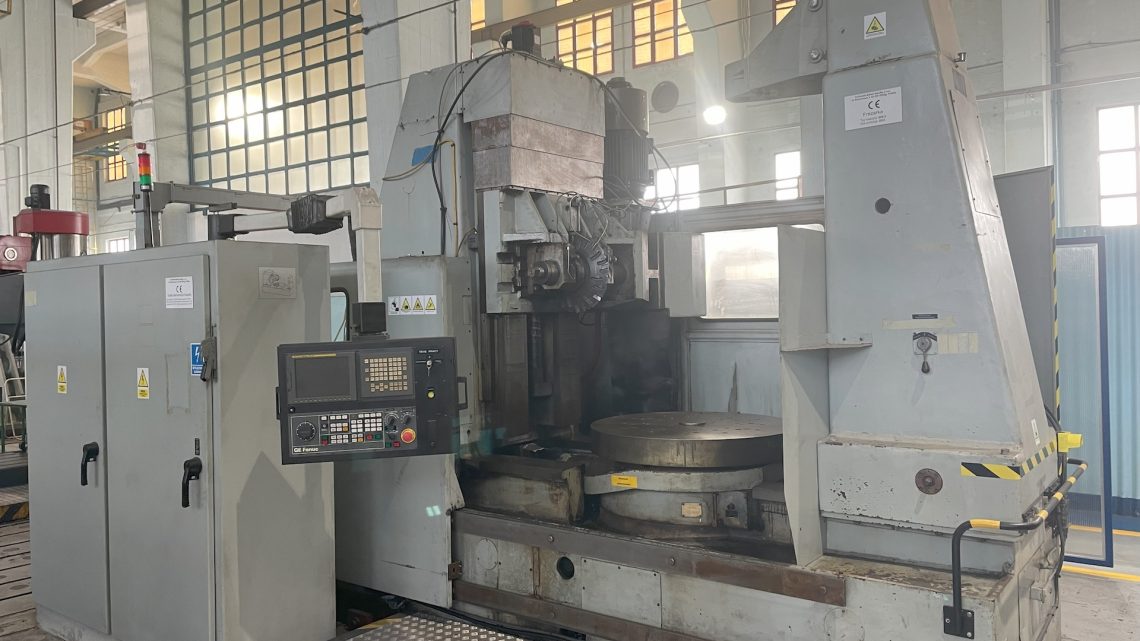
What Should I Pay Attention To When Buying a Second-Hand / used Gould & Eberhardt G&E M306 CNC Gear Hobbing Machine?
Here’s a detailed guide on what to pay attention to when buying a second-hand Gould & Eberhardt G&E M306 (or similar) CNC gear hobbing machine. Because gear hobbing machines are very precision-oriented and exposed to heavy mechanical loads, many wear points matter, and many issues show only under test. You’ll want a thorough inspection, ideally hands-on or with video + test parts.
What You Should Know / Baseline First
Before visiting or evaluating an offer, try to get as much info up front as possible so you know what “normal / good” looks like for the particular M306 you’re considering. If you can, find out:
- Exact model / variant: “M306” may have subvariants (different capacities, hob head variants, arbors, control types).
- Workpiece capacity: maximum diameter, face width, length between centers, gear module / diametral pitch range.
- Hob head specs: speed range, arbor size, hob diameter limits, head indexing or axial feed capacities.
- Control system type: CNC or semi-CNC; what control brand / version; what software version; whether it’s retrofitted or original.
- Accessories included: change gears, tailstock, steady rest, hob arbors, tooling, fixtures, work holding devices.
- Usage history: number of hours, whether mostly light duty / heavy cutting, what materials were typically hobbed, overnight / continuous usage.
- Service / maintenance history: how regularly bearings / gears / slides / lubrication / control electronics have been serviced or replaced.
If the seller can provide maintenance logs, calibration certificates, previous downtime or fault history, that’s a big plus.
What to Inspect & Test In Person (Or via Video)
Here are the inspection points; ideally you want to see the machine under power, do test hobbing cuts, see how smooth everything moves, etc. I’ve grouped them by subsystem.
| Subsystem | Things to Check / Test | Why It Matters / What Can Go Wrong |
|---|---|---|
| Hob Head / Arbor / Hob Cutter | • Run the hob head at various speeds; listen for vibration, unusual noise. • Inspect arbor and hob mounting: fit, alignment, whether mounting surfaces are damaged, wear, or has play. • Check for run-out of the hob cutter (both radial & axial). • Check whether cooling or lubrication to the hob head is working (if applicable). • Inspect gearing inside hob head (if accessible) for wear or backlash. • Check hob tool condition: if included, are teeth worn, chipped, hob tooth profile correct? | Bad run-out or poor mounting causes gear teeth errors, poor surface finish, possible tooth load issues. Overheating or poor lubrication can damage bearings. Worn hob tools or cutters degrade product quality and increase cutting forces. |
| Work Holding, Tailstock, Steady Rest | • Check that workpiece mounting spindle (if separate) is solid, concentric, with minimal run-out. • Inspect tailstock for alignment, quill travel, locking, taper; ensure it supports long workpieces properly. • Steady rest if used: check alignment, condition of contact surfaces, whether movable parts are free from excessive wear. • Check whether fixturing is included and in good shape. | Poor work holding or misaligned tailstock/steady rest leads to shaft / gear blank bending, run-out, wobble, which reduces gear precision. |
| Slideways, Gibs, Feed Mechanisms | • Move all axes (radial feed, axial feed, vertical if applicable) through full travel; note if there are binding, stick-slip, rough spots. • Measure backlash & reversal error in feeds. • Look for wear on way surfaces, cross slides, saddle, bed; any corrosion, scoring, pitting. • Inspect lubrication of slides / ways / gib system; check whether grease/oil system is functioning, seals intact. • Check leadscrews / feed screws, nuts, coupling, gear reducers for wear or backlash. | These components control accuracy and finish. Wear here leads to positional error, poor tooth lead / profile, chatter, poor surface finish or gear tooth geometry errors. |
| Table / Fixture Geometry & Accuracy | • Check table flatness, trueness; that the table can index (if applicable) correctly. • If machine uses indexing divisions or rotary table, check indexing accuracy. • Check alignment of the gear blank relative to the hob: that the setup can be aligned properly. • If there is a dividing head or angle indexing, test its precision. | Gear hobbing demands high alignment & indexing precision. Errors here translate directly to gear tooth spacing, backlash, run-out, profile errors. |
| Drive Motors, Gearboxes, Spindles | • Inspect motor condition: run under load if possible; check temperatures, noises, vibrations. • Gearboxes for feeds, hob spindle, indexing; check for oil leaks, noise, backlash. • Inspect belts, pulleys, couplings, alignments of drives. • Check spindle taper and arbor bearings condition. • Check power supply stability, whether motors have been overheated or abused. | Damaged motors or gearboxes reduce machine’s ability to cut at rated capacity. Backlash in gearboxes or worn bearings can lead to poor gear quality or increased scrap. |
| Control & CNC / Software | • What control system is installed (brand, age, version)? Is it original or retrofitted? • Can the CNC control still be supported; are parts / electronics available? • Check operator interface: display, control panel, buttons, joystick or hand wheel if present. • Review error logs if available, check for past faults. • Check whether support for generating gear profiles / hob cycles, tool path adjustment, etc., is included and functional. • If there is indexing / differential gearing control, check those controls carefully. | Obsolete control or lack of support can make maintenance very difficult and slow; small control issues can lead to significant downtime or inability to achieve required gear tolerances. |
| Accuracy / Test Cuts | • If possible, cut some test gears: tooth profile, helix, tooth spacing, diameter, lead, tooth finish. • Measure backlash, tooth run-out, concentricity, profile error. • Check repeatability: cut same gear, compare with previous or standards. • Test near the extremes of travel / feed rates to find whether errors increase. • Warm-up behavior: does thermal drift affect accuracy? • Check for vibration/chatter during heavy cuts. | These are the ultimate proof of machine condition: what the machine can deliver. Errors in actual gear cutting are what ultimately matter for usage. |
| Physical Condition & Cleanliness | • Inspect bed, columns, slides for rust, corrosion, or damage. • Inspect for oil / coolant leaks, whether reservoirs / sumps are clean. • Check guards, doors, covers; whether they protect from chips and coolant spray. • Inspect safety features: emergency stops, interlocks. • Check environment: has machine been in clean shop or dusty, wet, or corrosive environment? • Condition of chip removal / coolant filtration, whether chips scratch or embed in guideways. | Neglect in physical protection often hides damage; corrosion or grime build-up can accelerate wear. Safety features being broken is a legal / operational risk. |
| Support / Spare Parts / Tooling | • Are spares available for whatever hob arbors, cutter holders, dividing / indexing systems, control electronics, gearboxes etc. • Are manuals, technical drawings, parts lists, repair history available? • What is condition / availability of tooling: hobs, arbors, fixture kits, steady rests, collets, etc. • How easy/costly is to get replacement or refurbished components (especially hob cutter / arbor spares). | Without good tooling & spares, even a well-conditioned hobber may perform poorly or cost a lot to run. If parts are rare, lead time and cost become major. |
| Facility / Installation / Running Requirements | • Power supply: voltage, phase, amperage; is machine compatible with your facility or will you need transformers or upgrades. • Floor foundation & stability: hobbing tends to involve high forces; machine must be stable and well leveled. • Cooling / lubrication supply, coolant disposal / filtration. • Accessibility: to maintain head/gib way / change cutters / index table etc. • Environmental controls: temperature, humidity, dust, vibration (from nearby machines etc.). • Transportation logistics: moving this heavy precision machine into place without mis‐alignment or damage. | Poor installation or facility mismatch can degrade accuracy and increase wear. Ambient environmental issues cause thermal drift or corrosion. Alignment after move is often needed. |
Red Flags & Deal-Breakers
Here are things that often mean the machine will cost you much more than it seems, or might not be worth buying unless heavily discounted.
- Hob head arbor or cutter mounting severely worn or loose; hobs showing damage or extreme wear.
- Serious run-out or vibration in the hob head or arbor.
- Excessive backlash or play in feed / slideways that cannot be tuned out.
- Worn way surfaces with scoring or pitting.
- Gearbox problems: noise, leaks, missing lubrication, overheated motors.
- Aging or unsupported control electronics; if key parts are obsolete.
- Missing or damaged dividing or indexing mechanism (or very worn), as these are critical.
- Work holding, tailstock or steady rest damage; missing fixtures; inability to support over length properly.
- No or poor documentation of maintenance history—without this, condition is a guess.
- Significant corrosion from coolant / chips especially on ways / head slides.
- Safety features broken or absent.
How to Evaluate Price vs Value
To decide whether an offer is reasonable, factor in:
- The condition of the machine (from the above checks), particularly critical components (hob head, arbor, control, slide ways).
- What tooling / fixtures / arbors are included. If none or few, buying will need additional investment.
- Transport, installation, alignment, commissioning cost. Big precision machines are expensive to move.
- Cost of spare parts & ongoing maintenance. If parts are rare or expensive, owning cost rises.
- Whether the machine will meet your needed tolerances / capacity. If your gears need tight profile/lead or big size, substandard machine precision may force rejects.
- Downtime costs: can you test it; how quickly can you diagnose or repair it if something fails.