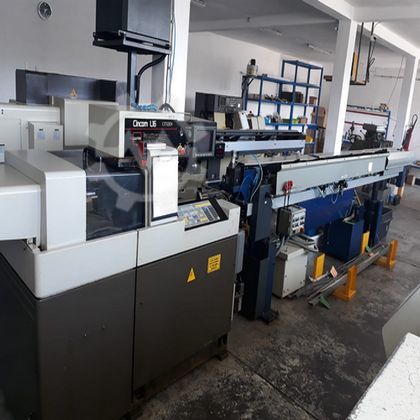
What Should I Pay Attention To When Buying a Second-Hand / used Citizen L16?
If you’re considering buying a second-hand Citizen L16 CNC Swiss / sliding-head lathe, it’s a very capable and compact machine—but because it’s high-precision, there are many checks you should do so you don’t end up with expensive surprises. Below is a breakdown of what to know, what to inspect/test, questions to ask, and red flags to watch out for.
What is a Citizen L16 — Baseline Specs & What to Expect
To evaluate condition properly, you should know what the L16 should be able to do. Some typical specs and features of the Citizen/“Cincom” L16:
| Spec | Typical / Published Value |
|---|---|
| Max machining diameter | ~ 16 mm (≈ 0.63-0.79 in) |
| Max machining length | ~ 125 mm in shorter version; some used machines are listed with ~ 200 mm depending on bar feeder or setup. |
| Number of tools | ~ 8 (original gang + opposed tool post) in older models |
| Spindle speed (main) | ~ 8,000 rpm in original versions; upgraded machines often list up to ~ 10,000 rpm. |
| Motor power (spindle) | Smaller power (~2.2-3.7 kW) in older “light” model; later versions more depending on upgrades and live tools. |
| Features often included | Back spindle, live tooling, gang tooling, bar feeder, C-axis, sub-spindle, coolant, etc., depending on the variant. |
So when assessing a used L16, you want to see whether it matches or is close to these specs. Any deviation (especially large degradation of spindle speed or diameter) must be justified or compensated in price.
What to Insist on Inspecting / Testing
Here are the major components & areas you should check in person (if possible) or via detailed video / documentation.
| Area | What to Inspect / Test | Why It’s Important / What Can Fail |
|---|---|---|
| Spindle, Bearings & Run-Out | • Spin the main spindle at multiple speeds: low, mid, high. Listen for bearing noise, vibration, overheating. • Check spindle run-out (radial & axial) using test bar. • Inspect the nose taper, clamping surfaces: any damage, wear, pitting. • If there is a back spindle, also test it similarly. • Check spindle motor amperage under load to see if it draws excessive current. | Worn spindle bearings or damage to spindle taper dramatically affect surface finish, precision, tool life. A noisy or hot spindle is a red flag. Back spindle wear can affect the ability to do opposed front/back work. |
| Guide Bush / Bush Housing | • Inspect guide bush or guide bush holder: wear, scoring, looseness, whether the guide bush holds work tightly without play. • Check bush alignment and how well the sleeve and bar slide; measure any run-out of the part through the guide bush. • If guide bush is replaceable or has sleeves, check condition of those. | The guide bush is critical in Swiss machines: any looseness causes deflection, chatter, poor surface finish. If worn, replacements (sleeves) are consumable; cost matters. |
| Tooling (Gang Tools, Opposed Tools, Live Tools) | • Inspect tool holders: wear, condition of cutting tips, whether tools are properly seated. • If live tooling (rotary tools / milling / drilling from gang / sub-spindle), check speed, spindle bearings, cooling. • Check indexing / C-axis on spindle if applicable; check accuracy, repeatability of C-axis / spindle index functions. • Check tool post movement: smoothness, backlash, rigidity. | Poor tooling or worn tool holders cause poor finishes / inaccurate features. C-axis or spindle indexing issues degrade machining of flats, milling, drilling etc. |
| Control & Electronics | • What control is installed (Mitsubishi, Citizen, other)? Age, firmware, support. • Inspect the display, servo drives, spindle drives, cables, connectors: signs of heat, damage, corrosion. • Check error / alarm history. • Verify custom macros / parameters: Swiss machines often have macros for cutoff, retract, etc.; errors in macros may cause risky behavior. For example, spindle index errors are reported in L16 machines. | Old or damaged controllers / drives may be difficult or expensive to maintain. Some issues, like intermittent spindle index errors, encoder wear etc, may not show up until you run certain cycles. |
| Bar Feeding / Back Spindle & Chuck | • Check the bar feeder (if included): whether feeding is smooth, guide rails for bar feed, whether catches are accurate. • Back spindle: test chucking, alignment, run-out. • Condition of jaws, chucks, backup tooling. • Test simultaneous front/back operations (if used). | If bar feed or back spindle isn’t accurate, throughput suffers; parts may be rejected due to dimension mismatch between front & back. Wear in chucks reduces gripping and may result in vibration or slippage. |
| Coolant / Lubrication / Chip / Cleanliness | • Inspect coolant system: cleanliness, pump condition, filters, whether coolant reaches appropriate tools. • Lubrication of moving parts: guide bush, slides, ways, tool post, etc. • Cleanliness: chips removal, presence of chips in way covers, cleanliness of interior. • Any signs of coolant leaks, rust, corrosion. | Poor coolant or lubrication increases wear; chips inside enclosures or ways damage surfaces. Rust or improperly maintained coolant may damage internal components. |
| Motion / Axis / Feed Accuracy & Backlash | • Move all axes (X, Z, Y if present) over full travel & test for smoothness, vibration, binding. • Measure backlash / reversal error / hysteresis in slides, tool posts. • Test positional repeatability: e.g. do identical cuts or retract and approach same position; measure deviation. • Check whether feed rates are stable at different settings. | Wear in slides or screws causes positional error, poor repeatability, and poor surface finishes. Feed rate instability causes variation in cut quality. |
| Spindle Thru-Hole / Diameter & Machining Capacity | • Measure the maximum diameter you need; ensure the machine’s spec for max bar diameter / part diameter is met. • For holes through part (if using thru-spindle) ensure through-hole diameter is clean & not worn or restricted. • Confirm that the machine can reach machining length you need. | If parts are near size limit, small wear reduces usable capacities. Restrictions in through-spindle bore limits part selection. |
| Maintenance / Usage History | • How many hours on the machine (power-on, cutting, idle etc.). • What materials were machined most often (harder materials cause more wear). • Whether spindle bearings, guide bush sleeves, slides have been refurbished or replaced; frequency of maintenance. • Whether machine has had collisions, overtravel, or misuse. • Whether spare parts & tooling have been maintained / replaced. | Knowing history lets you estimate remaining useful life. Machines heavily used but poorly maintained may cost more long term. |
| Safety Features & Guards | • Are guards, covers, splash shields intact. • Are interlocks, emergency stop, safety doors functioning. • Are covers for tool post, slides, way covers, bar feed installed & in good shape. • Electrical safety: wiring, protective covers, correct grounding. | Safety matters for operator protection, legal compliance. Missing guards often accompany other neglect. Improper electrical condition is dangerous. |
| Test Cuts & Demonstration | • If possible, run the machine and make parts: turning, drilling, live tooling / milling if used. Check surface finish, tolerance, concentricity, etc. • Use bar stock (the toughest you will run) and test feed & speed under load. • Test spindle indexing (flats or spots if used) to ensure indexing works reliably. • Check parts made on back spindle align well with front spindle parts. • Warm-up test: let the machine run for a while and see if accuracy drifts. | Real proof. A part made under real conditions tells you more about how the machine will behave in your shop than spec sheets. Warm up drift often reveals mechanical or control issues. |
Questions to Ask the Seller Up Front
These help you avoid surprises and estimate repair / operating cost.
- What is the exact variant / year of the L16 (e.g. Model V, guide bush version, any upgrades)?
- How many hours has it run (on spindle / live tools / back spindle) vs idle?
- What materials have been machined (aluminum / steel / high tensile / abrasive etc.)?
- Has the spindle or bearings ever been replaced or serviced? When?
- Condition of guide bush sleeves; whether they have been replaced; how much wear remains (measured if possible).
- Are all tools & live tooling included; what condition are they in; any missing or broken tools?
- Control and drive electronics: which control system, version, any recent failures; are spare parts / drive modules available.
- Bar feeder and back spindle included? Their condition (alignment, grip, run-out).
- Any past problems: e.g. intermittent errors (like “spindle index” errors), hard overtravel issues, etc. Are there error logs / maintenance records. (From forum sources, spindle index issues & encoder wear have been noted on L16s.)
- Can I see the machine running; make some sample parts under load; test accuracy, surface finish, etc.?
Common Weaknesses / Red Flags Specific to L16
From machine-tool forums and user reports, some issues that tend to occur in used L16s:
- Spindle index / encoder problems: Some machines report intermittent spindle index errors; these often point to encoder wear or spindle drive issues.
- Hard overtravel (OT) switches/problems: Overtravel or limit switches can get stuck or misadjusted, leading to errors that are hard to clear.
- Guide bush wear: Swiss machines use guide bushes which wear; worn bushes lead to poor surface finish, chatter, loss of precision.
- Control macro or parameter corruption: Hidden or custom macros (for cutoff, bar feeding, tool paths) may have been altered / corrupted. This can cause unexpected behavior or loss of performance.
- Wear on slides / tooling post / live tooling: Because the L16 is a compact, precision machine, even small wear can degrade performance significantly.
- Coolant / chip management: If chip and coolant are not well managed, chips may accumulate, coolant degrade, rust or corrosion can appear.
Red Flags / Deal-Breakers
If you find any of these, either negotiate heavily or avoid the machine unless price reflects the costs:
- Spindle is noisy, excessive vibration, or heat even under light load.
- Excessive spindle run-out or damaged taper / nose.
- Guide bush has large play or visibly worn; parts slip or deflect.
- Encoder / spindle indexing problems with no recent solved fixes.
- Live tooling failures, especially spindle bearings in live tools.
- Control issues that are intermittent, not documented, or unresolved.
- Parts or tooling missing (especially guide bush sleeves, back spindle chuck, tooling for live tools etc.).
- Worn or damaged slides / tool post causing binding, large backlash.
- Rust, corrosion in critical areas (such as guide bush housing, spindle bore, tooling interfaces).
- Safety / electrical issues: exposed wiring, broken guards, inoperative emergency stops.