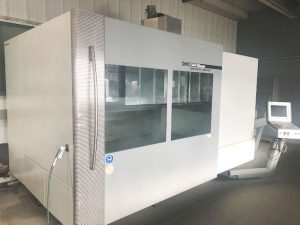
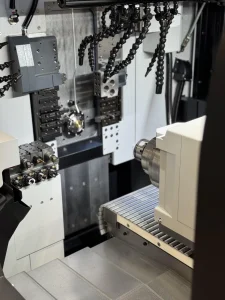
What Should I Pay Attention To When Buying a Second-Hand, Pre-Owned, Surplus, Used JOBS JOBMACH21 CNC Vertical Machining Center Double Column 5 Axes made in Italy?
If you are considering buying a used JOBS JOBMACH21 CNC vertical machining center, double-column, 5-axis (Italy), that’s a high-end, sophisticated piece of equipment. The upside is great capability; the risk is equally high if there are unseen flaws. Below is a detailed “due diligence” checklist and guidance to help you avoid surprises.
1. Understand the expected / nominal parameters first
Before inspection, obtain or ask for the original factory spec sheet (or at least the seller’s claimed specs). You’ll want benchmarks so you can tell if the machine is stressed, modified, or underperforming. Some things to clarify:
- Travel (X, Y, Z) — what are the original axis strokes?
- Worktable / work envelope size, weight capacity
- Type & speed of main spindle, power, torque, taper form
- Toolchanger type, number of tools, index time
- Configuration of the 5 axes (which axes move, rotary trunnions etc.)
- Drive / feed system types (ball screws, linear motors, servo motors, etc.)
- Control system / CNC brand & model, firmware version
- Any auxiliary / optional features (probing, coolant, chip handling, automatic head changers)
- Rigging / weight / dimensions (for shipping)
- Service history or past refurbishments
Having these as a reference will help you detect mismatches or worn performance.
2. Structural, frame & double-column integrity
A double-column (or portal) 5-axis VMC is a heavy, rigid structure. Any misalignment or deformation can degrade performance severely.
- Frame & base
– Check for cracks, weld repairs, signs of stress, distortions, or misalignment in the base.
– Inspect the joining surfaces, mounting points, and how well the columns are seated. - Columns, crossbeam / gantry structure
– Look for bending, twist, weld patches, or signs of past collisions.
– Verify parallelism and coplanarity between columns (use precision measuring, laser alignment, or straightedges).
– Check that crossbeams, gantry bridges, or the overhead structure has not sagged or been modified. - Bearing housings / support interfaces
– Where the axes ride (linear guides, slides) check for misalignment, padding or shims that may have been added.
– Check bolting, anchor shifts, or foundation movements.
3. Linear axes, guideways & motion subsystems
These are key areas of wear. In a 5-axis machine, precise motion control is critical.
- Linear guides / square rails / ways
– Move each axis (X, Y, Z, and the rotary/trunnion axes) and feel for smoothness, binding, steps, or hesitation.
– Use dial gauges or laser interferometer to check straightness, deviation, and non-linearity over travel.
– Inspect guide surfaces for scoring, corrosion, embedded chips, or pitting. - Ball screws / feed screws / nut assemblies
– Check for backlash, play, binding, or roughness in each axis.
– Move the axis slowly and reverse direction to detect hysteresis.
– Visually inspect threads for wear, damage, pitting, or lubrication problems.
– Check coupling and alignment between motor & screw. - Axes synchronization (if applicable)
– In 5-axis systems, synchronized motion may be needed (e.g. Y + trunnion). Check that axes stay coordinated under motion, and that no axis lags or leads excessively.
4. Spindle, rotary axes, trunnion / 5-axis mechanics
Because this is 5-axis, the moving heads / rotary axes / trunnion axes / rotational modules are critical—and more failure modes exist than in standard 3-axis machines.
- Main spindle & bearings / runout
– Run the spindle at different speeds; listen for noise, vibration, hums, or abnormal sounds.
– Mount a test bar or precision collet and measure radial and axial runout.
– After running for a while, check temperature of spindle housing to detect bearing fatigue.
– Inspect spindle nose / taper for wear, rust, nicks, dents. - Rotary / trunnion axes / rotary tables
– Exercise the rotary / tilt axes through their full range. Check for smoothness, binding, backlash, resonance, or mechanical shocks.
– Measure indexing repeatability (i.e. rotate to a position, stop, go away, return) to see how sharply the axis returns.
– Test dynamic behavior under motion—vibration, torsional deflection, axis coupling effects.
– For tilting tables or heads, check gear or drive mechanism (worm gears, harmonic drives, direct drive, etc.). - Head / tool orientation mechanisms
– If the machine has an articulating head, check its pitch/roll mechanism, seals, bearings, wiring harnesses, and any motion limits.
– Test its return to zero / calibration behavior.
5. Drives, motors, electronics & control system
This is where many latent failures hide. A good mechanical machine can be ruined by bad drives or corrupted controls.
- Control / CNC system boot & diagnostics
– Power up, observe the boot sequence. Watch for missing modules, alarms, I/O errors, or unresponsive drives.
– Access diagnostics screens, I/O status, axis fault logs. - Servo drives / inverters / motor condition
– Inspect drive cabinets or enclosures for dust, burned connectors, damaged fan units, overheating signs.
– Monitor motor / drive temperature under operation; check cooling fan health.
– Listen for humming, buzzing, arcing in drive areas. - Encoder / feedback / sensors
– Inspect encoder cables, connections, shielding, routing.
– During motion, check for signal dropouts, faults, or feedback errors. - Parameter backup & software integrity
– Ask for backup of parameter sets, configuration files, calibration data. Ensure these can be loaded/restored.
– Check whether the software version is original or has been patched/modified; rogue modifications can degrade stability. - Axis referencing, homing, limit switches
– Test homing routines for all axes. Ensure limit switches, reference returns, and software limits work appropriately.
– Jog axes at slow and higher speeds; look for stutter, overshoot, or misbehavior near axis limits. - Safety / interlocks / emergency stops
– Test E-stop, door interlocks, guard motion disable functions, limit switch responses.
– Open guards (in a safe demo) and see whether motion stops or alarm triggers.
6. Calibration, accuracy & metrology testing
You need to confirm whether the machine can still meet precision tolerances.
- Geometric tests
– Use laser interferometers, ballbar tests, or precision instrumentation to check straightness, angular error, flatness over axes.
– For 5-axis, test volumetric accuracy (i.e. measure how much error occurs in the 3D space as a function of rotations).
– Test repeatability: move to a given 3D point, retract, and return to see how close it comes. - Axis coupling / cross-axis errors
– Test for interactions: move in one axis, see if others shift slightly, or if there is “axis creep.” - Thermal drift / stability test
– Run the machine for an extended period under moderate load. Re-check position accuracy, backlash, and any drift. - Under load / real part test
– Machine a test part (ideally one similar to your intended production parts) and inspect outputs—dimensional accuracy, surface finish, alignment of multi-face machining.
– Run multiple cycles and see whether errors accumulate or degrade.
7. Tooling, toolchanger, spindle interface & tooling system
A 5-axis machine is only as good as its tools and how well the tool system functions.
- Tool changer / magazine
– Cycle the tool changer many times; check for misindexing, delays, collisions, sensor failures.
– Inspect the magazine carousel, slides, locks, motors, sensors, rails for wear or play.
– Observe tool change times and whether the system is smooth. - Tool holder / taper interfaces
– Inspect shanks, taper faces, retention systems (pull studs, collets, clamps) for wear, misalignment, or damaging marks.
– Mount test holders and check runout and tool-to-tool repeatability. - Tool reach / clearance / interference checks
– Simulate tool paths in extremes to ensure tools do not collide with the column, spindle, or machine body. - Tool cooling / through-spindle or side coolant
– If the machine supports through-spindle coolant or external tool cooling, test the system (pressure, leaks, blockage).
8. Maintenance history, usage, and wear records
Understanding how the machine has been used over its life is crucial.
- Ask for years of operation, actual runtime hours, or cycle counts (if recorded).
- Ask about duty profile: light finishing vs heavy roughing, continuous 24/7 vs intermittent job shop use.
- Request maintenance logs: records of parts replaced (bearings, screws, motors, drives), major repairs, alignment recalibrations, upgrades.
- Inquire about any collisions, crashes, overloads, or misuse events and how they were remedied.
- Ask about the environment: whether the machine operated in a clean, climate-controlled shop or in a harsh environment (dust, humidity, cutting fluids, corrosion).
- Examine for signs of neglect: missing covers, failed protections, accumulation of debris, evidence of floods or coolant contamination.
9. Spare parts, support & ecosystem
One of the biggest risks is maintaining the machine over time.
- Investigate whether spare parts are available for the JOBMACH21 model (or whether similar parts from other JOBS machines are compatible).
- Check whether there is local service / technician support in your country or region for JOBS machines (Italy).
- Ask for documentation: electrical diagrams, mechanical drawings, parts lists, program backup, calibration records, control manuals.
- Find out whether the manufacturer (JOBS) still supports that model line, or if aftermarket / third-party support exists.
- Ask if the seller can provide any spare components (drives, motors, cables, tool holders) along with the machine.
10. Shop readiness, infrastructure & facility compatibility
Even a perfect machine is useless if your workshop can’t support it.
- Ensure your shop’s power (voltage, phase, current capacity) matches the machine’s requirements.
- Confirm grounding, power stability, and electrical noise control (5-axis machines are sensitive to electrical disturbance).
- Check floor strength, rigidity, foundation flatness, anchoring, and whether the machine requires special base or isolation.
- Ensure overhead crane / rigging capacity to deliver, install, and maintain the machine.
- Adequate space and clearance for access, tool change, maintenance, and full motion envelopes.
- Cooling / ventilation in the control cabinet and the shop floor, to dissipate heat from drive electronics and motors.
- Chip / coolant management infrastructure (filtration, drainage, coolant supply, chip conveyors).
- Safety compliance: guarding, interlocks, emergency stops, enclosures as required by local law.
11. Pricing, negotiation & risk mitigation
Use your inspection and test results to negotiate or walk away.
- Estimate repair costs (bearings, drives, axes rework, control module replacement, calibration) and subtract from asking price.
- Require a test-acceptance clause: that the machine must perform a set of agreed tests (on parts) once installed.
- Demand inclusion of any spare parts, tools, backup modules, or wiring spares the seller may have.
- Bring a 5-axis / machine-tool metrology expert with you for inspection and testing.
- Insist on documentation (as detailed above) as part of the sale.
- Factor in shipping, rigging, alignment, calibration, and reinstallation costs into the overall purchase cost.
- If possible, split payments tied to performance milestones or capability verification.
- Ask about references or prior buyers of the same model to gauge reliability, known faults, or quirks.
12. “Red-flag” issues to watch for (deal-killers)
If you find many of the following, the risk might simply be too high unless the machine is extremely cheap, or you plan a full rebuild:
- Structural damage: cracks, bends, weld repairs in columns, beams, base, gantry
- Severe wear, scoring, pitting, or damage on linear guideways that would require regrinding or replacement
- Excessive backlash or play in linear or rotary axes
- Spindle runout or bearing noise / overheating problems
- Rotary / tilt axes that refuse to move smoothly, binding, excessive backlash, index failure
- Drives or electronics with constant faults, intermittent issues, burned modules, or missing modules
- Corrupt or missing control parameter backups, corrupted firmware or software
- Inability to run test programs, or the seller refusing full test runs
- No documentation, no spare parts, no support network
- Environmental damage (rust, corrosion in internal cavities, water intrusion)
- Mismatch between stated capabilities and actual motion or performance
- Safety systems that don’t work or are disabled
- Machine sitting idle for a long time without preservation (i.e. “dead stock”) which can lead to deterioration