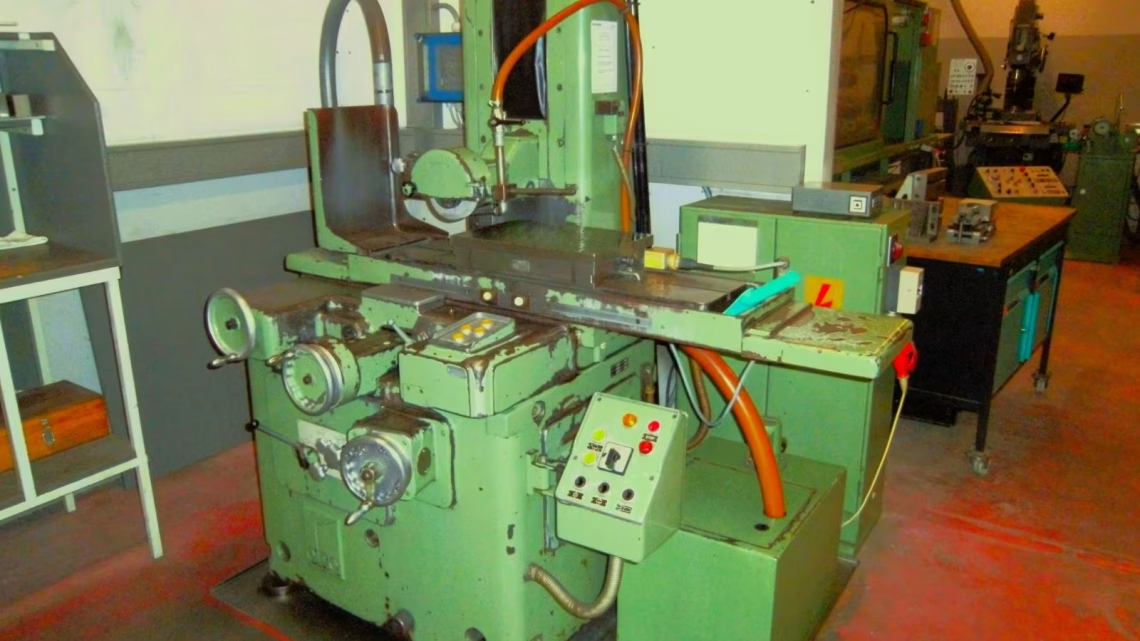
What Should I Pay Attention To When Buying a Second-Hand, Pre-Owned, Surplus, Used ABA FF 600/30 Surface Grinding Machine made in Germany?
When evaluating a used ABA FF 600/30 (or similar ABA / “FF” horizontal surface grinder) for purchase, there are many details—some subtle, some obvious—you should inspect. Below is a thorough checklist of what to pay attention to, what tests to run, and which defects are “deal-killers.” Use this during your on-site inspection (or in asking the seller for photos, videos, and test runs).
0. Know the baseline / expected specifications
Before visiting, gather or verify the original spec sheet so you can compare what the machine “should” do vs. its current condition. Some published specs for the ABA FF 600/30 are:
- Grinding length (travel in X): ~ 600 mm
- Table travel in cross (Y) direction: ~ 280 mm (or cross movement ~ 280 mm)
- Table speed: 2 – 30 m/min (variable)
- Grinding wheel size: 300 × 30 × 51 mm
- Workpiece height / clearance: ~ 560 mm
- Spindle motor power: ~ 3 kW (grinding motor) with total power ~ 5.83 kW
- Machine weight: ≈ 1.75 tonnes
- Table size: ~ 1,020 × 250 mm
These give you benchmarks: if the machine no longer comes close in performance or if the seller’s claims deviate significantly, that’s a warning sign.
1. Structural & visual condition
Start with a broad visual inspection to detect neglect, abuse, or hidden damage.
- Bed, table, and surfaces
– Examine the table surface for wear, pitting, corrosion, grooves, nicks, or evidence of rework.
– Check the T-slots (if any) for deformation, chipping, or wear.
– Check the underside of the table and support structure for cracks, fractures, or repairs. - Guideways, slides, and cross-slide
– Look for wear, scoring, galling, embedded chips, rust, or corrosion on guideways.
– Manually or via the machine, move table in both axes; feel for binding, steps, or “stick-slip” transitions.
– Over the full travel, check for “bumps” or inconsistencies in movement. - Spindle housing / structure
– Inspect the spindle head for alignment, signs of past disassembly, cracks or weld repairs.
– Check for looseness or deflection in the spindle housing. - Enclosure, guards, covers
– Are all panels, covers, splash guards, chip shields intact and properly mounted?
– Missing or ill-fitting guards allow chips, coolant, and debris to damage interior mechanics. - Coolant tank, piping, hoses, plumbing
– Check for leaks, corrosion, degraded hoses, loose fittings.
– Inspect the tank’s interior: sludge, chips, rust, foreign matter. - Wiring, cables, control enclosure
– Inside the control cabinet: look for dust accumulation, burnt wiring, discoloration, odd repairs.
– Ensure wires are properly routed, strain-relieved, insulated. - Modifications, non-OEM parts, retrofits
– Note any aftermarket additions, extra sensors, “custom” mounts or nonstandard parts. These can complicate service or spares.
2. Motion drives, mechanics & precision elements
This is where most hidden wear shows up, and it directly affects grinding accuracy.
- Driving screws, nuts, feed mechanisms
– Check for backlash, play, bind, or sloppy motion in longitudinal and cross axis feeds.
– Listen/feel for roughness during feed movement.
– Inspect the feed screw threads for wear, broken or chipped threads, pitting. - Cross-feed and longitudinal feed mechanisms
– Under slow feed, see if motion is smooth and constant.
– Under faster feed, watch for stuttering, overshoot, or lag. - Table drive / traverse system
– Operate the table traverse across full travel. Note uniformity, jerks, or irregular motion.
– Check for backlash or lost motion when direction is reversed. - Spindle & bearings / runout
– Run the grinding spindle at various speeds; listen for abnormal noise, grinding sounds, or vibration.
– Mount a test bar, dial indicator, or precision tool in the spindle and measure runout (radially and axially).
– Check for heating of spindle housing after some time; elevated temperature hints at bearing wear.
– Inspect the spindle nose and bore for wear, corrosion, marks or damage. - Wheel mounting, balance, and condition
– Check the wheel mounting flange, bore, keyways, balancing ring, etc.
– Look for wear on the wheel arbor, misalignment, or looseness. - Wheel dresser system
– If the machine has an automatic or manual wheel dresser, test its operation: movement, wear, alignment, repeatability.
– Inspect the dresser spindle, guideways, actuators. - Vertical feed / downfeed (if applicable)
– Many surface grinders have a vertical infeed for the grinding head—test that feed, check for backlash, gibs, smoothness. - Limits, homing, end stops
– Test limit switches, home sensors, travel boundaries; see how the machine behaves near ends of movement.
3. Controls, electronics, and instrumentation
Even with good mechanics, a bad control or sensor system can kill usability.
- Power-up, diagnostics, error logs
– Turn on the machine, look for error messages, missing modules, warning lights.
– Check diagnostic or system status screens. - Control panel, buttons, displays, hand wheels
– Are buttons intact? Does the display respond properly? Are hand wheels or manual controls in good condition?
– If there are operator interface modules (pendants, manual controllers), test their functions. - Servo or motor drives / inverters / controllers
– Inspect drive modules: cooling fans, heatsinks, connectors, wiring, for signs of overheating or damage.
– Check for module faults or warnings. - Sensors, encoders, position feedback
– Inspect any linear scales or encoders (if fitted) for cleanliness, alignment, wiring.
– Test for feedback errors or loss during axis motion. - Parameter integrity & backing-up
– Ask if the machine’s parameters (scaling, feed tables, offsets) have been backed up and can be restored.
– Verify that data is intact and not corrupted. - Manual / automatic cycles
– If the grinder has semi-automatic or automatic modes (e.g. auto-feed cycles), test those sequences.
– Check whether limit or interlock features disable motion properly. - Safety / interlocks / emergency stops
– Test all emergency stops, safety doors, guards, interlocks.
– Open covers and validate that motion is disabled or an alarm is given.
4. Grinding performance tests & part trials
To really know the condition, see it in operation and measure what it produces.
- Trial grinding test
– Bring a flat test piece (steel, or material you intend to grind).
– Run a grinding pass and inspect the surface finish, flatness, accuracy, consistency.
– Make repeated passes and see whether results drift or degrade. - Measure for flatness, parallelism, and error across length
– Use precision measurement tools (granite laps, straightedges, gauges, dial indicators) before and after grinding.
– Check whether there are “marks” or “bands” or uneven grinding over the length. - Repeatability
– Grind at a certain setting, return to zero, repeat—check if results are consistent. - Extended operation / heating test
– Run the machine continuously for some time and see whether performance shifts (drift, backlash, heating, vibration). - Vary speeds / feed rates
– Try slower and faster feeds, and varying wheel speed (if adjustable) to see behavior across the machine’s envelope. - Wheel dresser performance under load
– Dress the wheel and re-test; check whether dressing is accurate, stable, and repeatable.
5. Maintenance, history, and wear documentation
Understanding how hard the machine has been used and how well it’s been maintained is crucial.
- Ask for year of manufacture / build date (some listings show “1970” for an ABA FF 600/30)
- Ask for running hours / hours of grinding, or number of cycles.
- Request maintenance logs:
– Have bearings, guides, screws, or drives been replaced or serviced?
– Any crash events, overloads, repairs, structural fixes?
– Lubrication, coolant system maintenance, cleaning schedules. - Environmental conditions: Was it in a clean, temperature-controlled shop, or exposed to dust, humidity, chemicals, or neglect?
- Upgrades / retrofits: any modernization (e.g. DRO, motor upgrades, electronic replacements) and whether documentation / parts for those upgrades exist.
6. Spare parts, tooling, consumables & support
A used machine’s value depends heavily on your ability to maintain it going forward.
- Availability of parts
– Can you source spindle bearings, slides, screws, motor drives, belts, gibs, replacement parts for the control?
– Are there ABA (or successor) parts suppliers, or third-party equivalents? - Grinding wheels, abrasives, dressing tools
– Does the seller provide spare wheels, wheel flanges, balancing rings, dressing tools?
– Are consumables still standard / available or obsolete sizes? - Support / local service
– Are there technicians in your area familiar with ABA machines, surface grinders, or the specific model?
– Can the manufacturer or parts remanufacturers provide support or rebuilds? - Documentation / manuals / schematics
– Insist on getting operator manuals, wiring diagrams, spare parts lists, alignment and calibration guides.
– Backup copies of parameters or settings (if the control allows). - Redundancy / backup modules
– If possible, get backup control cards, drive modules, spare encoders, or at least parts that tend to wear or fail.
7. Facility, infrastructure, and compatibility
Even a perfect machine is useless if your shop isn’t ready for it.
- Electrical supply
– Ensure compatibility with voltage, phase, current, and frequency at your site (e.g. 380 V three-phase is common in ABA specs)
– Power quality: stable supply, grounding, noise suppression (important for precision control). - Foundation & floor rigidity
– The floor must be flat and rigid; any flex under load can degrade accuracy. - Space & clearance
– Enough room for access, operation, wheel changes, maintenance, loading/unloading workpieces. - Ventilation / cooling
– Electric motors, controls, and drives may generate heat—ensure good ventilation or cooling in the control cabinet and room. - Coolant system / drain / filtration
– You need a clean coolant supply, plumbing, filtration, drainage, and possibly coolant chiller or recirculation. - Safety & guarding
– Guards, interlocks, emergency stops, covers—all must be safe and compliant with local regulations.
8. Pricing, negotiation & risk mitigation
Use your inspection findings to guide negotiation and reduce risk.
- Estimate the cost of repairs or refurbishment (e.g. bearings, guides, spindle overhaul, control parts) and deduct from the asking price.
- Insist on a test / acceptance period: the purchase should be conditional upon performance of your own test parts after relocation.
- Ask for inclusion of as many spare parts, wheels, flanges, tools, and documentation as the seller can provide.
- Bring along a grinder or machine tool expert who knows surface grinding machines to help inspect.
- Include transport, setup, leveling, calibration, alignment costs in your total acquisition budget.
- Check for warranties or limited guarantees for parts or major components.
- If possible, phase payments related to performance (e.g. pay more once it achieves agreed tolerances).
9. Key “deal-killers” / red flags
While minor issues may be acceptable if priced right, some defects drastically reduce value or may make the machine unusable. Watch especially for:
- Severely worn, scored, or damaged guideways or slide surfaces
- Excessive backlash / play in feed screws, drive mechanisms
- High spindle runout or bearing noise / heat problems
- Loose or damaged spindle nose / arbor interfaces
- Broken, missing, or nonfunctional wheel dressing system
- Broken or missing guards, safety interlocks, or malfunctioning limit switches
- Control / drive electronics with unknown faults, missing modules, or irrecoverable errors
- Missing or heavily damaged documentation, wiring diagrams, or spare parts lists
- No access or long lead times to critical spares (especially spindle bearings, drive modules)
- Structural damage, cracks, or repairs to the bed, column, or frame
- The seller refusing to allow you to run test parts or extended trial
- Environmental damage (rust, corrosion, water damage) beyond superficial
- Mismatches between stated specs and real performance (e.g. stated 600 mm X-travel but actual motion is considerably less or uneven)