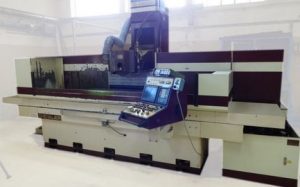
What Should I Pay Attention To When Buying a Second-Hand, Pre-Owned, Surplus, Used Dörries Scharmann VC 5000 Lathe CNC Vertical Double Column Turning Diameter 5000mm made in Germany ?
A Dörries / Scharmann VC 5000 (or similar “CONTUMAT VC / VC-series double-column vertical turning / vertical lathe”) is a very large, heavy, precision machine. Buying one used carries significant risk—but the rewards (for large-part machining) can be high. Below is a detailed, large-machine–aware checklist (plus model-specific cautions) of what you should inspect, test, and negotiate before buying.
What the VC 5000 series is (for benchmarking)
To inspect properly, you need to know the “expected” design features so you can spot deviations or wear. Some published details for the Dörries CONTUMAT VC 5000 (or VC / double-column vertical turning lathe in the same class) are:
- The VC series is double-column “portal” style vertical turning lathe (VTL / vertical lathe) machine, for large swing diameters (3,500 to 12,000 mm).
- The VC 5000 has a swing diameter of 5,000 mm (i.e. the maximum diameter the tool can swing).
- Table / faceplate diameters around 4,000–4,500 mm are used in such models.
- Ram (vertical tool head) sections are substantial; often hydrostatic or stiff guide systems, with Z-stroke options of 1,500 to 3,500 mm depending on configuration.
- Main drive: often dual motors (master/slave) in large configurations (e.g. 2 × 60 kW up to 2 × 150 kW, depending on load).
- The machine is built from heavy cast iron, with emphasis on stiffness, thermal stability, damping, and portal design to resist bending / torsion under heavy loads.
- Optional head attachments (milling, boring, angular heads) are sometimes provided, converting the lathe into a turn-mill center.
- The machine can handle very large workpiece weights (many tons).
Because such a machine is huge, errors or wear in guides, columns, drive systems, or alignment scale up into big costs. Always test under load.
With that in mind, here’s what to pay attention to.
Checklist: What to Inspect & Test (On-site / in person)
Below is a structured checklist grouped by subsystem. Use this during in-person inspection (or ask the seller to provide photos, video, data). Wherever possible, test under load or simulate load.
| Subsystem / Feature | What to Inspect / Test | Why It Matters / Red Flags |
|---|---|---|
| Foundation, base & frame | • Check base and floor mounting: is the machine securely anchored, level, not twisted? • Inspect base structure, ties between columns, braces, weld repairs, cracks, distortions. • Examine column feet, junctions, connections for residual stresses or damage. • Check for sagging, misalignment across the portal. | Any structural warping or cracks will degrade accuracy massively. Repairs in large machines are very costly. |
| Columns, crossbeam / portal structure | • Check for cracks, weld repairs, distortions, past collisions. • Look for evidence of straightening, added shims, or misfits. • Use straightedges / feeler gauges / laser to check column parallelism and flatness across the portal. | The portal must be rigid and true; any twist or misalignment kills concentricity and precision. |
| Guideways / slide surfaces / carriage rails | • For vertical (ram) guides and any cross-rails, check wear, scoring, corrosion, pitting. • Move the tool head / ram (if manually or via control) and feel for smoothness, binding, steps, “stick / slip” zones. • Use dial indicators over full stroke to detect non-linearities, “bumps,” or misalignment. | Wear in guides degrades positioning precision, causes chatter, leads to more rapid deterioration. |
| Ram / tool head / Z-axis | • Check full Z travel (ram stroke) for smoothness, binding, binding at extremes. • Inspect the ram head (tool housing) for damage, wear, stability, runout. • Test movement at various speeds; look for vibration, resonance, jerks. | The ram must hold stiffly under load. Any looseness or binding is a serious issue. |
| Tooling / head attachments | • If the machine has milling/boring/spindle heads attached, test their power, runout, vibration. • Check angular heads, swivels, linkages, and tool holder interfaces (taper, clamping) for wear or damage. • Cycle attachments (if automatic change) to test reliability, repeatability. | In many large vertical lathes, the tool head is the “active” part; its integrity is vital for precision turning, drilling, milling. |
| Main drive / table / faceplate / rotary axis | • Run the table / faceplate (rotary axis) at low, medium, and high speeds. Listen for noise, vibration, oscillation. • Test under load (if possible) with a heavy piece < 80–90% of expected capacity. • Measure runout of the faceplate / table with a test bar or dial indicator. • Test angular accuracy (C-axis, if present) and dynamic stability. | If the table drive, bearings, or design are compromised, any work will be out of tolerance. Repairing large rotary tables is extremely expensive. |
| Drive motors, gearboxes, mechanical transmissions | • Inspect motors: condition, noise, cooling, vibration, alignment. • Inspect gearboxes, couplings, belts (if any), transmissions; check for backlash, wear, crackling. • Listen under motion for clutch slippage, grinding, noise anomalies. | Mechanical drive components are wear points; their failure in large machines is a major cost. |
| Hydrostatic / bearing systems | Many Dörries VC designs use hydrostatic guide systems (in linear axes). | • Inspect oil/hydrostatic fluid systems: oil cleanliness, leakages, fluid level, pump conditions. • Check the health of hydrostatic support: whether bearing gaps are stable, whether the system holds pressure. |
| Control system, CNC, electronics | • Boot the control; note error/warning messages, missing modules, I/O faults. • Test axis referencing, homing, limit switches. • Run sample programs (turning, facing, contouring, cycles) to verify that interpolation, tool path, motion is correct. • Test drive / axis response, acceleration, deceleration, jerk behaviors. • Inspect control cabinets: wiring, fans, heat sinks, connectors, signs of overheating or burns. • Check parameter files, backups, firmware versions, ability to restore/backup parameters. | Large machines often have custom / complex motion paths, so the control must be trustworthy and intact. Rewiring or rebuilding control for such a machine is costly. |
| Alignment, calibration, metrology tests | • Use a laser tracker, spindle test bar, or large indicators to measure runout, radial/axial error, concentricity over full table diameter. • Test “centerline” offset across entire diameter (i.e. compare measurements near edge vs center). • After warming up, test repeatability: move away, return, measure deviations. • Under a known load, check if there is deflection, drift over time. | These tests reveal whether the machine can actually meet your tolerances under real operating conditions. |
| Wear, fatigue & material condition | • Look for stress cracks, fatigue marks, chip erosion, corrosion especially in interior passages, oil sumps, coolant zones, junctions. • Inspect surfaces not easily visible (cast interiors, structural cavities) if possible (non-destructive testing, dye-penetrant). • Check for prior repair or modifications (e.g. patches, plate additions, local welds). | Large machines often have hidden fatigue zones; past repairs may indicate prior failure or abuse. |
| Hydraulics / auxiliary systems (if present) | • If the machine uses hydraulics (e.g. for tool clamping, collet change, pallet clamping), inspect pumps, hoses, valves, leaks. • Test pressure under operation, leak behavior, response time. | Defective hydraulic systems can compromise clamping, stability, or safety. |
| Cooling / lubrication systems | • Inspect coolant systems: pumps, ducts, nozzles, filters, plumbing, leaks, contamination. • Lubrication: linear guide lubrication lines, table bearing lubrication, gear-box lubrication — ensure they are functional and clean. • Check oil cleanliness, filters, reservoirs. | In large machines, lubrication and coolant are critical to longevity and to prevent premature wear under heavy load. |
| Safety systems / interlocks / guards | • Check emergency stops, door guards, light curtains, safety covers. • Open a guard / door (if possible in a safe way) and see whether motion is inhibited. • Test limit switch behavior, alarms, fault response. | A machine of this size must have reliable safety systems. Lack thereof might be a dealbreaker for compliance or liability. |
| Service history, documentation & parts | • Get maintenance logs, repair history, parts replacement records (spindles, bearings, guides, motors). • Request all documentation: wiring / electric diagrams, mechanical drawings, parts catalogs, axis calibration records, control manuals, software version reports. • Ask about prior refurbishments or upgrades, and whether originals or decals have been preserved. | For such a massive machine, having proper documentation and knowing what was replaced or serviced is critical to future maintenance and for spares sourcing. |
| Parts, consumables & support ecosystem | • Verify availability of spare parts: drive modules, motors, gearboxes, guideway blocks, lubricating systems, electronics. • Check whether local (or regional) dealers or service houses support Dörries / Scharmann / CONTUMAT series. • Determine cost lead times, shipping costs for heavyweight parts. | The cost & lead time of spares for a large vertical lathe can be a major ongoing expense. Without parts support, downtime becomes very expensive. |
| Power / infrastructure / shop readiness | • Check electrical power: voltage, phase, current, power quality, ground, harmonics, power stability. • Foundation & floor: The floor must support the machine’s weight with minimal deflection. • Overhead clearance, crane / lifting capacity, removal & installation path. • Cooling, ventilation, dust control, chip removal infrastructure. | If your facility isn’t up to handling the scale of the machine, even a perfect machine might not perform well or may damage your shop. |
| Transportation, rigging & reinstallation | • Understand how the machine was previously installed, how it can be moved, dismantled, reassembled. • Check for missing lifting points, base shims, alignment fixtures. • Request as-is alignment data (if available) to guide reinstallation. | Moving or re-installing such a machine is itself a significant challenge and cost. Errors can lead to misalignment and damage. |
| Test under load / production test | • If possible, run a representative “real” part or dummy load (perhaps with a heavy steel block) near the machine’s working envelope. • Monitor for noises, vibration, temperature rise, drift, tool path deviations. • Run cycles repeatedly over minutes or hours to detect drift, thermal effects, backlash creep. • After running, re-measure critical dimensions to see if they drifted. | Seeing the machine under actual working load is the best “stress test” to reveal hidden problems. |
“Must-Have” Red Flags / Deal Breakers for a VC 5000
When inspecting, if you observe any of the following, they are serious red flags (and should heavily discount the offer or lead you to walk away unless the price is extremely low and you plan for major rebuilds):
- Major frame cracks, structural welding repairs, bent portal or column elements
- Significant wear or damage to guideways (ram, columns) that would require re-grinding or replacement
- Excessive backlash or play in the rotary table / faceplate
- Large runout or drift on the rotary axis under light test
- Large deviations in alignment or geometric measurements that cannot be remedied by adjustment
- Drive / motor failures, gearbox damage, slippage, loud noises or grinding in motion
- Hydrostatic system failure, fluid leaks, inability to maintain pressure or stability
- Control system faults, missing modules, corrupted parameters, inability to run basic test programs
- Missing or severely damaged documentation, wiring diagrams, schematics
- No viable spare parts source or long lead times on critical components
- Foundation or shop infrastructure incompatible with machine weight / size
- Safety system or interlock failures
- Evidence of “past crash / collision / overhaul” without full records
- Lack of usable test under load or refusal to let you run a full cycle test
Negotiation Factors & Risk Mitigation
Given how huge and expensive these machines are to repair or rework, use your inspection findings strategically:
- Estimate repair costs and subtract those from asking price (guideways, gears, drives, alignment, calibration).
- Insist on a test / acceptance period: the purchase should be conditional on performance of your own trial parts after relocation.
- Request inclusion of spare parts, tooling, backup modules: sometimes sellers have spare sets or consumables.
- Bring in a specialist: Ideally bring a large-machine vertical turning specialist or metrology expert.
- Check the seller’s references: prior buyers, reputation for machine condition, claims versus reality.
- Include rigging, transport & installation costs in your total acquisition budget. These may be comparable to the machine’s residual value.
- Warranty / liability clause: even used, insist on short-term liability for hidden defects (if possible).
- Check for prior refurb / remanufacture: machines that were overhauled by original manufacturer (or trusted shop) may be safer buys vs heavily used ones.
- Phased payment / acceptance: tie part of payment to performance metrics after installation.