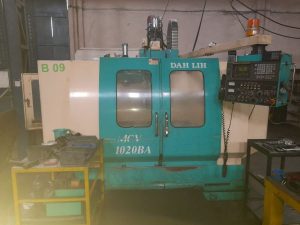
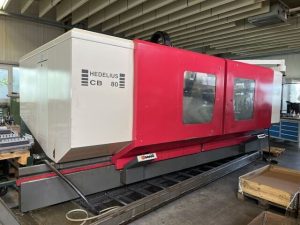
What Should I Pay Attention To When Buying a Second-Hand, Pre-Owned, Surplus, Used SURE FIRST CM-1065 CNC Vertical Machining Center made in Taiwan?
1. Know the nominal specs / expected capabilities
Before inspecting, find (or demand) the original spec sheet. That gives you benchmarks you can test against. From SURE FIRST’s product literature:
- Spindle speed: ~10,000 rpm
- Max tool diameter: 70 mm
- Max tool weight: 6 kg
- Max workpiece weight: ~800 kg
Knowing these helps you see if the used machine still performs close to spec or if components have been heavily degraded.
Also clarify:
- Axis travels (X, Y, Z)
- Table size and load capacity
- Spindle taper / nose standard (BT, ISO, etc.)
- Tool magazine type, number of tools, tool change time
- Control type (Fanuc, Siemens, Mits, or proprietary)
- Drive type (belt, direct, gearbox)
If the machine is far off from spec, that may imply heavy wear or modifications.
2. Visual & structural inspection
Check the “shell” and structural integrity first — many hidden problems manifest here.
- Frame, base, column & casting
– Look for cracks, weld repairs, distortions, signs of structural stress or damage.
– Corners, junctions, welds, gussets: check for creep or past repair patches. - Enclosures, guards, covers, splash panels
– Missing or damaged guard panels allow chips, coolant, and debris to accumulate internally.
– Check that doors, windows, cover panels operate smoothly, latch properly, are straight. - Bed / table surface
– Check for flatness, wear, pitting, scoring, corrosion or dents.
– Inspect T-slots for damage, burrs, or repair. - Guideway covers, wipers, bellows
– These protect the ways and screws from chips/coolant. Missing or torn covers are warning signs.
– Inspect bellows for cracks, tears, misalignment. - Corrosion, rust, oxidation
– Particularly inside enclosures, coolant sump, under chip pans, and along ways.
– Surface rust on precision surfaces (ways, screws) is a serious red flag. - Leaks / stains
– Oil, coolant, hydraulic fluid stains around pumps, reservoirs, piping.
– Check underside, around joints, near motors. - Wiring, cables, conduit, connectors
– Look for frayed wiring, spliced or nonstandard cables, missing conduit, poor strain relief, insulation damage.
– In control cabinet, check for dust accumulation, burnt marks, broken fans. - Modifications / non-OEM add-ons
– Aftermarket sensors, auxiliary cooling, extra monitors, custom mounts. Ask for documentation of such mods — they could be helpful or warnings.
3. Motion subsystems & precision elements
These are critical — wear or damage here can degrade accuracy or require expensive overhauls.
- Linear guideways / rails (X, Y, Z)
– Jog axes (if possible) and feel for smoothness, binding, or “stick zones.”
– Use a dial indicator (or test bar) to spot steps, uneven motion, or “staircase” behavior.
– Check for scoring, galling, chips embedded in the ways. - Ball screws / feed screws / nut assemblies
– Test for backlash or play (axial, radial) in each axis.
– Move axes through full travel and feel for noise, binding, or roughness.
– Check nut housings, lubrication lines, coupling conditions. - Spindle & bearings / runout
– Run spindle at various speeds; listen for abnormal whine, grinding, vibration, noise.
– Measure radial and axial runout using a test bar / dial indicator.
– After running several minutes, check spindle housing temperature: overheating suggests worn bearings or lubrication issues.
– Inspect spindle taper for wear, nicks, corrosion, damage. - Tool magazine / tool changer
– Cycle through tool changes repeatedly; watch for delays, mis-indexing, failures to grip or release, misalignments.
– Inspect mechanical parts: slides, cams, fingers, sensors, indexing mechanisms.
– Check the magazine for wear, dust, chip damage, sensor failures. - Cooling / lubrication / fluid systems
– Test coolant pump(s), flow, pressure, plumbing, hoses, nozzles, filters.
– Inspect coolant tank: sludge, metallic chips, contamination.
– Check lubrication (ways, screws, linear guides): Are lines intact, valves working?
– Inspect chip evacuation / chip conveyor / flushing systems. - Axis limit switches, homing & travel boundaries
– Test homing routines, limit triggers, software travel limits.
– Move to extremes of travel, see if backlash, binding or mechanical interference occurs.
4. Control & electronics checks
A sound mechanical system can fail if the control system, drives, or software is compromised.
- Power-up / boot diagnostics
– Watch the control boot sequence; note any errors, missing modules, alarms, cards that don’t respond.
– Access diagnostics / system status screens; check I/O status, alarm history. - Axis homing, referencing, limit behavior
– Test homing routines for each axis; check limit switch behavior.
– Jog axes at various speeds; observe for stutters, stalling, lag, or irregular movement. - Program execution / interpolation / canned cycles
– Run a simple program (linear moves, arcs, drilling, pocketing) to test interpolation, tool changes, feed control, IQ cycles.
– Check for feedrate override behavior, error corrections, tool offsets, coordinate transformations. - Servo drives, motors, encoders, feedback
– Inspect drive cabinet: fans, heatsinks, wiring, ventilation, dust.
– During operation, watch motor/drive temperature, listen for hums or odd electrical noise.
– Inspect encoder cables, shielding, connectors for damage.
– Test whether positional drift or encoder errors occur under motion. - Software / firmware / parameter integrity
– Ask for firmware / software version.
– Verify ability to back up and restore CNC parameters, tool tables, offsets.
– Check whether parameter tables (e.g. backlash compensation, gains) look reasonable (not blank or default).
– If possible, test parameter edits / save / reload behavior. - Safety systems / interlocks / limit switches
– Verify emergency stop, safety doors, interlocks, limit switch functions.
– Open guards (if safe) to see whether motion stops, or alarms are triggered.
5. Test machining & accuracy validation
You want to see the machine under real working conditions to judge its true capability.
- Test piece run
– Bring or request a job test representative of your intended work (size, material, tool load).
– Monitor for noise, vibration, chatter, deviations during tool changes, spindle behavior. - Measure the output
– On the test part, check dimensional accuracy, repeatability, flatness, perpendicularity, surface finish.
– Repeat the same move or cut multiple times and verify consistency. - Extended operation
– Let the machine run for 30–60 minutes. Watch for drift, thermal expansion, backlash change, heating of axes or guides.
– After the run, re-measure positions or parts to see if shifts occurred. - Edge / extreme testing
– Push the axes to near their extremes and monitor for mechanical strain, limitations, slowdowns, or stuttering. - Back-to-zero repeatability
– Move to a point, retract, return, and measure how closely the axis returns to the same point.
6. Usage history, maintenance, hours & reliability
The “story” behind the machine often reveals more than the machine itself.
- Operating hours / spindle hours / cycle counts
– Ask for actual logged numbers (if available). - Type of use
– Was it used in light duty (i.e. small parts, finishing) or heavy duty (deep cuts, high loads)?
– Were there high-speed operations vs conventional milling? - Maintenance and service records
– What bearings, screws, guides, motors have been replaced or serviced?
– Evidence of preventive maintenance or neglected upkeep?
– Any recorded crashes, overloads, repairs, retrofits? - Factory or shop environment
– Was it in a clean, climate-controlled shop, or dusty, humid, corrosive environment?
– How well was it kept: cleanliness, chip removal discipline, coolant management, guarding usage.
7. Spare parts, consumables & support ecosystem
A used machine is only as valuable as how maintainable it will be over its remaining life.
- Availability of spare parts
– For SURE FIRST CM series: spindle bearings, linear guides, ball screws, drive electronics, tool changer parts, seals, etc.
– Are there distributors or local importers in your country for SURE FIRST / Taiwanese machine tools? - Consumables / wear parts
– Tooling (collets, tool holders, end mills, inserts), coolant lines, seals, bearings, belts (if used), lubrication parts. - Technical / service support
– Are there technicians familiar with SURE FIRST machines locally or regionally?
– Ask whether Taiwan has support or parts catalogs still active for this model. - Documentation / manuals / drawings
– Ensure that mechanical, electrical, control, wiring, parts lists, schematics, maintenance manuals are included.
– Also ensure backup / parameter files, software, tool tables, calibration records.
8. Facility compatibility & infrastructure
Even a perfect used machine needs proper shop readiness.
- Power / electrical supply
– Voltage, phase (3-phase), current (amps). Ensure your facility can deliver stable, clean power.
– Servo systems are sensitive to voltage dips — ideally UPS or power conditioning may help. - Grounding, shielding, noise isolation
– Good grounding and shielding is important to avoid encoder noise or control instability. - Floor / foundation / leveling
– The machine needs a strong, flat, rigid floor. Leveling is critical to maintain accuracy. - Space / access / clearance
– Sufficient front, side, and rear clearance for maintenance, tool changes, loading workpieces.
– Overhead crane / lifting access for raising spindle head, changing parts. - Cooling / ventilation
– Servo drives, control cabinets, spindle motors can generate heat — adequate ventilation or climate control helps longevity. - Safety & compliance
– Guards, interlocks, emergency stops, enclosures, chip control that meet your local safety regulations.
9. Pricing, risk & negotiation strategy
Use your inspection results to guide negotiation.
- Estimate repair / refurbishment costs
– If screws or guides are worn, drives failing, spindle bearings weak — get quotes for replacement or reconditioning and subtract from asking price. - Insist on acceptance / testing clause
– The purchase should be subject to performance on your test parts. - Ask for included tooling / backup components
– Request that tooling, collets, backup drives/modules, or spare parts be included. - Bring an expert / technician
– If possible, take along someone experienced in machine tools or CNC repair to help assess. - Include transport / commissioning / calibration costs
– The cost to move, align, calibrate, and get the machine running will often be nontrivial. - Warranty / liability clause
– Even for a used machine, try to secure a short-term guarantee (e.g. 30–90 days) where you can reject it if major faults appear.
10. Red Flags & “Deal Killers” to Watch For
Here is a distilled “red flag” list — if many of these appear, the risk may be too high except at a very low price:
- Cracks, weld repairs, distortion in frame or column
- Severely worn, scored, or damaged guideways or ball screws
- Excessive backlash, slop, or binding in any axis
- Spindle bearing noise, high runout, taper wear, overheating
- Tool changer/magazine mis-indexing, jamming, repeated failures
- Servo drive modules with burn marks, bad fans, overheating
- Encoder errors, signal dropouts, intermittent faults
- Control parameter corruption, missing parameter backups, inability to save/restore
- Drift or degraded accuracy over extended operation
- Edge of travel errors / axis binding near extremes
- Missing or badly damaged documentation, schematics, manuals
- No local support, no spare parts availability, or unresponsive manufacturer
- High repair cost items unknown to seller (e.g. need full spindle rebuild, regrinding ways)