12/11/2025
What Should I Pay Attention To When Buying a Second-Hand, Pre-Owned, Surplus, Used Fanuc Robocut Alpfa α-1iC Wire EDM made in Japan?
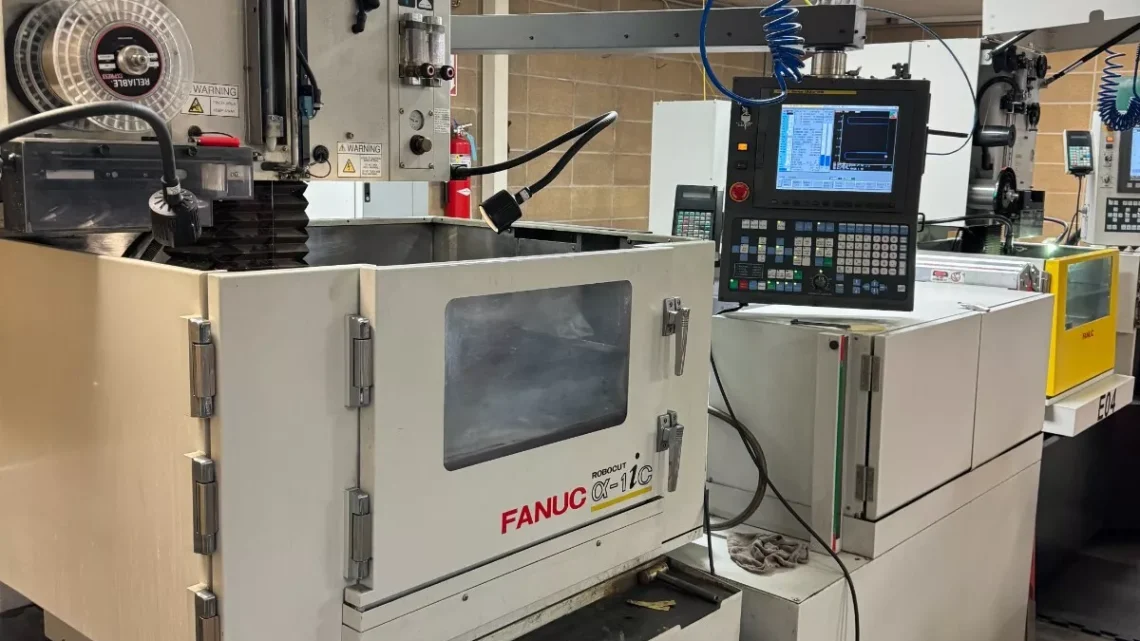
When considering buying a used FANUC ROBOCUT ALPHA‑1iC (wire EDM machine, made in Japan), there are several specific points to pay attention to — especially with used or surplus equipment. I’ll lay out the key checks you should make, with reasons, and link them to this particular model where possible.
What to check: core machine and specification
- Machine specifications match your requirements
- The ALPHA-1iC has e.g. workpiece size roughly 820 × 730 × 300 mm and a max workpiece weight ~1 000 kg (for a 2006 unit) according to one listing.
- Wire diameter range: e.g. 0.1–0.3 mm listed in one spec.
- Make sure the size, travel (X/Y/Z/U/V axes), tilt/taper capacity, axis lengths all suit the parts you’ll cut. If you intend to cut large parts or heavy workpieces, a small machine will be limiting.
- Check power supply: one spec said 400 V, 50/60 Hz, total power ~13 kW.
- Control system & electronics condition
- The machine uses a CNC control (for example a FANUC Series 180is-WB in one listing)
- For used machines you must check: is the control still supported? Are spare parts for the electronics available? “Call to the manufacturer and ask if the machine is still supported, and if there is a maintenance fee to receive support and/or parts.”
- Check for any retrofits or upgrades — older machines may have obsolete electronics, making maintenance costly.
- Wire feed / threading / tensioning system
- A key subsystem in wire EDM is the wire feed/replace system, automatic threading, tension control.
- For example, the manufacturer states: “Automatic wire threading in just 10 seconds … twin-servo wire tension control maintains wire tension to ±15 g”.
- On a used machine, inspect the condition of the wire guides, spools, tensioning rollers — they are wear items. Confirm whether the machine has had high wire consumption, many breaks, etc.
- Dielectric / filtration / flushing system
- Proper flushing of eroded particles, filtration of dielectric fluid (often de-ionised water for wire EDM) is vital for precision and for avoiding re-deposition of particles.
- One buying guide mentions dielectric fluid & filtration system as a main factor.
- On a used machine check: condition of the tank, whether filters are in good state, any signs of corrosion or contamination.
- Axes, mechanical condition, guides, spindles (for motion)
- Although wire EDM doesn’t have a rotating spindle like a milling machine, the X/Y/Z/U/V axes must be precise, smooth and without excessive backlash.
- Check for wear in linear guides, ballscrews (if applicable), any damage to axis covers or protective bellows.
- Also check the machine structure for any damage, chipping, crashed axes, etc.
- Machine environment, alignment & calibration
- Because wire EDM precision depends strongly on accuracy and machine thermal stability, ensure the machine has been maintained in a suitable environment. “One thing I found is the environment for a wire edm is almost as important as the machine choice. A super clean room away from oil mist and welding dust is essential. As well as temperature controlled.”
- Ask for calibration records, service logs. Check whether the machine was in production vs. idle for years.
- Taper/angle cutting capability
- Some wire machines support taper or angle cutting (U/V axes). For the ALPHA-1iC the spec lists U and V axis travel (120 mm each in one listing) and maximum cutting angle 30°.
- If your parts require taper cutting, confirm that the machine’s U/V axes are working properly and have not been impacted by misuse.
- Accessories, tooling, consumables included, spares
- A used machine often comes with fewer spares. Ask if extra wire spools, guides, nozzles, filters are included.
- Determine if any particular consumable parts are expensive or difficult to obtain for this model/age.
- Also check whether the fixture/table is in good condition or if you’ll need to invest in new fixturing.
- Service history and hours of use
- Ask how many hours the machine has run, what type of workloads it had (heavy duty, continuous vs occasional).
- Inspect whether major components (for example, generator, servo drives) have been replaced recently.
- Machines used for heavy production may have more wear — but well-maintained machines can still offer great value.
- Support and spare part availability in your region
- check if spare parts and service for FANUC wire EDM machines of this vintage are available locally or require import.
- Consider shipping costs, customs, installation, alignment costs if the machine is overseas.
Special cautions for used / surplus machines
- Don’t buy a machine that isn’t running: “Buying old EDM is a crap shoot at the best of time but NEVER even think about buying one that is not running.”
Always ask for a live demo, ideally cutting with your material. - Obsolete electronics / controls: If the CNC or drives are obsolete, repair or replacement may cost more than you expect.
- Hidden costs: Transport, installation, foundation (if required), power connection, machine setup/calibration.
- Wear items are expensive: In wire EDM, wire guides, cutting tanks, pumps, filters — if worn — degrade cutting quality dramatically.
- Machine environment and upkeep: A machine used in a dirty environment with welding fumes or oil mist may have heavy internal contamination, which affects accuracy later.
- Competition from new machines: Sometimes a used machine may cost nearly as much as a newer one with fewer hours — check the market.
Model-specific notes for the ALPHA-1iC
- The listing for 2006 model shows for example: X/Y/Z = 550/370/410 mm; U/V = ±60 mm each. Work piece weight 1 000 kg.
- Make sure the machine has the correct specification for your workload (size, weight, materials you will cut).
- Since it’s a Japanese-made FANUC machine, service quality is typically good but ensure parts availability for that generation.
- If the machine has been exported previously, consider the condition of the shipping, whether it has been properly stored or used intensively in prior service.
- Check for whether any upgrades have been done (e.g., high-precision linear scales, automatic wire feeders) and whether those upgrades function.
Summary: checklist you can use
Here’s a quick checklist you can use during inspection:
- Machine runs and cuts demonstration piece (with your material if possible)
- Control panel and CNC work properly, no error lights
- Wire feed/threading/tensioning system works smoothly, check for wire breaks
- Wire diameter capabilities suit your needs
- Work-tank and flushing/filtration system clean and functioning
- Axis travel and clipping to spec (X/Y/Z/U/V)
- Taper/angle cutting capability if you need it
- Table size and workpiece capacity (size + weight) adequate
- Servo axes and motion smooth, no unusual noise, backlash or slack
- Service history present (hours run, past repairs/upgrades)
- Spare parts available locally, condition of maintenance history
- Condition of consumables (guides, nozzles, wire spool remains)
- Power supply compatibility (voltage, phase)
- Physical condition: no major damage, machine environment suitable
- Shipping/installation cost and footprint in your site considered
- Total cost of ownership (including consumables, service) acceptable