11/11/2025
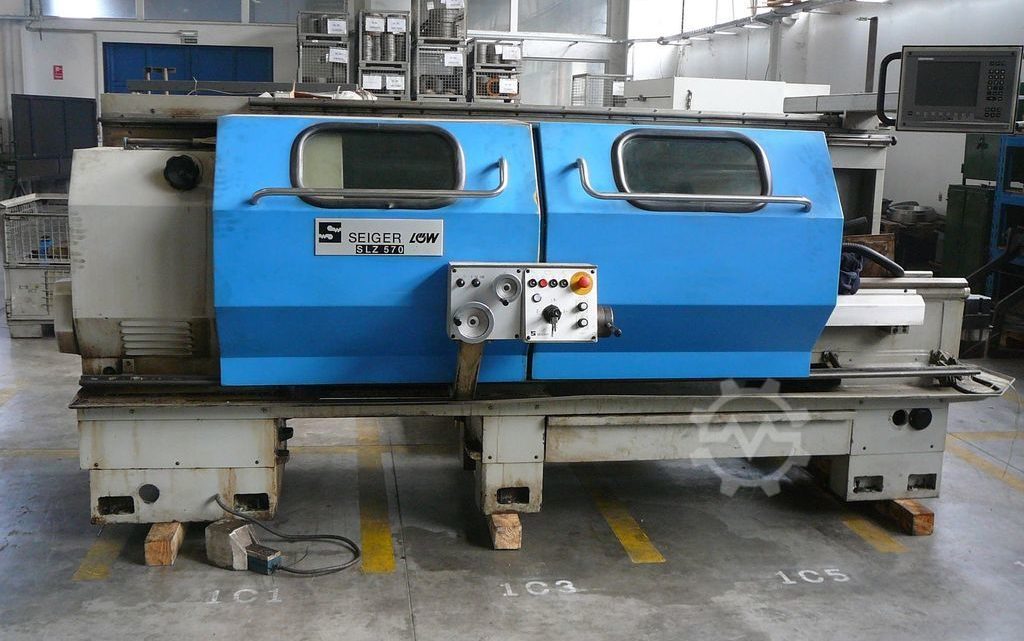
What Should I Pay Attention To When Buying a Second-Hand, Pre-Owned, Surplus, Used Sieger SLZ 570 Lathe made in Germany?
When buying a used or surplus Seiger SLZ 570 (Germany) lathe, you’ll want to perform a thorough check to ensure that the machine will serve your needs reliably. Below is a detailed checklist
What to check
1. Provenance & machine history
- Ask for the exact model version: e.g., SLZ 570E, SLZ 570/2 etc.
- Ask for the serial number, year of manufacture, hours/cycles run, and previous usage environment (e.g., heavy production vs. occasional use).
- Verify that it was made in Germany by Seiger in Lippstadt (Seiger advertises beds, spindles, castings “made in Germany”).
- Ask about maintenance history: Has it been abused? Were major parts replaced (spindle, guides, bed, CNC control)?
- Ask why the machine is being sold. If the reason is vague, proceed cautiously.
2. Technical specification & suitability for your work
- Confirm the turning diameter (≈ 570 mm swing over bed) and other specs like bed width, spindle bore:
- Swing over bed: 570 mm (SLZ 570E spec)
- Spindle bore Ø 93 mm standard, option up to Ø 130 mm for some variants.
- Check the distance between centers (1,000 / 1,500 / 2,000 mm spec in one listing)
- Ensure the machine capacity matches your parts: size, weight, length, material.
- CNC control version (Heidenhain ManualPlus 620 or Siemens SINUMERIK) may affect ease of programming/support.
- Check for any optional attachments or modifications (e.g., large bore spindle, automatic gearbox) from manufacturer spec sheet.
3. Physical condition & wear
- Inspect the bed: cast-iron, hardened slideways (that Seiger uses) should be in good condition. If bed is significantly worn, accuracy suffers.
- Check spindle: run-out, bearing health, vibrations, check the bore if used for heavy work.
- Check gibs, ways, cross slide, tailstock for wear.
- Check coolant/chip management system, guards, safety interlocks.
- Check electrical cabinet condition: dust, overheating signs, original wiring.
- If the machine has been relocated, verify proper re-alignment was done.
4. Accuracy, performance & testing
- Request a test run: measure actual turning accuracy, check repeatability.
- Ask about rapid traverse rates (if relevant) and compare with spec.
- Check the machine for squareness, alignment of axes, any chatter or unusual noise.
- The spec sheet mentions direct position measurement (linear scales) on X-axis for SLZ 570E.
- Evaluate remaining useful life: if major components like spindle or drives are near end-of-life, cost of rebuild can be significant.
5. Supportability & spare parts
- Verify availability of spare parts for Seiger SLZ series in your region. Older CNC controls might be harder to support.
- Ask if documentation, wiring diagrams, manuals, maintenance logs are included.
- Confirm that standard components (bearings, ballscrews, guides) are still available.
- If the control is Heidenhain or Siemens, check if software licensing or updates are required.
6. Transport/installation & setup cost
- Because it is a large machine (spec say width ~2,200 mm for some variants) ensure your floor has adequate capacity and footprint.
- Check power requirements and service conditions (voltage, phase, required foundation).
- Factor in rigging, alignment, foundation or pad preparation, and commissioning costs.
- Downtime while installing must be considered in cost/ROI.
7. Economic & risk assessment
- Compare the asking price with similar used SLZ 570 machines in the market.
- Factor in the cost of shipping, installation, spare parts, possible refurbishment.
- Check how quickly the machine will pay for itself through usage in your workload.
- Make sure you understand warranty or “as-is” terms: many used machine purchases are “as is” and you carry the risk.
Specific questions to ask the seller
- What exact variant is this (SLZ 570E, SLZ 570/2, center distance, etc.)?
- What is the condition of the spindle — bore size, bearing runs, any rebuild history?
- How many hours or parts did the machine run?
- Does the machine still maintain design accuracy (bed wear, slideway clearance)?
- What CNC control is installed (type, version, any updates)?
- Are all original manuals and wiring diagrams included?
- What attachments are included (tailstock, steady rest, workholding, automation)?
- Is the machine fully operational? Can I witness a live demo/test run?
- What is included for transport & installation?
- Are there any major known issues or upcoming needs (e.g., spindle replacement)?
Red flags / caution signs
- Machine has no maintenance records or the hours appear extremely high.
- Key components like spindle or slides show obvious damage or wear.
- Control system is outdated, unsupported or missing.
- Bed/ways are worn such that the accuracy cannot be restored economically.
- Spare parts for this model are rare or expensive in your region.
- The seller refuses a test demonstration or hides key information.
- Hidden costs of installation, alignment, or shipping make the deal less favourable.