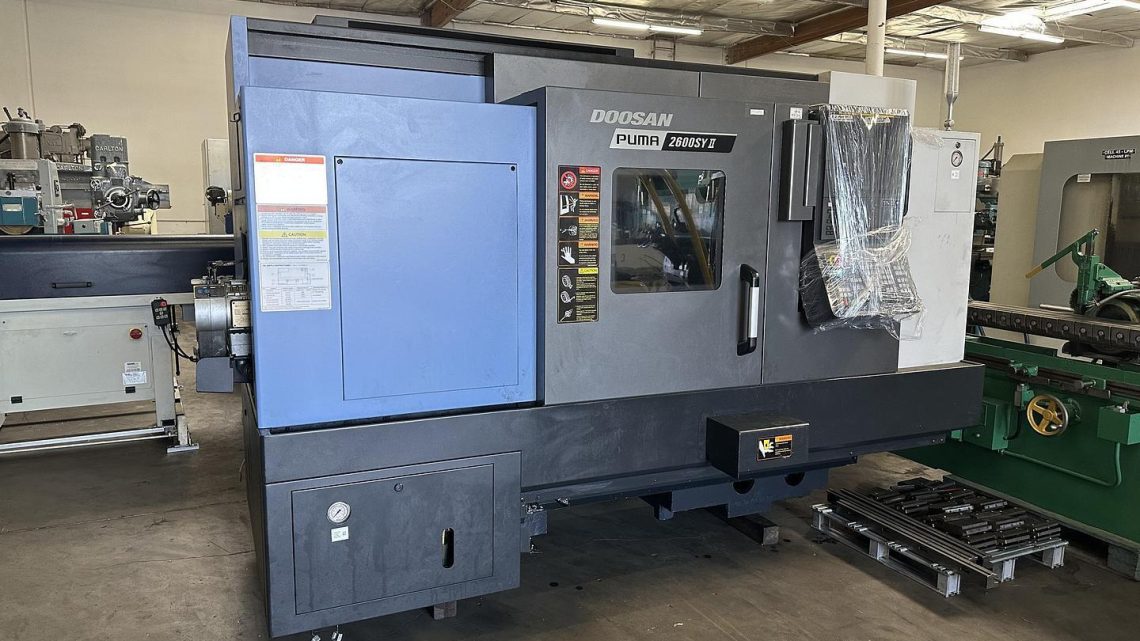
What Should I Pay Attention To When Buying a Second-Hand, Pre-Owned, Surplus, Used Doosan Puma 2600SY II CNC Turning Center made in South Korea?
Here’s a detailed checklist (plus notes and red flags) for buying a used Doosan / DN Solutions PUMA 2600SY II (or “Puma 2600 SY / SY II Y-axis / subspindle” variant) CNC turning center. Because it’s a fairly advanced lathe with additional axes (Y, subspindle, live tooling, etc.), you need to be extra thorough. I’ll also point out known specs so you can judge deviations.
Baseline / Nominal Specifications & What to Expect
Before assessing, you should get (or confirm from seller) the full spec sheet so you know what “as new” should deliver. Some known specs / features include:
- It is a Y / SY version: PUMA 2600 SY II includes a Y-axis (±52.5 mm) in addition to X and Z.
- X-axis travel: 260 mm (≈ 10.2 in)
- Z-axis travel: 830 mm (≈ 32.7 in) for many standard versions.
- Y-axis travel: ±52.5 mm (i.e. 105 mm total stroke) for the Y version.
- Spindle speed & power: the standard main spindle is rated (on PUMA 2600 SY II) for up to 4,000 rpm, power in the range 22 kW (≈ 30 hp) for main spindle.
- Bar / through spindle capacity: ~ 81 mm bar capacity (3.2 in) for “SY” versions.
- Subspindle / secondary spindle: Many used listings show that SY versions have a subspindle, sometimes up to 6,000 rpm.
- Live tooling / milling / Y + C axes: The “SY / Y / SY II” variants often include milling & live tooling capability, and C-axis functionality, increasing complexity.
- Rapid traverse: many sources list 30 m/min (for X, Z, Y) for rapid moves.
- Turret: many models use a 12-station (or optional 24 half-station) turret with driven tooling capacity.
- Dimensions / weight: for example, the Overmach spec sheet gives machine dimensions ~ 4400 × 2100 × 2170 mm, weight ~ 6450 kg.
Use those as benchmarks: when you test the used machine, if any of these are far off (reduced travel, much lower spindle power, poor performance), that signals possible deterioration, misrepair, or damage.
Detailed Inspection & Testing Checklist
Here is a methodical breakdown of what to inspect, test, and verify in each subsystem. Wherever possible, force the seller to allow test cuts or demonstration.
| Subsystem / Feature | What to Inspect / Test | Why It Matters / Red Flags |
|---|---|---|
| Frame, bed, and structural integrity | • Examine the bed, base, and frame for cracks, weld repairs, distortions, or signs of collisions. • Check whether the machine is properly leveled, stable, and rigidly anchored. • Use a straightedge, granite alignment bar, or laser to check the flatness of the bed over its length, and whether there is sag or twist. | Any deformation in the bed or structural frame undermines precision. Repairs are expensive and often only partially effective. |
| Guideways / slide surfaces | • Visually inspect all linear ways (X, Y, Z) for scoring, nicks, corrosion, embedded chips, or wear marks. • Move axes slowly over full travel and feel for smoothness, binding zones, friction variation or “sticky” spots. • Reverse direction and feel for backlash, slop, or dead zones. • Use dial indicators or measurement equipment to check straightness or linear deviations over travel. | Wear or damage in guide surfaces is a common wear point; once worn, accuracy and smoothness suffer significantly. |
| Ball screws / nut assemblies / drive couplings | • Move axes at different speeds and watch for roughness, vibration, or noise. • Check for backlash or play in screw-nut assemblies, especially in reversing. • Inspect the screw threads and nuts (where accessible) for pitting, wear, metal dust accumulation. • Examine coupling between motor and screw for misalignment or looseness. | Worn screws or nuts degrade positioning, repeatability, motion smoothness; replacement is costly. |
| Main spindle & turning system | • Run the spindle at various speeds (low, mid, high) and listen for bearing noise, vibration, hums, roughness. • Mount a test bar or collet + indicator to measure radial and axial runout. • Let it run for a while to warm up; then check ambient vs housing temperature to detect overheating. • Inspect spindle nose, taper, seating surfaces for wear, corrosion, nicks. • If the machine has a subspindle, test its clamping, alignment, rotation, and performance. | Spindle bearings and accuracy are among the most vital—and expensive—components. Overheating, excessive runout, or noise suggest serious trouble. |
| Y-axis / multi-axis subsystems | • Because the “SY” versions include a Y-axis, exercise the Y movement: sideways turret motion. Test smoothness, binding, or unequal resistance. • Reverse direction and check backlash in Y-axis. • When combining Y + X + Z motion, check for interpolation errors, overshoot, or lag. • If there is a C-axis (spindle indexing) or tilting features, test them for backlash, indexing accuracy, and motion quality. | The Y-axis and any extra axes add complexity and failure risk. Poor performance here limits 5-sided machining capabilities. |
| Tool turret / live tooling / tool changer | • Cycle tool changes repeatedly; watch for misindexing, collisions, delays, sensor errors. • Inspect locking plungers, sensors, rails, grippers, sensors, mechanical elements. • If live tools are present, run them under load, measure runout, monitor vibration. • Test tool-to-tool repeatability (remove tool, insert back, see how close it returns). | Tooling issues cause scrap, crashes, downtime. In high-end multitasking machines, turret and live-tool reliability is critical. |
| Control, electronics & wiring | • Power-up and watch startup messages; note any error codes, missing modules, alarms. • Test motion commands (jog, interpolation, path sequences) and transitions. • Inspect the electrical/CNC cabinet: fans, wiring, connectors, signs of burning, discoloration, corrosion, dust. • Test encoder feedback, sensor wiring, cable harness integrity. • Confirm parameter backups, software / compensation table backups, ability to restore configuration. • Run sample programs (turn + mill + multi-plane) to test interpolation and control logic. | Mechanical parts may be perfect, but a faulty control or missing module can render the machine unusable. |
| Coolant, lubrication & fluid systems | • Test coolant pump, flow, pressure, nozzles, hoses, filters. • Examine coolant tank: sludge, chips, corrosion, foreign debris. • Test the lubrication systems for axis slides, turret, bearings—ensure oil delivery works, lines are clear, no blockage. • Inspect for leaks or degraded hoses, seals, piping in wet / coolant-exposed zones. | Poor lubrication or coolant systems accelerate wear, reduce precision, and can cause failures in spindles or bearings. |
| Chip / debris / guarding / sealing | • Check chip conveyor, chip removal paths, flushing paths, and guarding. • Ensure all covers, bellows, wipers, seals are intact and functional to keep chips / coolant out of critical areas. • On internal cavities or behind enclosures, look for chip buildup or debris ingress. | Chips and abrasive debris are adversaries of CNC lathes; missing or damaged protection is a red flag. |
| Thermal drift & stability | • Run the machine under load for an extended period (30–60+ minutes). • Re-measure previous reference dimensions or test cuts to see whether drift occurred. • Monitor temperatures of axes, spindle, turret, structure for uneven heating or hot spots. | Thermal behavior is often the hidden killer of precision. Excessive drift or instability under load means the machine may not hold tolerances in real production. |
| Test part / production trial | • Run a representative production part (turning + milling) through its full motion. • Measure final dimensions, tolerances, surface finishes, multi-surface alignment. • Repeat the process to check repeatability and consistency. • Vary speeds and feeds and see how the machine handles them (especially transitions, corners, interpolations). | A real-world job stress test often reveals latent problems that static checks do not. |
| Maintenance history & usage record | • Ask for build year, serial number, runtime hours (if logged), spindle hours, cycle counts. • Request maintenance logs: replaced parts, repairs, past refurbishments, crash events. • Ask about the working environment: clean shop vs harsh environment, coolant quality, chip management discipline. • Check wear of common parts (turret, ways, tool holders, chucks, seals). | Good records reduce risk. A machine with unknown or neglected history is more of a gamble. |
| Parts, support & documentation | • Check whether Doosan / DN Solutions still support the 2600SY / SY II model line and offer spare parts (turrets, motors, drives, electronics, spindles). • Ensure you receive operator, maintenance, electrical/wiring manuals, parts lists, calibration & compensation data, and software backups. • Ask if the seller can include spare modules, cables, consumables, tooling. | Without parts or support, downtime or failure may become ruinous. |
| Shop / infrastructure readiness & installation | • Confirm your power supply (voltage, phases, current) matches machine requirements. • Ensure proper grounding, clean stable electrical feed. • Check that the shop floor/foundation is rigid, level, and able to bear the machine weight without undue vibration. • Ensure space and clearance for access, maintenance, tool changes, axis motion. • Verify chip / coolant drainage, filtration, ventilation, waste handling. • Safety compliance: emergency stops, guards, interlocks must satisfy local regulations. | Even a perfectly functioning machine can fail or perform poorly if installed in a deficient environment. |
“Red Flags” & Deal Killers
Here are conditions you should treat as warning signs or potential deal-breakers:
- Spindle bearing noise, overheating, or excessive runout
- Axis motion with “hard spots,” inconsistent friction, binding zones
- Deep scratches, corrosion, or damage on guideways / slide surfaces
- Turret or tool changer misindexing, jamming, sensor failures
- Y-axis / extra axes that behave poorly or do not track well
- Control electronics with missing modules, firmware issues, corrupted backups, burned wiring
- Absent or dysfunctional coolant / lubrication systems
- Guards, bellows, or seals missing / broken, leading to chip ingress
- Excessive thermal drift or instability discovered during test run
- Machine lacking documentation, schematics, calibration data, or software backups
- No local parts or service support for the model
- Seller refusing to allow full functional testing or hiding interior parts
Negotiation Guidance & Risk Mitigation
- Estimate refurbishment cost (guides, spindle bearings, turrets, electronics) and subtract from asking price.
- Require a test / acceptance period after installation where you can run your own sample part.
- Demand the seller provide documentation, software / parameter backups, spare parts, tooling.
- Bring a lathe / multi-axis expert to inspect with you.
- Factor in transport, rigging, alignment, calibration, leveling costs.
- If possible, tie part of payment to performance (i.e. machine must hold ±X tolerance over Y hours).
- Ask for references from prior buyers of the same model.