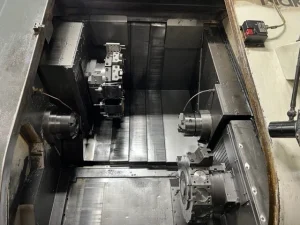
What Should I Pay Attention To When Buying a Second-Hand, Pre-Owned, Surplus, Used Summit SC30-9X80M CNC Flat Bed Lathe made in USA?
Here’s a detailed checklist and set of cautions to guide you when evaluating a Summit SC30-9X80M (or similar SC30 SmartCut flat-bed CNC lathe) in the used / surplus market. Because Summit’s SmartCut line is a hybrid manual/CNC flat-bed turning platform, you’ll need to check both traditional lathe systems and CNC systems. Use this list onsite (or remotely via photos/videos) to expose hidden issues and negotiate better.
What we know about the Summit SC30-9X80M — baseline expectations
Before inspecting, you should know what the machine should be capable of so you can judge deviation.
From a listing:
- Swing over bed ≈ 30.32 in (≈ 770 mm)
- X-travel ~ 13.78 in (≈ 350 mm)
- Z-travel / between centers: 80 in (≈ 2,032 mm)
- Spindle: 20 HP drive, 9-inch bore, A2-15 spindle nose, up to ~ 600 RPM
- Turret / tool stations: 8-station turret (per listing)
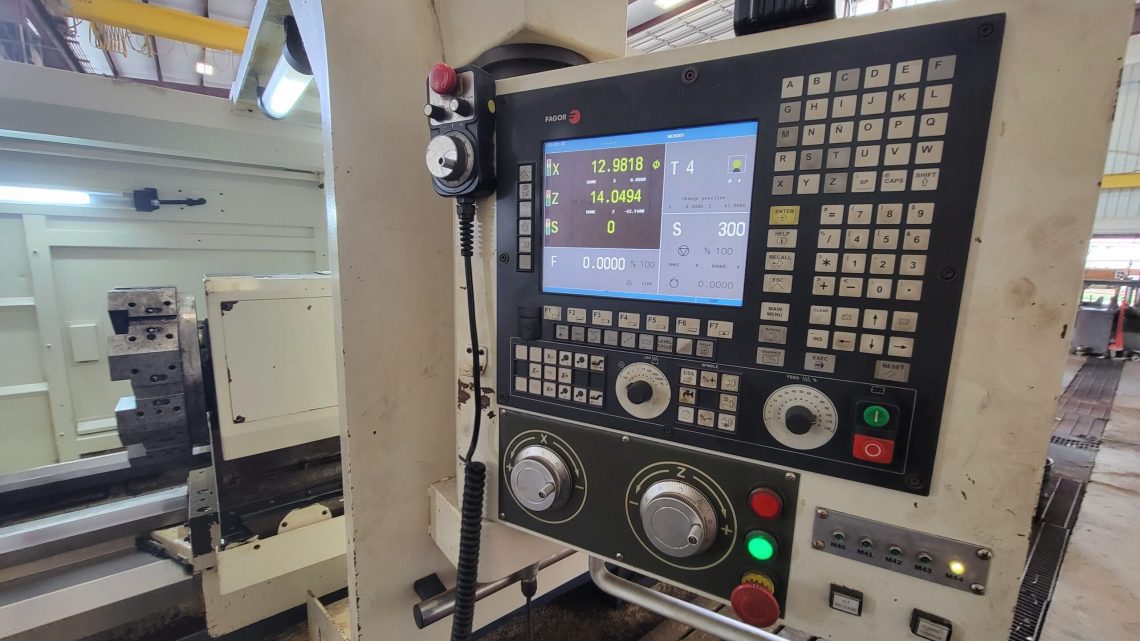
- Control: Fagor 8055TC with RS-232 / USB / Ethernet capability
- From Summit’s product pages: SmartCut flatbed lathes use a heavily ribbed cast bed & base, hardened and precision ground bedways, precision ground ball screws, infinitely variable spindle speed ranges, and use Yaskawa spindle drives, among standard features.
These specs are your “target” or benchmark. In your inspection, you want to see whether the candidate machine still achieves or nearly matches these, or whether it has degraded severely.
Inspection & evaluation checklist
Below is a systematic breakdown by subsystem with what you should check or test, and what red flags to watch for.
| Subsystem / Area | What to Inspect / Test | Why It Matters / Warning Signs |
|---|---|---|
| Base, bed & structural integrity | • Examine the cast bed, flat base, ribbing, welds, repair patches, cracks, distortions. • Check whether the bed is still straight and not bowed, sagging or twisted. A straightedge or large granite surface, or laser line, can help. • Ensure the machine is properly mounted/leveled. | Any distortion in the bed will degrade alignment, cross-slide geometry, and cause errors in turning over length. |
| Bedway / slide surfaces | • Inspect bedways (flat / ground surfaces) for scoring, pitting, scratches, embedded chips or corrosion. • Jog the carriage across the full Z stroke; feel for zones of increased friction, binding, “sticky spots.” • Reverse direction and check for backlash or inconsistent motion. | Wear, embedded chips, or damaged bed surfaces directly degrade the slide motion, accuracy, and repeatability. |
| Ball screws, nut assemblies, drive train | • Move axes (X, Z) at various speeds; listen / feel for noise, roughness, “grittiness.” • Test for axial / radial play in screw / nut (especially in X feed). • Inspect screw coupling to motor — alignment, looseness, wobble. • Look for signs of lubrication failure (dry spots, metal dust accumulation). | Worn screws or nuts degrade positioning and can be expensive to rebuild or replace. |
| Spindle, bearings, runout | • Run spindle at low, medium, and higher speeds (if possible) and listen for bearing noise, hum, vibration. • Mount a test bar or collet + reference instrument to measure radial and axial runout. • After continuous run, check spindle housing temperature for overheating (which suggests bearing fatigue). • Inspect spindle nose, taper, seating surfaces for nicks, rust, wear. | Spindle bearings are critical and expensive. Excessive runout or heat is a serious red flag. |
| Turret / tool changer / tool stations | • Cycle the turret repeatedly; observe indexing accuracy, speed, mis-indexing, collisions, or failed locks. • Inspect plungers, locking mechanisms, sensors, guide tracks, switches. • Test tool-to-tool repeatability (i.e. remove a tool, reinsert, check if nominal position returns). | Turret / tool changer reliability is vital. Worn or misaligned turrets cause scrap, crashes, or slow cycles. |
| Control system & electronics | • Power up the control; note any error codes, missing I/O modules, faults, alarms. • Jog axes, test interpolation, combined motion, tool change sequences, macro routines. • Open the control / drive cabinet (if allowed) — inspect wiring, connectors, heat sinks, fans, discoloration, burnt traces. • Check encoder cables, feedback wiring, look for loose or damaged wiring. • Ensure the parameter backup, configuration files, compensation tables, and calibration data are present and restorable. | A damaged or corrupted control system can render the machine unusable. Missing or faulty electronics are expensive to fix. |
| Coolant, lubrication & fluid systems | • Test coolant flow, pump, hoses, nozzles, filters. • Inspect coolant tank for sludge, contamination, rust, chips. • Check lubrication (if the machine uses way oil or axis lubrication) — lines, delivery, blockages. • Inspect for leaks in hoses, seals, pipe joints in wet zones. | Poor fluid systems speed up degradation of bearings, slides, and mechanical components. |
| Chip control, guards, covers & sealing | • Ensure that all guards, covers, bellows, wipers are intact and functioning. • Check for chip intrusion into critical areas like slides, screws, turrets. • Inspect the chip conveyor (if present), its drive, and return paths. | Chips and abrasive debris are among the biggest hazards in lathe environments; missing protection is a major liability. |
| Thermal stability & drift | • Run the machine under moderate load for a while (30–60 min). • Re-measure previously measured reference points or test parts to see if there is drift. • Check whether axes or components heat unevenly, causing expansion or distortion. | Thermal drift is a real issue in large machines; excessive drift implies design, cooling, or wear problems. |
| Test part / production run | • Run a representative test part (turning, facing, boring) across Z length, X travel. • Measure the output part: dimensional accuracy, roundness, taper, surface finish. • Repeat runs to check consistency and repeatability. • Vary feeds & speeds within the machine’s envelope to see how well it behaves at extremes. | Real part work is the truest test of a used machine’s health. Latent issues often show under real load. |
| Maintenance history & operating background | • Ask for manufacturing year, serial number, operating hours (if logged). • Get maintenance logs: part replacements, rebuilds, major repairs, turret rebuilds. • Inquire whether any collisions, crashes, electrical events (brownouts, power surges) occurred. • Ask about the working environment: was it a clean shop or tough environment (dusty, humidity, coolant exposure)? • Check wear on common replaceable parts: tool holders, chucks, belts, seals, covers. | A clean history with documentation reduces risk; unknown or neglected history is higher risk. |
| Parts, support & documentation | • Confirm Summit or its dealers still support the SmartCut / SC30 line; check spare parts availability (motors, drives, electronics, turrets, screws). • Ensure you receive manuals: operator, maintenance, electrical schematics, parts lists, calibration / compensation files. • Request any spare modules, backup cards, cables, or consumables the seller may have. | Even a perfect machine becomes useless without parts or technical support. |
| Shop readiness & infrastructure | • Ensure your power supply (voltage, phase, current) meets the machine’s requirements. • Check grounding, power stability, clean wiring. • The floor / foundation must be rigid, level, and able to support the machine mass. • Make sure there is enough clearance for maintenance, tool change, access to all sides. • Chip / coolant drainage, filtration, waste handling, and ventilation must be adequate. • Safety compliance: emergency stops, guards, enclosures must meet local regulation. | Even a high-quality machine fails in a poorly set-up or incompatible shop environment. |
Key Red Flags / Deal-Breakers
If you find any of the following, they are serious issues:
- Severe spindle noise, overheating, or very high runout
- Axis motion with binding zones, inconsistent friction, or “dead spots”
- Deep gouges, pitting, or damage on bedways or slides
- Turret or tool changer that misindexes, jams, or fails repeatedly
- Control system with constant errors, missing modules, corrupted parameters
- Missing or severely damaged guards, covers, seals, or protection
- Inadequate or degraded coolant / lubrication / fluid systems
- No documentation (manuals, schematics, parts lists) or missing software backups
- No availability of spare parts or dealer support in your area
- Seller refusing full testing, restricting access to internal systems, or not allowing you to run test parts
Sample metrics & reference specs to compare
Use the published specs above to check candidates:
- Spindle: 20 HP, 9-inch bore, A2-15, up to 600 RPM
- X travel: ~ 13.78 inch
- Z travel: ~ 70.87 inch (for 80 in between centers)
- Turret: 8 stations (on the quoted listing)
- Bed / construction: Summit advertises heavily ribbed cast bed, hardened / ground bedways, precision ground ball screws, Yaskawa spindle drives, variable spindle speed, etc.
If the candidate machine’s measured metrics fall far short (for example too low spindle power, high runout, poor Z travel), use those discrepancies in negotiation or walk away if too severe.