14/10/2025
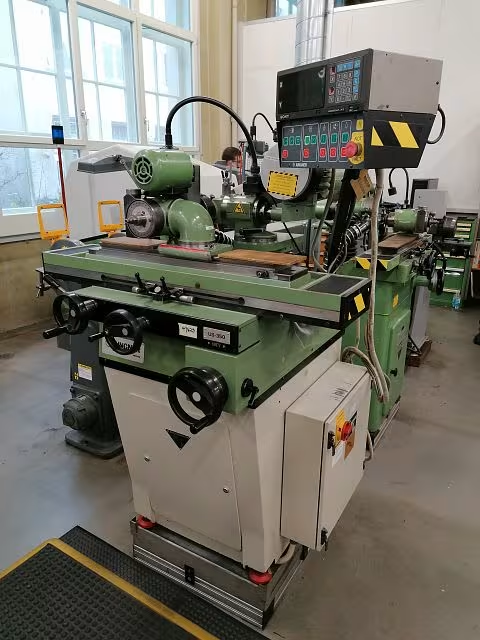
Before You Buy: Essential Criteria for Evaluating a Used, Second-Hand, Pre-Owned, Surplus Jungner US350 Tool Grinder Machine made in Sweden
When buying a used / second-hand / surplus Jungner US350 (or similar Jungner “US” series) tool & cutter grinder / tool grinder (made in Sweden), you’ll want to perform a diligent and structured evaluation. These machines are precision equipment, and their performance, remaining life, and maintainability depend heavily on how they were used, maintained, and stored. Below is a detailed checklist / set of criteria (with explanations) to guide you:
Key Evaluation Criteria
Here’s a structured breakdown of the what, why, and how to inspect a used Jungner US350 (or its siblings). Use this as a reference when you or a technical expert go to inspect the machine.
| Area / System | What to Check | Tolerance / Signs of Issue | Why It Matters |
|---|---|---|---|
| Machine identity / documentation | Model, serial number, year of manufacture, original drawings / manuals, maintenance logs | Serial and model should match seller’s claim; logs may show major rebuilds, upgrades, or neglect | Ensures you know exactly what you’re buying; helps in sourcing parts and compatibility |
| Overall condition & alignment | Visual inspection for wear, corrosion, rust, dents, misalignment; check flatness and straightness | Any bending, warpage, or signs of impact are red flags | Precision grinders require rigid frames and accurate alignment |
| Base, bed, column, and guideways | Check for wear, abrasion, surface finish, “witness marks”, cracks; measure close tolerances | Excessive play, grooving, scoring, uneven wear, looseness > acceptable limits | Poor guideways lead to inaccuracy, chatter, and reduced tool life |
| Spindle & bearings | Runout, noise, vibration, smooth rotation free of play; inspect bearings for wear or damage | Radial / axial play should be minimal; high vibration is a warning | The spindle is central to grinding accuracy |
| Grinding wheel spindles / arbors / adapters | Condition of taper fits, conformity, runout when mounted, damage to flanges | Poor fit leads to vibration and geometry errors | Critical for tool grinding precision |
| Drive systems / belts / couplings / pulleys | Belt condition (cracks, wear), coupling alignment, backlashes, misalignment, looseness | Worn belts or misalignment degrade performance | Efficient and precise drive is essential |
| Motors & electrical systems | Motor health (amps, insulation resistance), wiring, controls, switching, junction boxes, condition of motor brushes (if applicable) | Overheating, insulation breakdown, burnt wiring or smell is a red flag | Reliable power & control are fundamental |
| Lubrication / hydraulic / coolant systems | Presence and condition of oilways, pumps, reservoirs, filters, pipes, seals; coolant delivery system (pumps, nozzles) | Obstructions, leaks, lack of lubrication, dirty coolant, burnt oil smell | Poor lubrication or coolant can trash the machine or tools |
| Machine table / workpiece holding | Flatness, repeatability, clamping fixtures, tailstock (if present), collets, centers | Any flex, looseness, or wear reduces repeatable accuracy | Tool grinding demands high rigidity and repeatability |
| Motion & feed systems (slides, screws, leadscrews, backlash) | Check backlash, wear, play in lead screws, ball screws (if any), gibs, cross slides; also test travel limits | Excessive backlash or slop is unacceptable | Impacts profile accuracy and repeatability |
| Control systems / instrumentation / gauges | If it’s manual or semi-automatic: check dials, micrometers, indicators, verniers. If retrofitted: check controller, feedback, sensors | Misleading or worn gauges, faulty sensors degrade usability | Accurate measurement and movement control are necessary |
| Calibration / test performance | Run test cuts or grinding operations; measure output, tolerances, roundness, surface finish | If the machine can’t reliably hold tolerances, value is compromised | Real proof of capability, not just “looks good” |
| Parts availability & maintenance history | Are spare parts still available (bearings, spindles, electrical, belts, etc.)? Has the machine been maintained or overhauled? | If parts are obsolete or custom, servicing becomes risky | The economics of ownership depend heavily on serviceability |
| Documentation & drawings | Original technical drawings, assembly drawings, parts lists, operator’s manual, maintenance manual | Missing or incomplete documentation can severely limit your ability to repair or retrofit | Documentation supports long-term maintainability |
| Safety & guarding | Safety covers, shields, electrical protections (e-stop, interlocks), enclosures, chip/coolant guards | Missing guards or unsafe state is a non-starter (or expensive to remediate) | Safety is mandatory in industrial use |
| Transport, relocation & costs | Weight, structure, ease (or difficulty) of disassembly, shipping damage risk, setup costs | Heavy machines are expensive to move / install | You want realistic estimation of total cost to get into production |
| Economic / ROI considerations | Asking price vs replacement / refurbishment cost, likely downtime, productivity, expected life remaining | If your cost to refurbish + buy is too high, you may be better off with a newer machine | The “used” premium must leave margin for risk and future investment |
Practical Steps When Evaluating
When you or your technical staff go to inspect:
- Bring measuring & inspection tools: Dial indicators, test bars, run-out gauges, micrometers, vibration sensors, thermal camera, multimeter, etc.
- Run the machine (if possible): Let it idle, accelerate, decelerate, traverse all axes, engage coolant, simulate actual work. Listen, feel for vibration, check any stiction or hesitancy in movement.
- Check baseline geometry: Use test pieces, or known reference standards to test how accurate it still is (runout, straightness, concentricity). That gives you an objective benchmark.
- Inspect hidden / internal parts: Remove covers, panelling to check internal wear, cleanliness, signs of leaks, corrosion, poor maintenance.
- Request maintenance and repair history: Any records of overhauls, prior spindle replacements, major repairs, upgrades, or downtime history.
- Check how it was stored / used: A machine stored in a dry, clean shop is much better than one in a dusty, humid, or corrosive environment.
- Verify that consumables or accessories come with it: Collets, centers, wheel adapters, fixtures. Without them, you may face additional cost.
- Confirm shipping and restoration costs: You may need to rebuild key systems. Factor that in aggressively.
Special Considerations for Jungner “US” Series / Historical Swedish Machines
- Legacy design: Many Jungner machines were built decades ago. Some components may be out of production or custom.
- Retrofits and upgrades: Some used Jungner machines are retrofitted (modern drives, electronics). Confirm how “original” it is, and whether retrofit parts are properly integrated.
- Wear patterns typical of tool grinders: Because grinding is high-precision, wear even in small amounts can have outsized negative effects.
- Balance & vibration sensitivity: Even small imbalance or vibration in a tool grinder may ruin your workpieces; hence, you want to see how balanced and smooth the spindles are.
- Spindle rebuild history: If the spindle or bearings have already been rebuilt, ask when and by whom.
- Electrics & controls standard: Original machines may have voltages or control schemes that are nonstandard in your country; conversion might be needed.
- Support network: See if there are specialists for Jungner machines (repair services, used-parts suppliers).
- Wear compensation / alignment adjusters: Look for built-in ways the machine can compensate for wear (e.g. ways shims, adjustable gibs). If many parts are at the limit, further compensation may not be possible.
Red Flags / Deal Breakers
- Severe rust, pitting, or corrosion on guideways, base, or bed
- Spindle with significant run-out, noise, or knocking
- Excessive backlash or play in feeds and slides
- Missing or unserviceable key components (e.g. spindle, motor, drive belts)
- No historical documentation and no way to source spare parts
- Electrical systems in poor or unsafe condition
- Safety guards missing or damaged beyond repair
- The total cost to restore exceeds your justified value or buying a newer (or better maintained) machine
- If the seller refuses to let you run or test the machine, or inspect internal parts