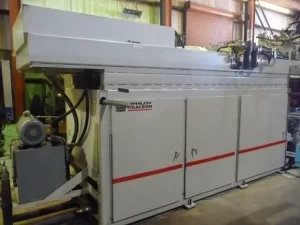
What is Vacuum Aluminum Brazing Furnace?

A Vacuum Aluminum Brazing Furnace is a specialized thermal processing system used to join aluminum components through brazing in a vacuum environment. Brazing is a metal-joining process where a filler metal (typically an aluminum alloy with a lower melting point than the base metal) is heated to a liquid state and flows into the joint by capillary action, creating a strong metallurgical bond upon cooling. The vacuum environment is critical for aluminum brazing to prevent oxidation and ensure high-quality joints. Below is a technical explanation of the furnace and its operation:Key Components of a Vacuum Aluminum Brazing Furnace
- Vacuum Chamber:
- Constructed from stainless steel or other high-temperature-resistant materials to withstand vacuum conditions and high temperatures.
- Maintains a low-pressure environment (typically 10⁻⁴ to 10⁻⁶ Torr) to eliminate oxygen and prevent oxidation of aluminum surfaces.
- Heating System:
- Utilizes electric heating elements (e.g., molybdenum or graphite) to achieve precise temperature control, typically in the range of 550°C to 620°C (1022°F to 1148°F) for aluminum brazing.
- Radiant or convection heating ensures uniform temperature distribution across the workpieces.
- Vacuum System:
- Consists of mechanical pumps, diffusion pumps, or turbomolecular pumps to achieve and maintain the required vacuum level.
- Removes air and residual gases to prevent oxidation and contamination during the brazing process.
- Cooling System:
- Includes gas quenching systems (e.g., nitrogen or argon) to cool the furnace and workpieces after brazing, preventing thermal distortion.
- Water-cooled walls or heat exchangers may be used to manage furnace temperature.
- Control System:
- Advanced programmable logic controllers (PLCs) or computer-based systems monitor and control temperature, vacuum level, and process timing.
- Ensures precise adherence to brazing cycles, including heating, soaking, and cooling phases.
- Workpiece Fixturing:
- Custom fixtures or jigs hold aluminum components in precise alignment during brazing, ensuring proper joint formation.
- Fixtures are often made from materials like stainless steel or ceramics to withstand high temperatures and avoid contamination.
Brazing Process in a Vacuum Aluminum Brazing Furnace
- Preparation:
- Aluminum components are cleaned to remove oxides, oils, and contaminants, often using chemical cleaning or ultrasonic methods.
- A brazing filler metal (e.g., Al-Si alloy, typically with 7-12% silicon) is applied as a clad layer, foil, or paste at the joint interface.
- A flux (e.g., non-corrosive NOCOLOK flux) may be used in some cases to further reduce oxides, though vacuum brazing often eliminates the need for flux.
- Loading:
- Components are placed in fixtures and loaded into the furnace chamber.
- The chamber is sealed, and the vacuum system is activated to evacuate air and achieve the desired vacuum level.
- Heating:
- The furnace is heated to the brazing temperature, typically just below the melting point of the base aluminum alloy (e.g., 600°C for 6061 aluminum).
- The filler metal melts and flows into the joint via capillary action, while the vacuum prevents the formation of aluminum oxide (Al₂O₃), which inhibits bonding.
- Soaking:
- The temperature is held steady for a precise duration to ensure complete wetting and filling of the joint by the filler metal.
- Uniform temperature distribution is critical to avoid distortion or incomplete brazing.
- Cooling:
- The furnace is cooled gradually, often with inert gas quenching, to solidify the filler metal and form a strong metallurgical bond.
- Controlled cooling minimizes residual stresses and distortion in the aluminum components.
- Unloading:
- Once cooled to a safe temperature, the vacuum is released, and the brazed components are removed for inspection or further processing.
Technical Advantages
- Oxidation Prevention: The vacuum environment eliminates oxygen, preventing the formation of aluminum oxide, which is a significant barrier to brazing.
- High-Quality Joints: Produces clean, strong, and leak-tight joints with minimal voids or defects.
- No Flux Requirement: Vacuum brazing often eliminates the need for flux, reducing post-brazing cleaning and corrosion risks.
- Complex Assemblies: Enables brazing of intricate aluminum components, such as heat exchangers, with tight tolerances.
- Repeatability: Precise control over temperature and vacuum ensures consistent results in high-volume production.
Applications
- Automotive Industry: Brazing of aluminum heat exchangers, radiators, and condensers.
- Aerospace: Joining lightweight aluminum components for aircraft structures and thermal management systems.
- Electronics: Manufacturing of aluminum-based cooling systems for power electronics.
- HVAC Systems: Production of aluminum coils and heat exchangers for air conditioning units.
Technical Challenges
- Temperature Control: Aluminum has a narrow brazing temperature window (close to its melting point), requiring precise control to avoid melting the base material.
- Vacuum Integrity: Maintaining a high vacuum level is critical, as leaks can introduce oxygen and compromise joint quality.
- Cost: Vacuum brazing furnaces are expensive to purchase and operate due to their complex design and high energy consumption.
- Material Compatibility: Fixtures and furnace components must be compatible with aluminum to avoid contamination or reactions.
Typical Specifications
- Temperature Range: 500°C to 650°C (932°F to 1202°F).
- Vacuum Level: 10⁻⁴ to 10⁻⁶ Torr.
- Chamber Size: Varies from small lab-scale furnaces to large industrial units (e.g., 1 m³ to 10 m³).
- Heating Rate: 5-20°C/min, depending on furnace design and workload.
- Cooling Rate: Controlled to prevent thermal shock, typically 10-50°C/min with gas quenching.
ConclusionA vacuum aluminum brazing furnace is a highly controlled system designed to join aluminum components with precision and reliability. By leveraging a vacuum environment, it overcomes the challenges of aluminum’s high oxidation tendency, producing strong, clean joints for critical applications. Its technical complexity and precise process control make it indispensable in industries requiring high-performance aluminum assemblies.