What is Tube & Profile Laser Cutting Operation?
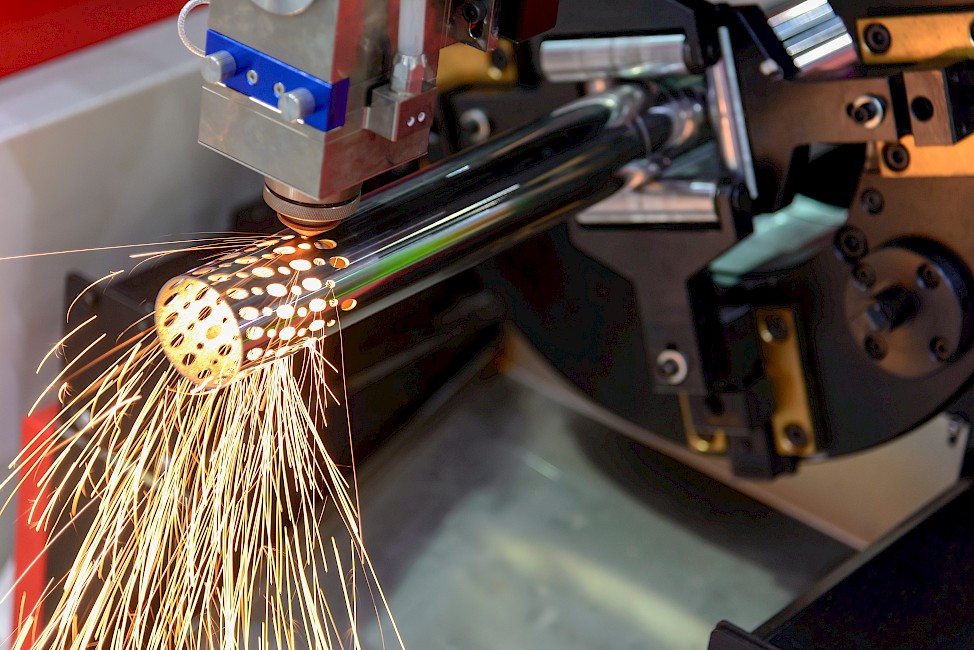
Tube & profile laser cutting is an advanced CNC-controlled manufacturing process used in the sheet metal sector to cut round tubes, square tubes, rectangular profiles, open channels, and complex cross-sectional profiles with high precision. Instead of conventional sawing, drilling, or milling, a focused high-power laser beam is used to achieve clean cuts, holes, slots, and notches in tubular and profile-shaped workpieces.
How the Process Works
- Laser Source & Beam Delivery
- A fiber or CO₂ laser generates a highly concentrated light beam.
- The beam is guided through optical components and focused to a spot diameter of ~0.1 mm.
- Assisted by process gases (O₂, N₂, or air), the laser melts or vaporizes the material.
- CNC Machine Integration
- Tubes and profiles are clamped in a rotating chuck system and moved in synchronization with linear CNC axes (X, Y, Z).
- This enables cutting not only along the tube length but also angular cuts, bevels, and contours.
- Profile recognition systems and automatic loading/unloading modules support continuous production.
- Cutting Process
- Continuous wave laser energy locally heats and melts the sheet metal.
- Assist gas ejects molten metal from the kerf, ensuring a narrow cut and preventing oxidation (when nitrogen is used).
- The CNC program determines geometry (holes, slots, notches, miters, copes).
Applications in the Sheet Metal Sector
- Structural components: Frames, supports, and brackets for machinery and buildings.
- Automotive: Exhaust systems, chassis parts, roll cages, precision tubular elements.
- Furniture & architecture: Decorative profiles, perforated tubes, designer structures.
- Aerospace & rail: Lightweight but strong tube assemblies.
- General fabrication: Pipe connections, hydraulic/pneumatic system tubing.
Technical Advantages Over Conventional Methods
- High Precision & Repeatability: ±0.1 mm accuracy, allowing complex geometries without secondary machining.
- Flexibility: Ability to cut different cross-sections (round, square, hexagonal, C/U channels, custom extrusions).
- Reduced Waste: Nesting algorithms optimize cutting paths and material usage.
- High Productivity: Automated handling, faster cutting compared to mechanical processes.
- Edge Quality: Smooth, burr-free edges reduce or eliminate post-processing.
- Design Freedom: Enables complex joints and interlocking structures that would be impractical with drilling/milling.
Conclusion
Tube & profile laser cutting operation is a cornerstone technology in the modern sheet metal sector. By combining laser precision, CNC automation, and material flexibility, it enables cost-effective production of high-quality tubular and profile-based components. It is especially valuable in industries that demand lightweight structures, tight tolerances, and efficient material usage.