What is Tapered Roller Bearings?
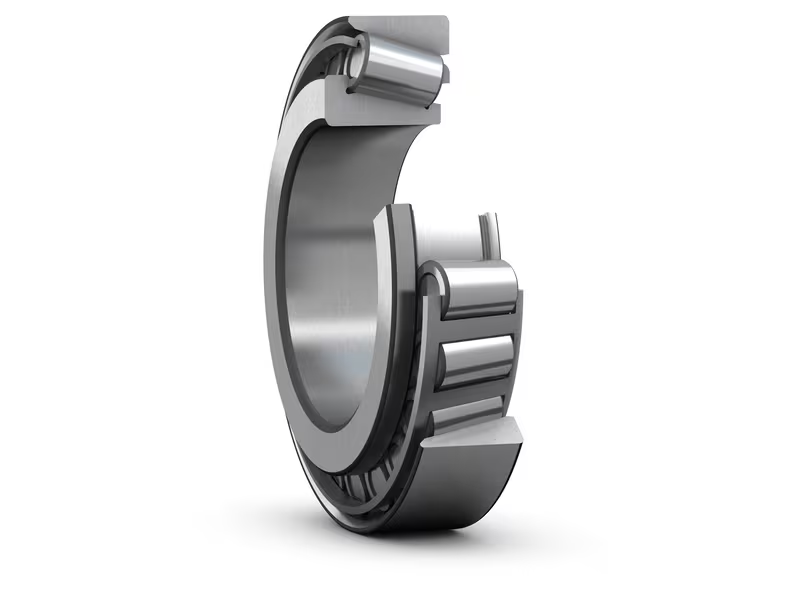
Tapered roller bearings are a type of rolling-element bearing designed to handle both radial and axial (thrust) loads simultaneously, making them critical components in machinery and production sectors where complex load conditions are common. Below is a technical explanation tailored to their application in these industries:Design and StructureTapered roller bearings consist of four primary components:
- Inner Ring (Cone): The inner raceway, which fits onto the rotating shaft.
- Outer Ring (Cup): The stationary outer raceway, mounted in the housing.
- Tapered Rollers: Conical rolling elements that sit between the inner and outer rings, distributing loads across a larger contact area.
- Cage: A separator that holds the rollers in place, ensuring even spacing and preventing contact between them.
The rollers and raceways are designed with a tapered (conical) geometry, where the inner and outer ring raceways and the rollers converge at a common point on the bearing’s axis, known as the apex. This geometry allows the bearing to manage both radial loads (perpendicular to the shaft) and axial loads (parallel to the shaft) effectively.Operating Principle
- Load Distribution: The tapered design ensures that the contact between the rollers and raceways occurs along a line (line contact) rather than a point (as in ball bearings). This increases the bearing’s load-carrying capacity and durability under heavy loads.
- Axial and Radial Load Handling: The angle of the taper (contact angle) determines the ratio of axial to radial load capacity. A steeper angle enhances axial load capacity but reduces radial capacity, and vice versa.
- Rolling Motion: The rollers roll between the raceways with minimal friction, guided by the cage, which reduces wear and heat generation compared to sliding bearings.
Technical Specifications
- Materials: Typically made from high-carbon chromium steel or other high-strength alloys to withstand heavy loads and resist wear. Advanced coatings (e.g., ceramic or anti-corrosion) may be applied for specific applications.
- Lubrication: Grease or oil lubrication is critical to reduce friction, dissipate heat, and prevent metal-to-metal contact. The choice depends on operating speed, temperature, and load.
- Precision Classes: Bearings are manufactured to specific tolerances (e.g., ISO or ABEC standards) to ensure proper fit and performance in high-precision machinery.
- Sizes and Configurations: Available in single-row, double-row, or four-row configurations, with sizes ranging from small (e.g., 15 mm bore) to large (e.g., over 1 m) for heavy industrial applications.
Applications in Machinery and Production SectorsTapered roller bearings are widely used in industries requiring robust load handling and durability:
- Automotive and Transportation:
- Wheel Hubs: Used in vehicle wheel assemblies to support combined radial (vehicle weight) and axial (cornering forces) loads.
- Transmissions and Differentials: Handle high torque and thrust loads in gearboxes and drivetrains.
- Heavy Machinery:
- Construction Equipment: Found in excavators, bulldozers, and cranes, where they support heavy loads and shock impacts.
- Mining and Quarrying: Used in crushers, conveyors, and vibrating screens due to their ability to handle extreme loads and harsh conditions.
- Industrial Gearboxes: Support high radial and axial loads in wind turbines, steel mills, and paper manufacturing equipment.
- Machine Tools: Employed in spindles and rotary tables, where precision and rigidity are critical for accurate machining.
- Railway Systems: Used in axle boxes and traction motors to withstand dynamic loads and ensure reliable operation.
Advantages
- High Load Capacity: Can handle combined radial and axial loads, making them versatile for complex machinery.
- Durability: Line contact distributes loads evenly, reducing stress concentrations and extending service life.
- Adjustability: Preload can be adjusted during installation to optimize performance for specific applications.
- Versatility: Available in various configurations (e.g., single-row, double-row, or thrust types) to suit diverse needs.
Limitations
- Complex Installation: Requires precise alignment and preload adjustment to avoid premature failure.
- Cost: More expensive than simpler bearings (e.g., deep groove ball bearings) due to their complex design and manufacturing.
- Sensitivity to Misalignment: Excessive misalignment can lead to uneven load distribution and reduced lifespan.
- Lubrication Dependency: Inadequate lubrication can cause overheating and failure, especially in high-speed applications.
Production Considerations
- Manufacturing: Tapered roller bearings are produced with high-precision machining and heat treatment to achieve the required hardness (typically 58–62 HRC) and dimensional accuracy. Automated assembly lines ensure consistent quality.
- Maintenance: Regular inspection, lubrication, and monitoring for wear or vibration are essential to maximize bearing life in production environments.
- Selection Criteria: Engineers must consider load magnitude, speed, operating temperature, and environmental conditions (e.g., dust, moisture) when selecting bearings. Software tools like bearing selection calculators or FEA (finite element analysis) are often used to optimize choices.
Example Technical Data (Typical Single-Row Tapered Roller Bearing)
- Bore Diameter: 50 mm
- Outer Diameter: 90 mm
- Width: 20 mm
- Dynamic Load Rating (Cr): ~80 kN (radial)
- Static Load Rating (Cor): ~100 kN
- Limiting Speed: ~7,000 rpm (grease), ~9,000 rpm (oil)
- Contact Angle: 10°–30° (varies by design)
ConclusionTapered roller bearings are essential in machinery and production sectors due to their ability to handle complex loads, high durability, and adaptability to demanding conditions. Their design makes them ideal for applications requiring reliability under heavy radial and axial forces, such as in automotive, industrial, and heavy equipment systems. Proper selection, installation, and maintenance are critical to ensuring optimal performance and longevity.