What is Perforated Aluminium Foil Rewinding Machine?
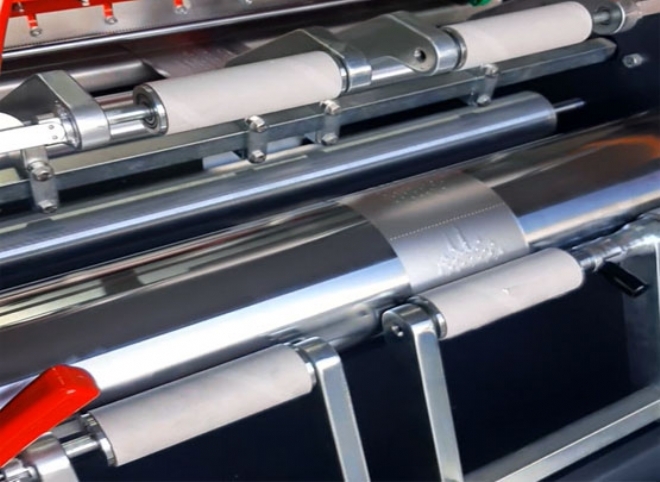
A Perforated Aluminium Foil Rewinding Machine is a specialized industrial device used in the packaging and converting industry to process large jumbo rolls (mother rolls) of aluminium foil into smaller, consumer-ready rolls with integrated perforations. Aluminium foil, typically thin sheets (ranging from 6–25 microns in thickness), is widely used for food wrapping, household applications, and specialized products like hookah (shisha) foil. The “perforated” aspect refers to the machine’s capability to create controlled perforations—weakened lines or holes—across the foil web during the rewinding process. These perforations facilitate easy tearing by the end-user, improving usability for applications such as catering rolls or single-sheet dispensing.Unlike standard rewinding machines that only wind and cut, perforated models incorporate a perforation unit to produce “tear lines” at predefined intervals (e.g., every 12 cm or 15 cm). This is particularly common for hookah foil, where the foil is often slit into narrower widths (e.g., 2–4 equal parts on a 38 mm bobbin) and perforated for quick separation into sheets. The machine enhances efficiency in high-volume production, ensuring precise length control, uniform winding tension, and minimal waste. It is typically semi-automatic or fully automatic, drawing from advanced European or Taiwanese technologies for reliability and speed.Technical Explanation and Working PrincipleTechnically, a Perforated Aluminium Foil Rewinding Machine operates on the principles of web handling and converting, where a continuous web (strip) of material is unwound, processed, and rewound under controlled tension. The process involves mechanical, electrical, and sometimes pneumatic systems to manage the delicate nature of aluminium foil, which is prone to wrinkling, tearing, or stretching due to its low thickness and high ductility. The machine’s design emphasizes precision to maintain foil integrity while adding functional features like perforations.Key Components and Their FunctionsThe machine’s architecture typically includes the following interconnected modules:
- Unwinding Unit:
- Purpose: Feeds the jumbo roll of pre-perforated or plain aluminium foil into the system.
- Technical Details: Equipped with an air shaft or expandable mandrel (e.g., 3-inch inner diameter core) to hold the mother roll, which can have diameters up to 600–700 mm and widths up to 520–600 mm. A magnetic powder brake or servo-driven tension control system (e.g., 10 kg braking force) maintains constant web tension (typically 1–5 N/cm) to prevent slack or over-stretching. Sensors (e.g., ultrasonic or photoelectric) monitor roll diameter and automatically adjust speed to avoid foil breakage.
- Advanced Features: Auto-splicing for seamless transitions between rolls in continuous operation, and edge guiding systems (e.g., using CCD cameras or ultrasonic sensors) to align the web within ±0.5 mm accuracy.
- Tension Control System:
- Purpose: Ensures even distribution of force across the web to avoid defects like telescoping (uneven winding) or creasing.
- Technical Details: Employs closed-loop feedback using load cells or dancer rollers to dynamically adjust tension. For aluminium foil (density ~2.7 g/cm³, yield strength ~20–150 MPa depending on alloy), tension is finely tuned via PLC (Programmable Logic Controller) inverters. Surface and center rewinding modes are common: surface mode uses a pressure roller for outer-layer contact, while center mode drives the core directly for tighter inner winding.
- Perforation Unit:
- Purpose: Creates perforations inline during rewinding, distinguishing this machine from standard rewinders.
- Technical Details: Utilizes a rotary perforation system with heated or mechanical blades (e.g., cross-perforation wheels) that score or punch the foil web at set intervals. Perforation density and pattern are programmable (e.g., every 12–15 cm, with 50–70% cut rate for tear strength). For hookah foil, it may include slitting knives to divide the web into multiple narrower lanes (e.g., 2–4 parts from a 38 mm bobbin). The unit operates at synchronized speeds (up to 300 m/min) with the main drive, using servo motors for precise positioning. Heat-assisted perforation (if thermal) melts localized areas without fully severing the foil, controlled by PID (Proportional-Integral-Derivative) algorithms for temperature stability (±2°C).
- Rewinding Unit:
- Purpose: Winds the processed foil onto smaller cardboard or plastic cores to form finished rolls.
- Technical Details: Often a turret-style system with 6–8 spindles for high throughput (e.g., 40 rolls/min). Cores are 25–38 mm in diameter, with finished roll outer diameters of 80–150 mm and lengths of 1–300 m. Drives include AC servo motors (e.g., 2.2 kW main motor) for variable speeds, with counter rollers applying lay-on pressure (5–20 N) for smooth, bubble-free winding. Gluing devices (nozzle-based, with hot-melt adhesive) secure the foil start/end to the core, reducing rejection rates by 10–20%. In semi-automatic models, manual core loading is used; fully automatic versions include robotic arms for core insertion and ejection.
- Cutting and Smoothing Unit:
- Purpose: Severs the web at the end of each roll and ensures a flat finish.
- Technical Details: Pneumatic or guillotine cutters activated by length sensors (e.g., encoder-based, accuracy ±1 mm). Brush rollers or air jets smooth the edges post-cut. For perforated foil, the system aligns cuts with perforation lines to avoid weak spots.
- Control and Automation System:
- Purpose: Oversees the entire process for efficiency and safety.
- Technical Details: PLC-based HMI (Human-Machine Interface) touch screen with multi-level access (operator/technician). Features include recipe storage for different foil types (e.g., household vs. catering), auto-stop on length/weight (via load cells), and fault detection (e.g., film break sensors triggering emergency halt). Power systems use frequency inverters (e.g., 2.2–0.75 kW) for energy recovery, achieving up to 20% efficiency gains. Safety interlocks comply with CE standards, including emergency stops and guarding.
Operational Workflow
- Setup: Operator loads the jumbo roll onto the unwinding shaft, selects parameters (e.g., perforation interval, roll length) via HMI, and inserts cores into the rewinding spindles.
- Unwinding and Processing: The web advances at controlled speed (50–300 m/min). Tension is maintained as the foil passes through the perforation unit, where blades create tear lines. Optional embossing (micro-patterning via engraved rollers) can be added for grip enhancement.
- Rewinding: The perforated web winds onto cores under dual-mode tension. Length is tracked by encoders or weight sensors.
- Cutting and Unloading: At target length, the web cuts automatically. Brushes smooth the roll, a sticker applicator (optional) labels it, and the turret rotates to unload.
- Monitoring: Real-time diagnostics via sensors prevent issues like web misalignment or excessive vibration (amplitude <0.1 mm).
Performance Specifications (Typical for Modern Models)
- Capacity: 20–40 rolls/min, handling foil widths 300–520 mm, thicknesses 9–25 μm.
- Speed: Up to 300 m/min, with 24/7 operation capability.
- Power Consumption: 5–10 kW, with energy-efficient drives.
- Accuracy: Length tolerance ±0.5–1%, perforation spacing ±1 mm.
- Materials: Compatible with aluminium foil, PE/PVC films, baking paper; upgrades for shrinking or cartoning.
Advantages and Considerations
- Efficiency: Reduces manual labor by 70–80% in automatic models, with low waste (<1%).
- Customization: Programmable for various perforation patterns, slitting, and embossing.
- Maintenance: Requires regular cleaning of blades/rollers to prevent residue buildup; lubricate bearings quarterly. Calibrate sensors annually for precision.
- Limitations: Sensitive to foil quality—impurities can cause jams. Not ideal for ultra-thin foils (<6 μm) without modifications.
This machine is essential for industries like food packaging and tobacco accessories, where perforated foil enables user-friendly dispensing.