What is Stainless Steel Colloid Mills used for precision grinding, emulsifying, and homogenizing?
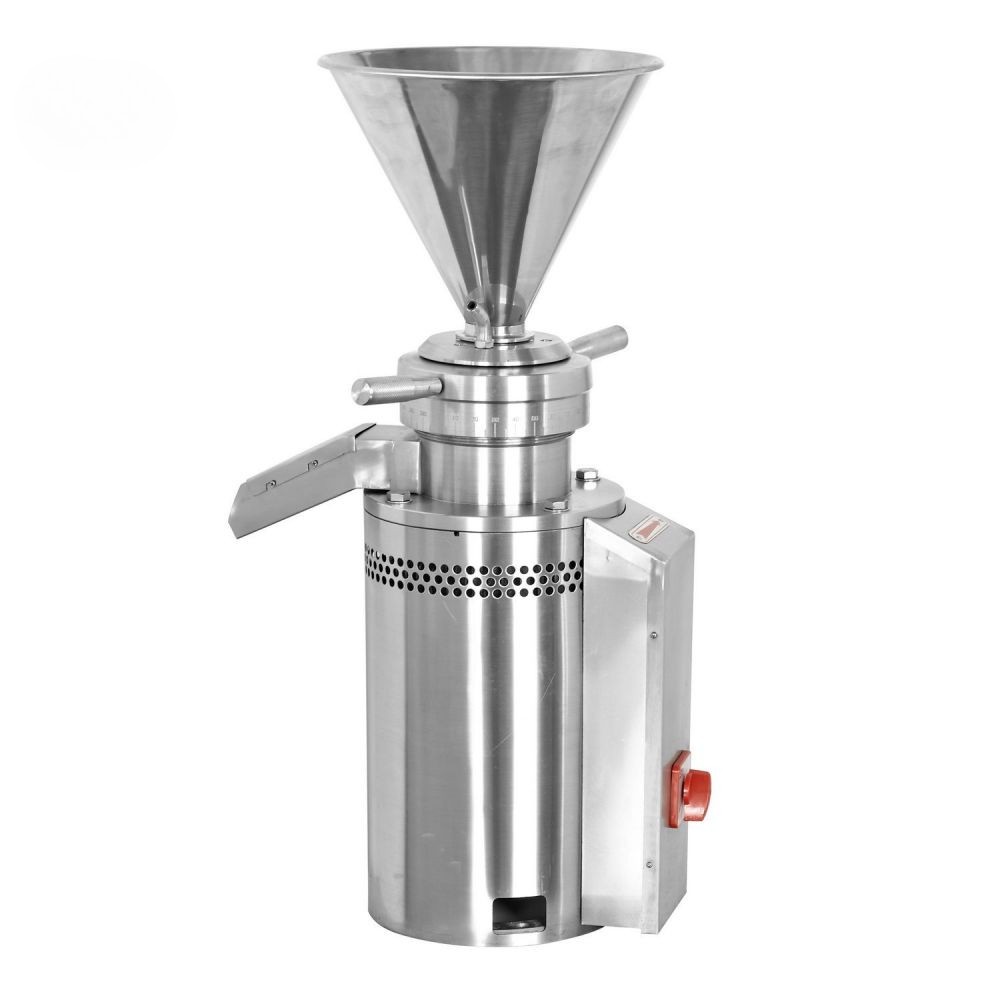
Stainless steel colloid mills are specialized machines used for precision grinding, emulsifying, and homogenizing in various industries, including food, pharmaceuticals, cosmetics, and chemicals. They are designed to process materials into fine, uniform particles or stable emulsions by subjecting them to intense shear forces, mechanical grinding, and high-speed rotation. Below is a technical explanation of their function, mechanism, and applications:Technical Overview of Stainless Steel Colloid Mills1. Working PrincipleA colloid mill operates on the rotor-stator principle, where a high-speed rotor rotates within a stationary stator, creating a narrow gap (typically adjustable between 0.1–3 mm) through which the material is processed. The key mechanisms include:
- Shear Forces: The high rotational speed of the rotor (typically 2,000–18,000 RPM, depending on the model) generates intense shear forces in the narrow gap between the rotor and stator. This breaks down particles and droplets, reducing their size and creating a uniform dispersion.
- Mechanical Grinding: The rotor and stator surfaces are often textured (e.g., toothed or grooved) to mechanically grind solid particles into finer sizes, achieving micron-level particle reduction (typically 1–50 microns).
- Centrifugal and Hydraulic Forces: The rotor’s high-speed rotation induces centrifugal forces that push the material through the gap, while hydraulic shear further aids in emulsification and homogenization.
- Cavitation and Turbulence: The rapid movement of the rotor creates localized pressure changes, leading to cavitation (formation and collapse of microbubbles), which further aids in particle size reduction and mixing.
The result is a finely ground, homogenized, or emulsified product with a smooth texture and stable consistency.2. Key Components
- Rotor: A conical or cylindrical component that rotates at high speed, often made of high-grade stainless steel (e.g., 316L) for corrosion resistance and durability.
- Stator: A stationary component surrounding the rotor, also made of stainless steel, designed to complement the rotor’s geometry.
- Adjustable Gap: The clearance between the rotor and stator can be adjusted to control the fineness of the output.
- Housing: A stainless steel casing that encloses the rotor-stator assembly, ensuring sanitary conditions and preventing contamination.
- Motor: A high-powered electric motor drives the rotor, typically with variable speed control for process optimization.
- Cooling/Heating System: Some models include jackets for temperature control to prevent overheating or to maintain specific processing conditions.
- Seals: Mechanical seals or O-rings ensure leak-proof operation, critical for hygienic applications.
3. Materials and DesignStainless steel (typically 304 or 316L) is used for its corrosion resistance, durability, and compliance with sanitary standards (e.g., FDA, GMP). The material ensures compatibility with acidic, alkaline, or abrasive substances and facilitates easy cleaning for applications requiring high hygiene, such as food and pharmaceuticals.4. Technical Specifications
- Particle Size Reduction: Achieves particle sizes as low as 1–50 microns, depending on the material and gap setting.
- Throughput: Varies from 50 L/hour to 50,000 L/hour, depending on the mill size and application.
- Power: Ranges from 1.5 kW for small-scale mills to 75 kW for industrial models.
- Rotor Speed: Typically 2,000–18,000 RPM, adjustable for specific processes.
- Viscosity Range: Can handle low-viscosity liquids (e.g., water-like) to high-viscosity pastes (e.g., peanut butter).
5. ApplicationsColloid mills are versatile and used for the following processes:
- Precision Grinding:
- Reduces solid particles to micron-sized ranges for applications like pigment dispersions, pharmaceutical suspensions, or food pastes.
- Example: Grinding nuts into smooth peanut butter or reducing active pharmaceutical ingredients (APIs) to uniform particle sizes for better bioavailability.
- Emulsifying:
- Creates stable emulsions by dispersing immiscible liquids (e.g., oil and water) into fine droplets.
- Example: Producing mayonnaise, creams, or lotions where oil and water phases are uniformly blended.
- Homogenizing:
- Ensures uniform distribution of particles or droplets in a mixture, preventing phase separation.
- Example: Homogenizing milk to prevent cream separation or creating stable cosmetic emulsions.
- Dispersing:
- Distributes solid particles evenly in a liquid medium, preventing agglomeration.
- Example: Dispersing pigments in paints or dyes in textile processing.
6. Industries and Specific Uses
- Food Industry:
- Processing sauces, mayonnaise, peanut butter, chocolate spreads, fruit purees, and dairy products.
- Example: Homogenizing milk to achieve a consistent texture or grinding soybeans for soy milk.
- Pharmaceutical Industry:
- Producing ointments, creams, gels, and suspensions with uniform particle sizes for consistent drug delivery.
- Example: Reducing API particle size for better solubility in oral suspensions.
- Cosmetics Industry:
- Creating smooth lotions, creams, lipsticks, and emulsions with fine textures.
- Example: Emulsifying silicone oils in water-based cosmetic formulations.
- Chemical Industry:
- Producing paints, coatings, lubricants, and adhesives with uniform dispersions.
- Example: Dispersing pigments in paint to ensure consistent color and finish.
- Other Applications:
- Processing battery slurries, ceramic suspensions, or nanomaterials in advanced manufacturing.
7. Advantages of Stainless Steel Colloid Mills
- High Precision: Achieves consistent particle sizes and stable emulsions, critical for quality control.
- Sanitary Design: Stainless steel construction meets stringent hygiene standards (e.g., FDA, EHEDG).
- Versatility: Handles a wide range of viscosities and material types.
- Scalability: Available in lab-scale to industrial-scale models.
- Durability: Resistant to wear, corrosion, and chemical degradation.
8. Limitations
- Heat Generation: High-speed operation can generate heat, potentially affecting heat-sensitive materials (mitigated by cooling systems).
- Maintenance: Requires regular cleaning and maintenance of rotor-stator components to prevent wear or contamination.
- Energy Consumption: High-powered motors can be energy-intensive for large-scale operations.
- Not Suitable for Dry Solids: Requires a liquid medium for effective processing.
9. Operational Considerations
- Gap Adjustment: The rotor-stator gap must be optimized for the desired particle size and material viscosity. A smaller gap increases shear but may reduce throughput or increase heat.
- Material Feed: Continuous or batch feeding affects throughput and consistency. Pre-mixing may be required for heterogeneous materials.
- Cleaning: Clean-in-place (CIP) systems or disassembly is necessary for sanitary applications to prevent cross-contamination.
- Speed Control: Variable speed settings allow customization for different materials (e.g., lower speeds for viscous pastes, higher speeds for emulsions).
10. Example Process: Emulsifying Mayonnaise
- Input: Oil, water, egg yolk, vinegar, and seasonings are fed into the mill.
- Processing: The rotor spins at 3,000–6,000 RPM, shearing the oil and water phases in the rotor-stator gap. The egg yolk acts as an emulsifier, stabilizing the mixture.
- Output: A smooth, stable emulsion with droplet sizes of 1–5 microns, resulting in creamy mayonnaise.
- Parameters: Gap set to 0.2–0.5 mm, with cooling to maintain temperatures below 40°C to preserve product quality.
ConclusionStainless steel colloid mills are precision engineered for grinding, emulsifying, and homogenizing by leveraging high shear forces, mechanical grinding, and turbulence in a rotor-stator system. Their ability to produce fine, uniform particles or stable emulsions makes them indispensable in industries requiring consistent, high-quality products. Technical optimization of gap size, rotor speed, and material feed ensures efficient processing tailored to specific applications.