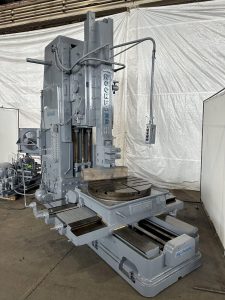
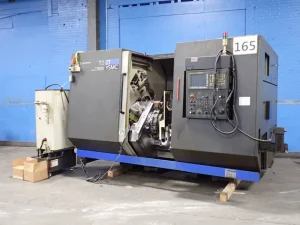
What is Spiral Matic Tube Former with Slitter?

Spiral Matic Tube Former with Slitter is an integrated line that continuously makes spiral-lock seam tubing/duct from coil stock and then cuts it to length with a flying slitter. It’s used in the sheet-metal industry for HVAC spiral duct, dust/fume extraction lines, grain/chip conveying, chimneys, culverts, etc.
How it works (process flow)
- Decoiling & straightening – Galvanized steel, stainless, aluminum, or coated coils are uncoiled and leveled.
- Edge profiling – The strip edges are pre-formed to create the interlocking spiral lock seam geometry.
- Tube forming – An adjustable forming cage/head wraps the strip helically; rolls force the profiled edges together to create a gas-tight, mechanically locked seam while the tube advances forward.
- Length measuring – An encoder tracks tube length.
- Flying slitter (cut-off) – A circular slitting saw (or shear/plasma on some models) accelerates to line speed and orbits the tube to cut squarely without stopping the line; burr and deformation are minimized.
- Run-out/stacking – The finished tube exits to a run-out table or cradle.
“With slitter” here denotes the flying cut-off around the finished tube. Some machines also have an inline strip-slitting cassette to narrow the feed strip for small diameters—this is a separate option.
Key assemblies
- Single/dual decoiler with brake and peeler; coil OD & weight per spec.
- Pinch/straightener and edge-forming rolls (seam profile tooling).
- Adjustable forming cage (mechanical scale or servo set) covering a diameter range; bead/stiffening rolls may be integrated.
- Lock-seam closer ensuring uniform seam compression.
- Lubrication (spray/roller) for seam and blade life.
- Flying slitter carriage with circular blade, servo drives, guard, and mist extraction; alternative guillotine shear for soft aluminum.
- PLC/HMI for diameter set-up, length, batch size, speed, diagnostics.
- Safety: perimeter guards, interlocks, two-hand jog, E-stops.
Typical capacity (varies by model)
- Diameter range: ~Ø80–1600 mm (3–63 in); heavy-duty lines may go larger.
- Material thickness: 0.4–1.2 mm (24–18 ga) galvanized is common; up to 1.5–2.0 mm on reinforced versions for small diameters.
- Line speed: 8–40 m/min depending on gauge/diameter and cutter type.
- Length tolerance: ±(2–3) mm typical; roundness ≤1–2% of Ø with proper set-up.
- Materials: DX51D+Z (GI), 304/316 SS, Al-Mg alloys, pre-painted coils.
Output & seam quality
- Spiral lock seam (4-ply interlock) gives high stiffness and low leakage; meets HVAC standards (e.g., SMACNA, DW/144 leak classes when sealed).
- Optional stiffening beads, perforated liner, or sealant injection for higher pressure classes and noise control.
Advantages vs longitudinally seamed duct
- Continuous production with flying cut-off → high throughput and consistent lengths.
- High section rigidity from the spiral lock + beads → thinner gauges possible for a given pressure/diameter.
- Fewer joints over long runs, good aerodynamic smoothness, and efficient material usage.
What to specify when buying
- Diameter envelope and quick-change tooling (manual vs servo).
- Supported gauges/materials and required seam profile set.
- Cut-off type (circular slitter vs shear vs plasma) and burr/spark control.
- Length/diameter preset recipes, encoder resolution, and batch logic.
- Options: beader, sealant applicator, strip slitter, inline marker/labeler, stacker, and dust extraction at the saw.
- Compliance (CE, OSHA/NR-12), guarding, and fume/noise mitigation.
Practical set-up tips
- Match strip width to target diameter (pitch) and seam profile; wrong width causes ovality or open seam.
- Verify seam roll pressure and lubrication—under-compression leaks, over-compression cracks coatings.
- Keep saw blade sharp and speed-matched to line speed to avoid heat tint and burring.
Bottom line: A Spiral Matic Tube Former with Slitter is a high-productivity, CNC/PLC-controlled helical duct line that forms a spiral lock-seam tube from coil and cuts it to length on the fly, delivering round, stiff, and low-leakage tubes for industrial and HVAC sheet-metal applications.