24/08/2025
What is Industrial Stainless Steel Wiped Film Evaporator?
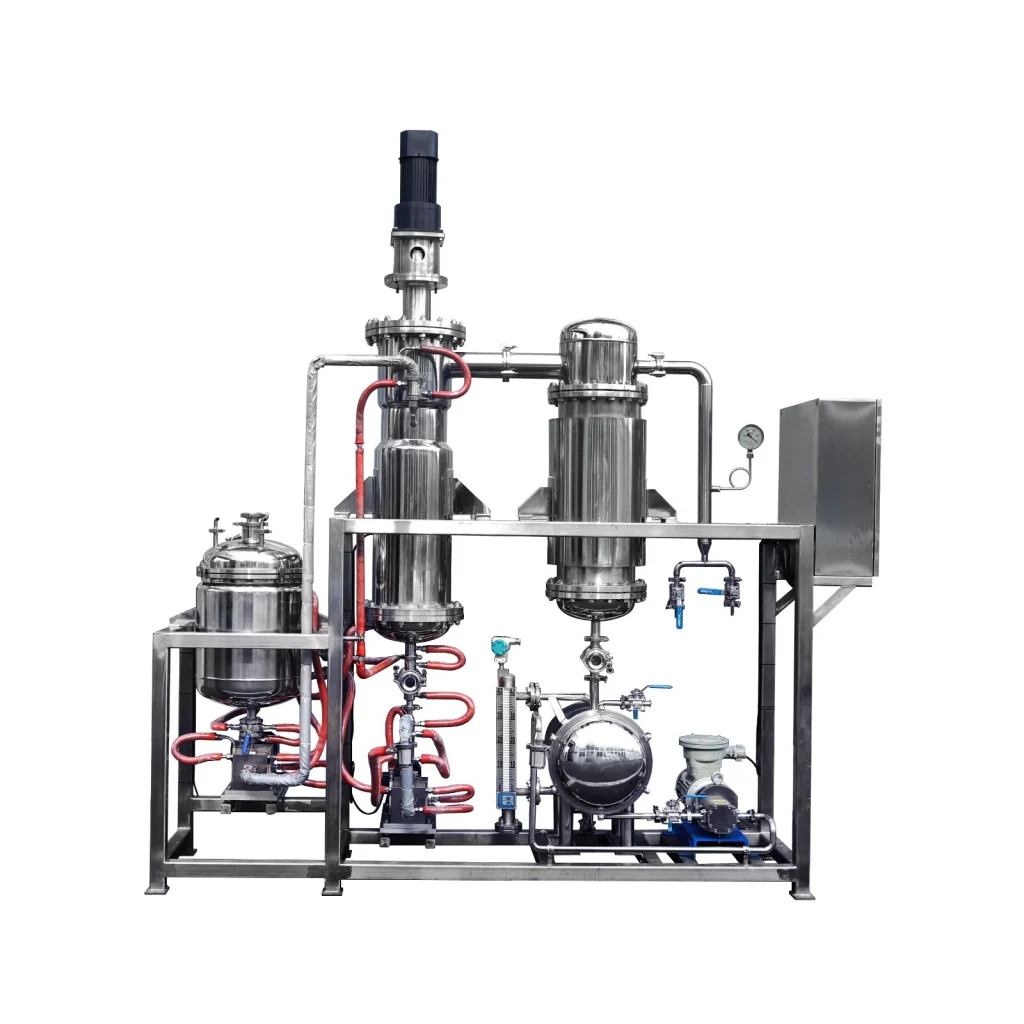
Industrial Stainless Steel Wiped Film Evaporator (WFE) is a continuous, thin-film evaporation system designed to concentrate, strip solvents, or gently distill heat-sensitive, viscous, or fouling liquids. A rotating wiper spreads feed as a 0.1–1.0 mm film over a heated cylindrical wall; high surface renewal and very short residence time (typically 3–60 s) enable rapid mass/heat transfer at low bulk temperatures under vacuum.
How it works — unit operations
- Feed & preheat/degassing → optional feed tank & preheater remove non-condensables/flash.
- Film formation → rotor with wiper blades or rollers spreads liquid as a uniform thin film on the heated 316L stainless shell.
- Evaporation → heat (thermal oil/steam) drives volatile components to vapor; intense shear keeps film turbulent even at high viscosity.
- Vapor handling → vapors travel a short path to an external condenser (WFE) or to an internal condenser (Short-Path/Molecular variant).
- Discharge → concentrated residue is scraped downward and removed via gear or lobe pump; condensate collected separately.
- Vacuum → 1–200 mbar for WFE; 0.001–5 mbar for short-path duty depending on product and solvent.
Key assemblies (stainless steel)
- Heated shell/evaporation body: SS316L (often Hastelloy for chlorides/acids).
- Rotor & wipers: SS shaft with PTFE/graphite/PEEK wipers or spring-loaded rollers; tip clearance ≈ 0.5–2 mm.
- Mechanical seals: double-cartidge with barrier fluid; dry-running options for solvents.
- Jacket: thermal-oil or steam; design pressure/temperature commonly 6–10 bar / up to 300 °C (oil).
- Vacuum train: dry screw/claw pumps with boosters, cold trap.
- Condenser(s): shell-and-tube or internal (short-path).
- Instrumentation: inlet/outlet temps, jacket inlet/return, vacuum gauge, Coriolis or mag flow, ΔP, level, RTDs along body.
Why it’s used (process advantages)
- Short residence + high shear → protects thermolabile compounds, minimizes polymerization/coking.
- Handles wide viscosities (≈ 0.1 up to 50,000 mPa·s warm) and slurries with crystals.
- Low ΔT operation under vacuum; high overall U from continuous film renewal.
- Low holdup volume, fast start/stop & grade changes.
- Scalable: surfaces from 0.05 to >20 m² per body; modular trains (multiple effects).
Typical operating ranges
- Rotor speed: 100–1,000 rpm (size-dependent).
- Evap. rate: broadly 5–150 kg m⁻² h⁻¹ (solvent & duty dependent).
- Film thickness: 0.1–1.0 mm.
- LMTD: often 10–40 K under vacuum.
- Feed solids: up to 80 wt% in some services.
Process design cues (what to specify)
- Product data: viscosity vs T, boiling curve, thermal stability, fouling tendency, solids/crystals.
- Targets: feed flow, inlet/outlet solvent %, max product temp, allowable residence time.
- Duty: single-stage vs multi-effect, WFE vs Short-Path (internal condenser for high-boiling, high-vacuum molecular distillation).
- Materials & finish: SS316L, electropolished Ra ≤ 0.8 µm for pharma/food; ASME BPE where needed.
- CIP/SIP: spray balls, drainability, elastomer compatibility (FKM/EPDM/PTFE).
- Safety: explosion protection (ATEX/NFPA), nitrogen blanketing, solvent recovery.
Applications
- Pharma/biotech: solvent removal after synthesis, APIs, vitamins, lipids.
- Fine chemicals: monomers/oligomers, plasticizers, specialty resins, amines.
- Food/nutraceutical: flavors, oils, omega-3, botanical extracts.
- Polymers: pre-polymer concentration, residual monomer stripping.
- Waste/solvent recovery: reclaiming high-value solvents from residues.
WFE vs Short-Path (Molecular) — quick compare
- WFE (external condenser): better for solvent stripping/concentration; vac ~1–200 mbar; simpler, higher throughputs.
- Short-Path: internal condenser, mean free path scale → works at very low pressure for high-boiling, thermally sensitive products (e.g., tocopherols, waxes, cannabinoids) with sharper separations.
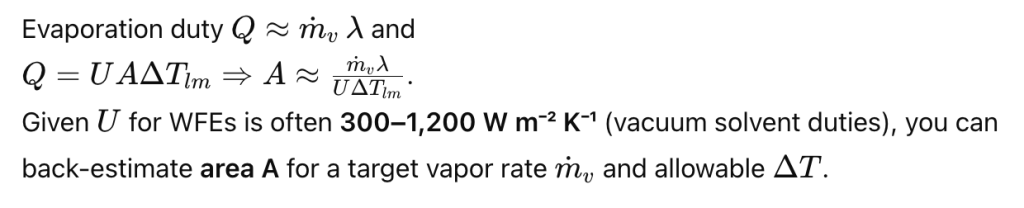
Performance/scale of estimate
Practical tips
- Choose roller-type rotors for abrasive/fouling feeds; blade-type for general duty and gentle films.
- Keep inlet viscosity within spec by preheating; viscosity dominates film quality.
- Size the vacuum system for non-condensables + leak rate, not just ideal vapor load.
- Install cold traps to protect pumps; use heat-traced lines to avoid condensing in the body.
- For sticky products, specify variable-speed drive and segmental wipers for easy changeover.
Bottom line: A stainless steel WFE is a high-shear, short-residence, vacuum evaporator that delivers fast, gentle solvent removal or separation for difficult, heat-sensitive, and viscous streams—common across pharma, fine chemicals, food oils, and polymer intermediates.