What is Single-component Metering & Dispensing System tank-to-tip metering system for single component sealants and adhesives?
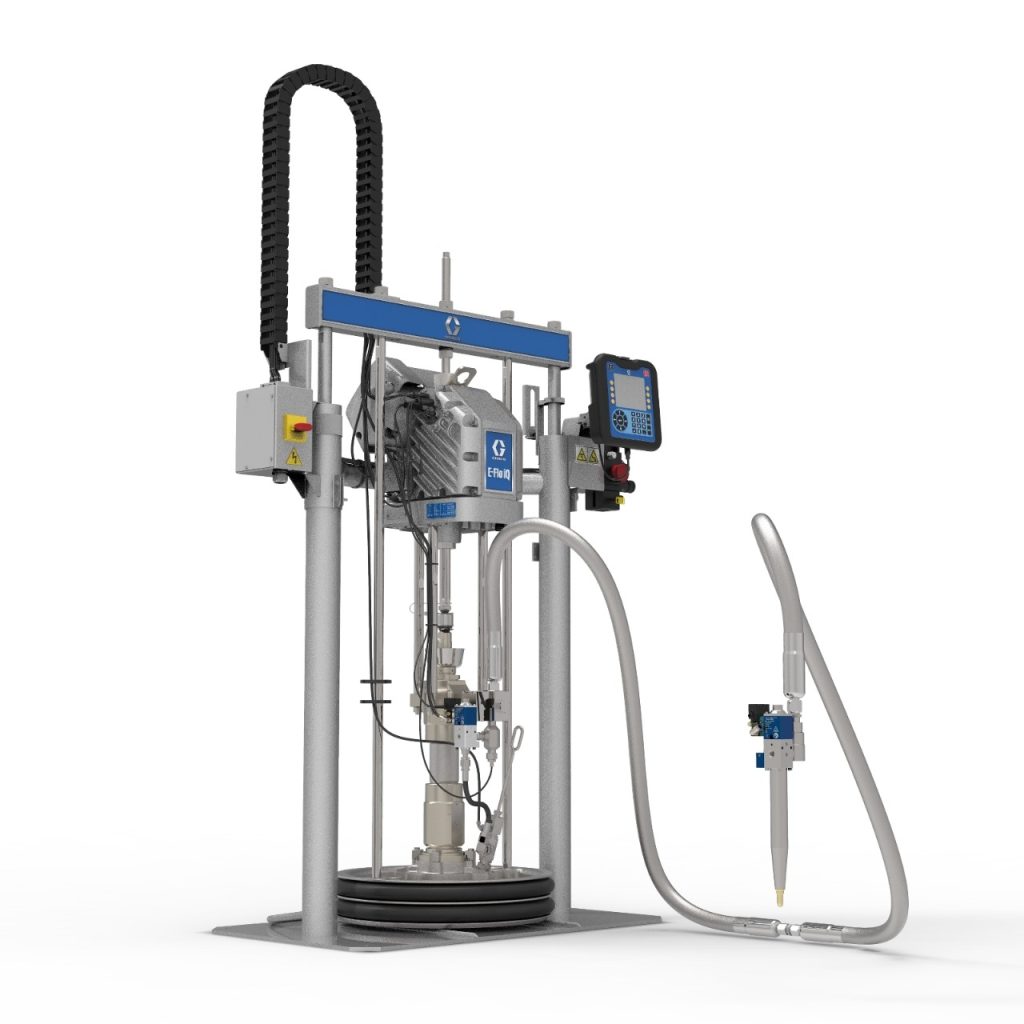
Overview of Single-Component Metering & Dispensing SystemsA Single-Component Metering & Dispensing System is an industrial fluid handling technology designed for precise application of one-component (1K) sealants and adhesives. These materials, such as silicones, urethanes, or acrylics, are pre-formulated and do not require on-site mixing with a second component, unlike two-component (2K) systems. The system ensures accurate volume control, consistent flow rates, and repeatable deposition patterns (e.g., beads, dots, or sprays) to minimize material waste, reduce defects, and enhance manufacturing efficiency. Common applications include automotive assembly (e.g., structural bonding), electronics potting, and general sealing in industrial production.The “tank-to-tip metering system” refers to an end-to-end, integrated process that controls material flow from the bulk storage tank (or supply source like a drum or pail) directly to the dispensing tip (nozzle) without intermediate reservoirs or complex external dosing setups. This approach maintains uniform pressure and flow throughout the fluid path, preventing variations due to material viscosity changes, temperature fluctuations, or pump inconsistencies. A prominent example is Graco’s E-Flo iQ system, which exemplifies this tank-to-tip architecture for robotic or automated dispensing.Technical ExplanationCore Components and ArchitectureThe system typically comprises the following interconnected elements, forming a closed-loop or semi-closed fluid circuit:
- Material Supply (Tank/Drum):
- Bulk storage in pails, drums (e.g., 5–55 gallons), or totes, often at ambient or controlled temperatures.
- Materials like single-component sealants (e.g., RTV silicones) or adhesives (e.g., hot-melt or anaerobic types) are drawn directly from the supply without pre-heating tanks in non-thermal systems.
- Technical note: Viscosity ranges from low (e.g., 1,000–10,000 cP for thin adhesives) to high (e.g., >100,000 cP for filled sealants), requiring pumps tolerant of abrasives or fillers.
- Pumping Mechanism:
- Type: Positive displacement pumps, such as piston pumps or progressive cavity pumps, are standard. In advanced systems like the E-Flo iQ, an electric servo-driven motor powers a piston pump.
- Operation: The servo motor uses position feedback (e.g., encoder data) to precisely control piston stroke length and speed, enabling volumetric metering. Flow rates can range from low (e.g., 0.1–5 cc/min for micro-dispensing) to high (e.g., up to 6,400 cc/min for continuous extrusion).
- Technical Precision: Achieves ±1% repeatability in shot volume or flow rate by calculating dispensed volume as V=A×SV = A \times S
V = A \times S, where ( A ) is the piston cross-sectional area and ( S ) is the stroke distance. No external dosing valves are needed, reducing complexity.
- Metering and Flow Control:
- Method: Volumetric metering via the pump’s displacement, augmented by flow meters (e.g., gear or Coriolis-type) for real-time feedback.
- Closed-Loop Control: Integrates sensors (e.g., pressure transducers at inlet, outlet, and hose) and a PLC (Programmable Logic Controller) or touchscreen interface. The controller adjusts pump velocity dynamically to maintain setpoint flow or pressure.
- Pressure regulation: Maintains constant pressure (e.g., 50–500 psi) from tank to tip, compensating for backpressure or material shear-thinning.
- Flow consistency: Servo control ensures velocity v=QAv = \frac{Q}{A}
v = \frac{Q}{A}(where ( Q ) is volumetric flow rate), preventing pulsations common in pneumatic pumps.
- Tank-to-Tip Integration: The fluid path is minimized (e.g., direct hose from pump to robot-mounted valve), eliminating intermediate accumulators. This reduces residence time, preventing premature curing or settling in reactive materials.
- Dispensing Valve/Applicator (Tip):
- Types: Pneumatic or electric on/off valves, such as tip-seal (prevents drooling), snuff-back (retracts material to avoid stringing), or ball-seat models. Heated variants support applications up to 158°F (70°C) for viscosity reduction.
- Operation: Valve opens/closes in milliseconds (e.g., <50 ms response time) for sharp start/stop control. Dispense patterns are programmed via the controller, synchronizing with automation (e.g., robot speed).
- Technical Features: Positive shut-off via rod or pinch mechanisms ensures zero post-dispense flow. For low-flow apps, metering rods provide displacement control down to 0.01 cc accuracy.
- Hoses and Fluid Path:
- Heated or insulated hoses (e.g., 1/4–1/2 inch diameter) maintain material properties. Length minimized (e.g., 5–20 ft) to reduce pressure drop, calculated as ΔP=8μLQπr4\Delta P = \frac{8 \mu L Q}{\pi r^4}
\Delta P = \frac{8 \mu L Q}{\pi r^4}(Hagen-Poiseuille equation for laminar flow, where μ\mu\muis viscosity, ( L ) length, ( Q ) flow, ( r ) radius).
- Heated or insulated hoses (e.g., 1/4–1/2 inch diameter) maintain material properties. Length minimized (e.g., 5–20 ft) to reduce pressure drop, calculated as ΔP=8μLQπr4\Delta P = \frac{8 \mu L Q}{\pi r^4}
- Control System:
- Electronics: Industrial PLC or servo controller with HMI (Human-Machine Interface) for parameter storage (e.g., bead length, speed, temperature).
- Monitoring: Real-time diagnostics for pressure, flow, and pump position. Alarms for deviations (e.g., >5% flow variance).
- Automation Integration: Interfaces with robots (e.g., via Ethernet/IP) for synchronized dispensing, reducing payload (e.g., only valve on robot arm).
Operational Principles
- Metering Process: Material is pumped on-demand from the tank. The servo motor’s position sensor tracks piston movement, computing dispensed volume in real-time. Feedback loop: If pressure drops (e.g., due to high viscosity), motor speed increases to sustain ( Q ).
- Dispensing Modes:
- Shot Dispensing: Discrete volumes (e.g., 0.1–100 cc) with high repeatability (±1%).
- Continuous Flow: Steady bead application, ideal for sealing paths, with flow rates synced to applicator velocity (e.g., 10–100 mm/s).
- Bead Quality: Uniform cross-section maintained by constant pressure, avoiding tails or voids.
- Advantages in Tank-to-Tip Design:
- Consistency: End-to-end pressure control (±5 psi stability) prevents flow variations from tank level changes or material inconsistencies.
- Efficiency: Direct metering eliminates reload cycles (unlike shot meters), enabling continuous operation. Reduces components (e.g., no separate dosers), lowering maintenance (e.g., fewer seals to replace).
- Scalability: Handles viscosities up to 1,000,000 cP and temperatures from ambient to 70°C, suitable for filled or abrasive materials.
- Cost-Effectiveness: Lightweight setup for robotics (e.g., <5 kg payload), with low energy use (electric vs. pneumatic).
Limitations and Considerations
- Not ideal for ultra-high viscosities (>1,000,000 cP) without heating.
- Requires clean material supply to avoid pump clogs.
- System calibration (e.g., via flow verification) is essential for long-term accuracy.
This technology, as seen in systems like the E-Flo iQ, revolutionizes single-component applications by providing intelligent, automated control for high-precision manufacturing.