What is Portable Pipe Beveling Machine?
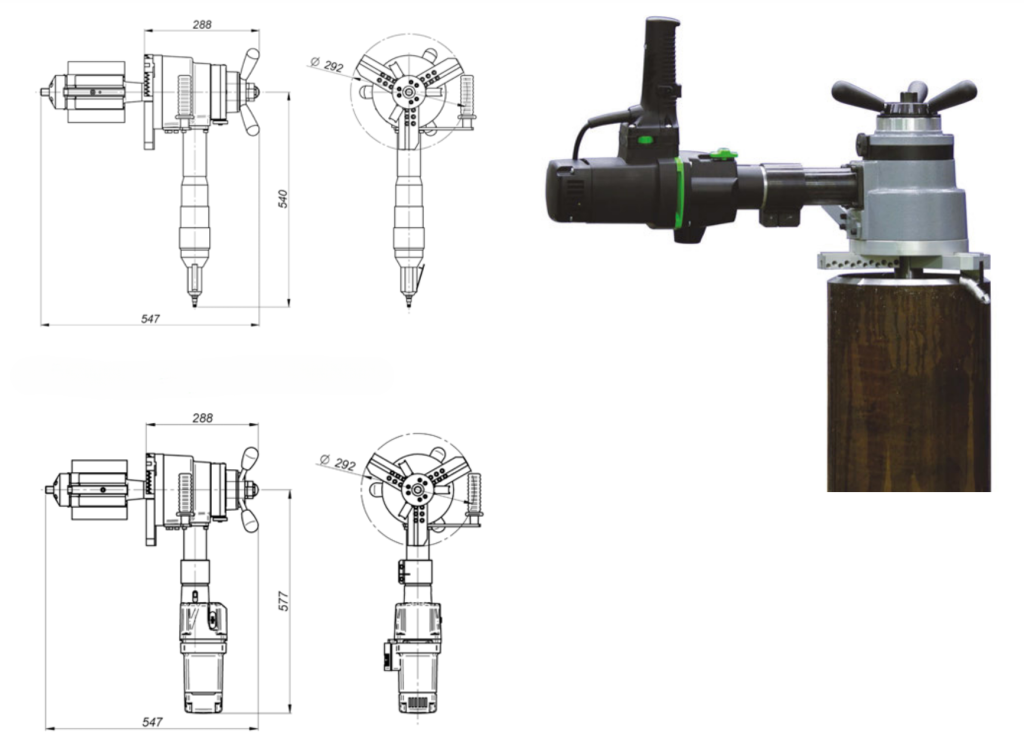
A portable pipe beveling machine is a compact, mobile machining tool designed to create precise angled edges (bevels) on the ends of pipes or tubes, primarily for weld preparation. Unlike stationary industrial bevelers, these machines are lightweight (typically 10–50 kg), self-contained, and engineered for on-site or field use, allowing a single operator to transport and set up the device without heavy infrastructure. They employ cold-cutting techniques—such as milling, facing, and counterboring—using carbide or high-speed steel inserts to remove material without generating heat-affected zones (HAZ), sparks, or flames, which is critical for maintaining material integrity in alloys like stainless steel or carbon steel.Technically, these machines operate on principles of rotational machining: a motorized head (electric, pneumatic, or hydraulic) drives a cutting tool assembly that rotates around the pipe’s circumference while advancing axially. The setup ensures concentricity (alignment within ±0.025 mm) and squareness (±0.015 mm) for high-precision weld joints, reducing defects like incomplete fusion or distortion. Common configurations include:
- ID (Internal Diameter) Clamping Models: Expandable mandrels or jaws grip the pipe’s interior bore via a draw-rod mechanism, pulling jaw blocks up an inclined ramp for torque-resistant fixation. Suitable for pipes with IDs from 12.4 mm to 1,016 mm.
- OD (Outer Diameter) Clamping Models: Use external saddles, bands, or rollers to secure the pipe, ideal for larger diameters (up to 914 mm OD) where internal access is limited.
- Hybrid or Split-Frame Designs: Modular frames that clamp externally and allow tool insertion for simultaneous operations like beveling and facing.
Power sources vary: electric (115V/230V, 1–2 hp) for workshop precision, pneumatic (90–100 psi) for hazardous environments, or battery/hydraulic for remote sites. Feed rates range from 2–26 inches per minute (ipm), with spindle speeds up to 200 RPM for efficient material removal. Cutting inserts (e.g., 6 replaceable carbide blades) work in tandem to produce a machined finish (Ra < 3.2 μm), adjustable land widths (0–4.8 mm), and bevel angles (15°–60°, commonly 30°, 37.5°, or 45° for V, J, U, or compound preps).Technical Explanation for the Sheet Metal SectorIn the sheet metal sector—encompassing fabrication of ducts, enclosures, structural components, and tubular assemblies from sheet-derived pipes or tubes—these machines address edge preparation challenges where weld quality directly impacts structural integrity, aesthetics, and compliance (e.g., ASME or ISO standards). Sheet metal work often involves thinner-walled (0.5–10 mm) cylindrical sections formed from flat sheets via rolling or bending, making portability essential for iterative fabrication workflows without transporting bulky parts to fixed stations.Key Technical Aspects Relevant to Sheet Metal:
- Material Compatibility and Processing:
- Handles sheet metal-derived pipes in carbon steel, stainless steel, aluminum, duplex, or Inconel, with wall thicknesses up to 10 mm (e.g., Steelmax PB10 or Exact PipeBevel series).
- Cold beveling prevents HAZ (up to 1–2 mm wide in thermal methods), preserving corrosion resistance and ductility in coated or thin sheets. For example, milling with indexable carbide inserts removes 0.1–2 mm per pass at feed rates of 0.05–0.2 mm/rev, minimizing burrs and ensuring flat lands for butt welds.
- Precision and Tolerances:
- Self-centering clamps (e.g., via worm gears or recirculating ball bearings) achieve radial runout <0.05 mm and axial squareness <0.015 mm, critical for sheet metal tubes prone to ovality from forming.
- Multi-tool holders enable simultaneous facing (squaring the end), beveling (angled groove), and counterboring (internal chamfer), reducing cycle times to 45–120 seconds per end. Adjustable torque keys compensate for insert wear, preventing vibration that could distort thin sheet metal (e.g., 1–3 mm walls).
- Adaptations for Sheet Metal Applications:
- Small-Diameter Focus: Many models (e.g., TAG or GBC series) target ½”–24″ (12–610 mm) OD, aligning with sheet-formed ducts or HVAC tubing. Built-in pipe rollers or stoppers facilitate repeatable bevels on batches of uniform sections.
- Versatility for Hybrid Work: While optimized for pipes, models like the SKF 025 or Steelmax BM25 integrate plate beveling capabilities, beveling straight edges on sheet metal plates (15°–60° angles, up to ¾” land) or curved sections. This is useful in sheet metal shops fabricating elbows, flanges, or transitions from flat stock.
- Ergonomics and Portability: Weighing 15–25 kg, with quick-setup (e.g., 5-minute band clamping), they suit mobile fabrication bays. Torque-reactive designs eliminate vise needs, allowing in-place machining on assembled sheet metal frames.
- Operational Parameters:
- Bevel Geometry: Produces V-preps (single bevel for 1G position welding), J-preps (compound for thick walls), or U-grooves. Angle accuracy ±1°, depth control via micrometer feeds (0.01 mm resolution).
- Safety and Efficiency: No open flames suit dusty sheet metal environments; low-maintenance gear drives (tapered roller bearings) handle 8–10 hour shifts. For high-volume sheet metal runs, automatic models (e.g., Exact PipeBevel 220E) integrate with CNC for consistent OD beveling.
- Limitations in Sheet Metal Context: Best for cylindrical sections; flat sheet beveling may require dedicated plate bevelers. Not ideal for ultra-thin sheets (<0.5 mm) due to clamping risks.
In summary, portable pipe beveling machines enhance sheet metal workflows by enabling precise, on-demand weld prep that boosts joint strength (e.g., reducing weld defects by 20–30%) and throughput, particularly in fabrication of pressure vessels, boilers, or architectural metalwork