What is Single-Column Hydraulic Press Machine?
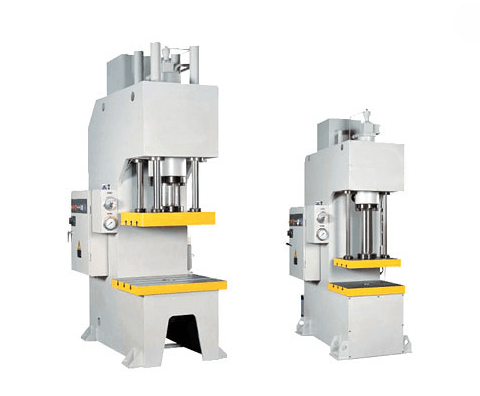
A Single-Column Hydraulic Press Machine, also known as a C-frame hydraulic press, is a versatile piece of equipment widely used in the sheet metal sector for various forming, stamping, and assembly operations. Its design features a single, vertical C-shaped frame, which provides structural stability and open access to the work area from three sides, making it ideal for handling sheet metal components. Below is a technical explanation of the machine, tailored to its applications in the sheet metal industry:Structure and Components
- Frame: The single-column (C-frame) design is a welded or cast steel structure resembling the letter “C.” It consists of a vertical column, a horizontal bed (lower platen), and an upper platen or ram housing. The open design allows easy loading and unloading of sheet metal workpieces.
- Hydraulic System: The core of the machine is its hydraulic system, which includes:
- Hydraulic Cylinder: A single or double-acting cylinder that drives the ram (movable upper platen) to exert force.
- Hydraulic Pump: Typically a gear or piston pump, powered by an electric motor, that pressurizes hydraulic fluid.
- Valves and Controls: Directional control valves, pressure relief valves, and flow control valves regulate the movement and force of the ram.
- Reservoir: Stores hydraulic fluid, typically oil, which transmits power to the cylinder.
- Ram/Platen: The ram is the moving component that applies force to the sheet metal workpiece. It is guided by precision bearings or slides to ensure accurate movement.
- Worktable/Bed: The stationary lower platen where the sheet metal and tooling (dies, molds) are placed.
- Control System: Modern machines feature programmable logic controllers (PLCs) or CNC systems for precise control of ram movement, pressure, and cycle time. Touchscreens or manual controls allow operators to set parameters.
- Tooling/Dies: Custom or interchangeable dies are mounted on the ram and bed to perform specific operations like punching, bending, or forming.
Working PrincipleThe single-column hydraulic press operates on Pascal’s principle, where pressure applied to a confined fluid is transmitted equally in all directions. The hydraulic pump pressurizes the fluid, which drives the piston in the hydraulic cylinder. This moves the ram downward to apply force on the sheet metal placed between the die and the bed. The force, stroke length, and speed are adjustable, making the machine suitable for a range of sheet metal operations.Technical Specifications
- Force Capacity: Typically ranges from 10 to 500 tons, depending on the machine size and application. For sheet metal, 50–200 tons is common for bending, stamping, or punching.
- Stroke Length: Adjustable stroke (e.g., 100–500 mm) to accommodate different workpiece thicknesses and die heights.
- Speed: Hydraulic presses offer variable speeds, with approach, pressing, and return phases. Typical pressing speeds range from 5–30 mm/s, while approach/return speeds are faster (50–150 mm/s).
- Daylight: The maximum vertical clearance between the ram and bed, typically 300–1000 mm, to accommodate large sheet metal parts or tall dies.
- Accuracy: Modern presses achieve positional accuracy of ±0.01 mm with CNC control, critical for precision sheet metal forming.
- Power Supply: Electric motors (e.g., 5–50 kW) drive the hydraulic pump, with power requirements varying by press capacity.
Applications in the Sheet Metal Sector
- Bending: Forming sheet metal into angles or complex shapes using V-dies or custom tooling. The press applies controlled force to deform the metal along a predetermined axis.
- Punching/Blanking: Cutting holes or shapes in sheet metal using punch-and-die sets. The press forces the punch through the sheet into the die, creating precise cutouts.
- Stamping/Forming: Creating complex shapes, embossing, or deep drawing sheet metal into components like automotive panels, appliance housings, or brackets.
- Shearing/Trimming: Removing excess material from sheet metal edges for clean, precise finishes.
- Assembly: Press-fitting or joining sheet metal components, such as riveting or clinching, to create assemblies without welding.
- Coining: Applying high pressure to create fine details or improve surface finish on sheet metal parts.
Advantages for Sheet Metal Work
- Accessibility: The C-frame’s open design allows easy access for loading/unloading large or complex sheet metal parts and quick die changes.
- Versatility: Suitable for a wide range of operations (bending, punching, forming) on various metals (steel, aluminum, stainless steel, etc.).
- Precision: Hydraulic systems provide smooth, controlled force application, ensuring uniform deformation and high repeatability.
- Compact Footprint: Single-column presses require less floor space compared to double-column or four-column presses, ideal for small workshops.
- Adjustability: Variable force, speed, and stroke settings allow customization for different sheet metal thicknesses (e.g., 0.5–10 mm) and material properties.
Limitations
- Force Distribution: The single-column design may experience slight deflection under high loads, limiting its use for extremely heavy-duty applications (e.g., >500 tons).
- Speed: Hydraulic presses are slower than mechanical presses for high-volume production, though they excel in precision and flexibility.
- Maintenance: Hydraulic systems require regular maintenance (e.g., fluid checks, seal replacements) to prevent leaks or contamination.
Safety Features
- Light Curtains: Infrared sensors to halt operation if hands or objects enter the work area.
- Two-Hand Controls: Requires operators to use both hands to initiate the cycle, preventing accidents.
- Emergency Stop: Immediate shutdown mechanism for safety.
- Overload Protection: Pressure relief valves prevent damage to the machine or tooling under excessive force.
Materials and Tooling
- Sheet Metal: Commonly processed materials include mild steel, stainless steel, aluminum, copper, and alloys, with thicknesses typically ranging from 0.5 mm to 10 mm.
- Tooling: Dies are made from hardened tool steel (e.g., D2, A2) or carbide for durability. Custom dies are designed for specific operations, such as progressive stamping or deep drawing.
Modern Advancements
- Servo-Hydraulic Systems: Replace traditional hydraulic pumps with servo motors for improved energy efficiency and precise control.
- Automation Integration: Compatibility with robotic arms or automated material handling systems for high-volume sheet metal production.
- IoT and Monitoring: Sensors for real-time monitoring of pressure, temperature, and cycle times, enabling predictive maintenance and data-driven optimization.
Example Use CaseIn an automotive sheet metal workshop, a 100-ton single-column hydraulic press is used to bend 2 mm thick steel sheets into door panel reinforcements. The press is equipped with a CNC controller to set a precise bending angle of 90° with a tolerance of ±0.1°. The operator loads the sheet onto a V-die, and the ram descends at 10 mm/s, applying 80 tons of force to form the bend. The open C-frame allows easy removal of the formed part, and the process is repeated for 500 parts per shift.In summary, the single-column hydraulic press is a critical tool in the sheet metal sector due to its flexibility, precision, and compact design. It excels in small to medium-scale production and prototyping, where accessibility and adaptability are key.