What is Recycling of Textile Waste Machine ?
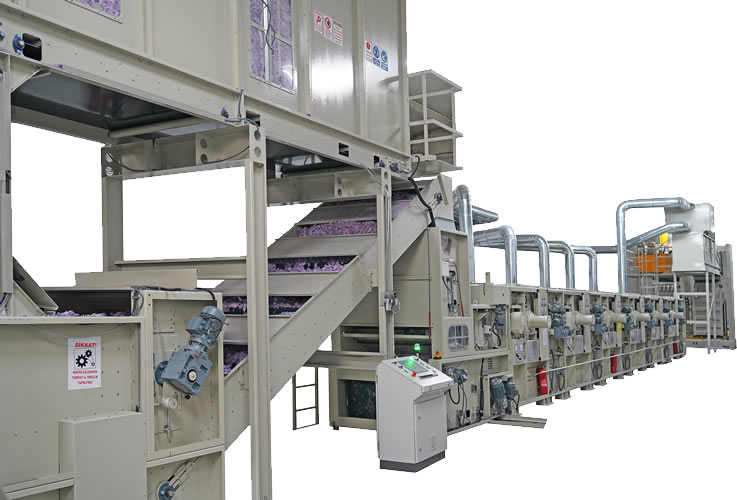
A Textile Waste Recycling Machine is an industrial mechanical processing system designed to recover usable fibers from textile waste by opening, cleaning, blending, and re-conditioning discarded textile materials so they can be reused in new textile production or secondary applications.
Below is a technical, sector-focused explanation, written for professionals in the textile machinery and recycling industry.
1. What Is Textile Waste?
Textile waste typically consists of:
- Pre-consumer waste
- Spinning waste
- Weaving and knitting selvage
- Cutting room scraps
- Post-consumer waste
- Used garments
- Household textiles
- Industrial textile waste
- Nonwoven offcuts
- Carpet waste
- Technical textile scrap
These materials still contain valuable fibers (cotton, polyester, blends) but are compressed, tangled, or contaminated, making them unsuitable for direct reuse without processing.
2. Purpose of a Textile Waste Recycling Machine
The machine’s core objective is to:
Mechanically convert textile waste back into loose, reusable fiber form, while preserving fiber length as much as possible and removing impurities.
This enables:
- Re-spinning
- Open-end yarn production
- Nonwoven manufacturing
- Insulation and filling material production
- Fiber blending with virgin material
3. Core Working Principle (Mechanical Recycling)
Textile waste recycling machines operate using mechanical fiber opening technology, not chemical dissolution.
Main Processing Logic:
- Feeding
- Opening
- Cleaning
- Blending
- Output fiber discharge
The process relies on rotating drums fitted with needles, teeth, or pins, combined with controlled feed systems and suction airflow.
4. Main Components of a Textile Waste Recycling Line
A typical complete recycling line (such as a 5-stage system) consists of the following:
4.1 Guillotine / Pre-Cutting Unit
- Cuts large textile pieces into manageable sizes
- Ensures consistent feeding
- Prevents overloading of drums
4.2 Feed Chute System
- Regulates material flow
- Often equipped with:
- Steel grooved rollers
- Rubber pressure rollers
- Controlled by frequency inverters (VFDs)
4.3 Multi-Stage Opening (Shifanoz / Sifonez / Opener)
- Core of the machine
- Consists of multiple drum sections (e.g. 5 or 6 stages)
- Each drum progressively:
- Opens fibers
- Reduces clumps
- Releases trapped impurities
Technical advantage of multi-stage design:
- Lower fiber damage
- Better fiber length preservation
- Higher cleaning efficiency
4.4 Cleaning & Separation
- Dust, lint, and foreign particles removed via:
- Adjustable blades
- Airflow channels
- Filters
- Jamming protection via motor amperage monitoring
4.5 Press / Baling Unit
- Compresses recycled fiber into bales
- Facilitates storage and transport
4.6 Dust Filter System
- Industrial filtration (bag filters or cyclones)
- Essential for:
- Worker safety
- Environmental compliance
- Machine longevity
5. Technical Parameters (Typical Industrial Range)
| Parameter | Typical Value |
|---|---|
| Recycling capacity | 500 – 1,500 kg/hour |
| Number of stages | 3 – 6 drums |
| Drum width | 1.2 – 1.8 m |
| Line length | 20 – 35 m |
| Installed power | 100 – 300 kW (line dependent) |
| Control system | PLC + VFD |
| Applications | Cotton, blends, denim, waste fabric |
6. Control & Automation Features
Modern textile recycling machines include:
- PLC-controlled operation
- Frequency-controlled motors for feed and drums
- Amperage-based jam detection
- Adjustable:
- Drum speed
- Feed rate
- Blade clearance
- Emergency stop and safety light barriers
These features ensure:
- Stable operation
- Fiber quality consistency
- Reduced downtime
7. Output Fiber Characteristics
The recycled fiber produced is:
- Opened
- Cleaned
- Partially shortened (depending on waste type)
- Suitable for:
- Open-end spinning
- Blending with virgin fiber
- Nonwoven webs
- Filling applications
Important technical note
Mechanical recycling does not restore fiber to virgin quality, but optimizes reuse within industrial tolerances.
8. Applications in the Textile Industry
Textile waste recycling machines are widely used in:
- Open-end spinning mills
- Nonwoven production plants
- Insulation material factories
- Mattress and furniture filling
- Automotive textile recycling
9. Industrial & Economic Importance
From a machinery sector perspective, these systems deliver:
- Raw material cost reduction
- Waste disposal cost elimination
- Circular production capability
- Compliance with sustainability regulations
- Short ROI for high-volume producers
10. Summary (Technical Definition)
A textile waste recycling machine is a multi-stage mechanical fiber opening and cleaning system that transforms textile waste into reusable fibers through controlled drum-based processing, enabling sustainable and cost-efficient textile production.