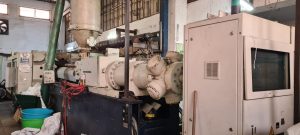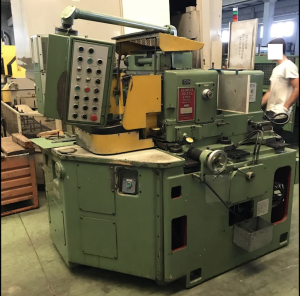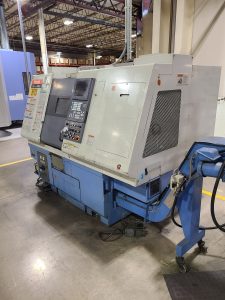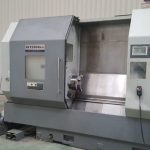
What Industry Experts Recommend Before Purchasing a Pre-Owned, Second-Hand, Surplus, Used Nakamura WT-150 CNC Turning Center – Year 2011 made in Japan?
Here is a professional, industry-oriented guide to what experts recommend before purchasing a pre-owned, second-hand, surplus, used Nakamura WT-150 CNC Turning Center (2011, Japan). This covers technical inspection, operational verification, true condition assessment, and total cost considerations—based on best practices used by experienced CNC buyers, shop managers, and machine tool evaluators.
What Industry Experts Recommend Before Buying a Used Nakamura WT-150 CNC Lathe
1. Verify Machine Identification & History
Before anything else:
- Confirm model and year: Ensure it is truly a Nakamura WT-150 (2011) with correct serial numbers.
- Check country of origin: Made in Japan — excellent reputation but important for parts and manuals.
- Review ownership history: How many previous owners? Was it in a high-production cell or light duty?
- Service and maintenance records: A full maintenance log increases confidence significantly.
Expert recommendation: Machines with documented preventative maintenance generally perform longer and require fewer surprises.
2. Inspect Structural & Mechanical Integrity
This is where most experts begin the evaluation:
Frame & Bed Rail Condition
✔ Check for wear, corrosion, heat stress, or improper mounting
✔ Ensure bed alignment and flatness are within tolerance
Spindle & Axis Behavior
✔ Spindle run-out measurement using gauge tools
✔ Listen for grinding, bearing noise, or vibration
✔ Verify proper lubrication and oil levels
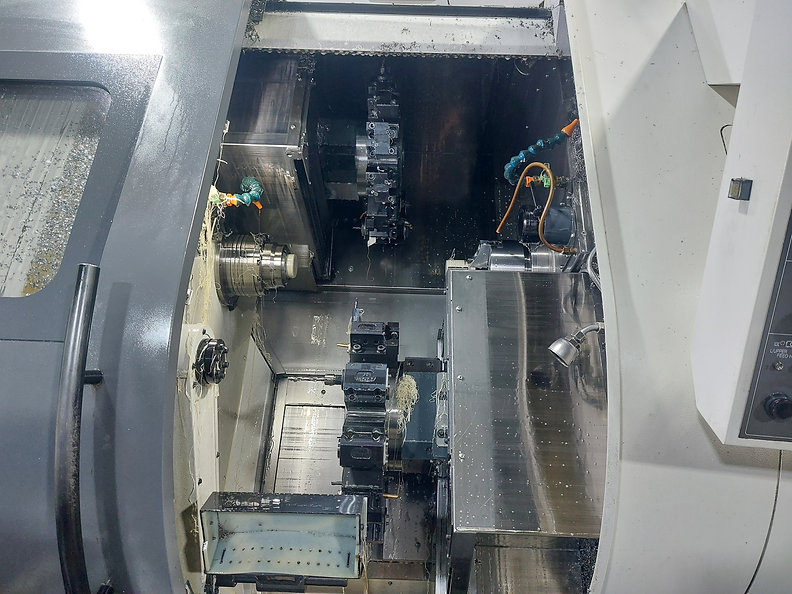
Turret & Tool Holding
✔ Turret indexing accuracy and repeatability
✔ Condition of tooling, adapters, collets, and holders
Linear Motion Components
✔ Ball screws / slides, bearings, guides for backlash or play
✔ Smooth motion without binding or noise
Expert tip: A high-accuracy machine with weak motion system components is a bad investment—often more costly to repair than to replace.
3. Electrical, Drives & Control System Evaluation
The Nakamura WT-150 uses integrated CNC controls and servo systems. Experts insist on:
Control Unit & Software
✔ Confirm model of CNC control (e.g., Fanuc, Mitsubishi, etc.)
✔ Verify existence of backups, programs, and parameters
✔ Check for error codes or memory faults
Servo Drives & Feedback Systems
✔ Smooth acceleration/deceleration without stalling
✔ Test each axis through full travel
Wiring & Cabinet Condition
✔ Clean cabinet (no dust, corrosion, or burned connectors)
✔ Proper grounding and electrical labeling
4. Functional Testing & Cut Verification
Nothing replaces a live test in the expert checklist:
Dry Run
✔ Run the machine through all axes slowly
✔ Verify limit switches and homing repeatability
Live Cutting Test
✔ Use representative material (e.g., steel/aluminum)
✔ Inspect surface finish, chatter, and dimensional accuracy
✔ Check coolant flow and chip evacuation
Expert rule: A machine that runs fine empty but produces poor results under load should be a red flag.
5. Spindle & Tooling Checks
The spindle and tooling system are among the most expensive components to repair:
Spindle Condition
✔ Measure run-out at various speeds
✔ Inspect taper for wear and corrosion
Tooling Compatibility
✔ Ensure tooling standard matches your shop (e.g., BT30, BT40)
✔ Tool inventory availability and cost
6. Turret Function and Condition
A critical area for turning centers:
✔ Accurate indexing without hesitation
✔ Indexed position repeatability within OEM specs
✔ No slipping or excessive noise
Turret repairs or failures are costly—industry experts emphasize this check thoroughly.
7. Wear & Tear Indicators
Experienced inspectors look beyond appearance:
Surface Conditions
✔ Coolant leaks, hose cracks, and seal wear
✔ Worn paint may indicate rough handling but not always poor condition
Chip Conveyor & Guards
✔ Functionality and safety compliance
✔ Ease of maintenance
Wear patterns on ways and slides
✔ Excessive wear indicates high utilization
8. Documentation, Manuals & Support
Experts rarely buy machines without:
- Operator manuals
- Electrical and hydraulic schematics
- Parts lists
- Service manuals
If manuals aren’t included, budgeting should account for acquiring them.
9. Parts Availability & After-Sales Support
For a 2011 Nakamura:
✔ Determine availability of:
- Spindle bearings
- Servo motors
- Control boards
- Turret parts
Expert insight: Japanese brands typically have strong global support, but older models may still face parts lead times.
10. Total Cost of Ownership (TCO) Assessment
Buying price is only 20% of the cost. Experts evaluate:
- Transport & rigging costs
- Installation & leveling
- PLC/CNC rebuild if needed
- Training costs
- Warranty or return policy
Expert Priority Checklist (At a Glance)
| Category | Expert Priority |
|---|---|
| Spindle + Tooling Condition | ⭐⭐⭐⭐⭐ |
| Structural & Motion System | ⭐⭐⭐⭐⭐ |
| Control System Health | ⭐⭐⭐⭐ |
| Functional Cutting Test | ⭐⭐⭐⭐⭐ |
| Maintenance History | ⭐⭐⭐⭐ |
| Parts Availability | ⭐⭐⭐⭐ |
| Cost of Ownership | ⭐⭐⭐⭐ |
| Documentation | ⭐⭐⭐⭐ |
Summary — What Experts Will Not Compromise On
✔ Live cutting demonstration with quality results
✔ Verified spindle and turret performance
✔ Authentic maintenance records
✔ Tested axis movement and control reliability
✔ Available spare parts and documentation