What is Pipe Welding Rotator?
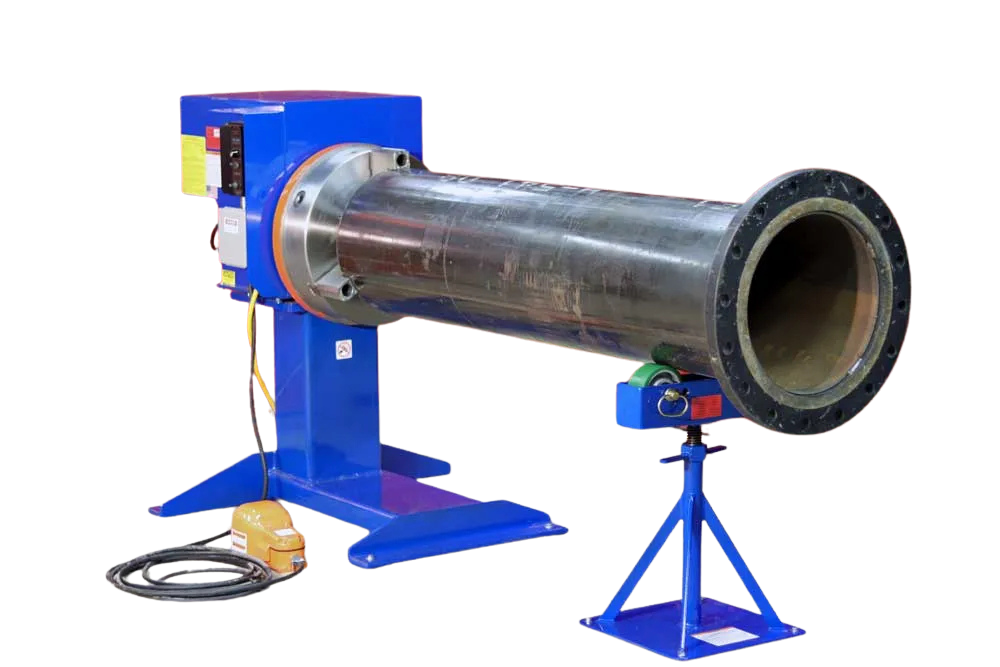
A Pipe Welding Rotator is a specialized piece of equipment used in welding and fabrication workshops to rotate cylindrical workpieces—most commonly pipes, pressure vessels, and tanks—during welding, polishing, or assembly. It ensures uniform rotation, stable positioning, and consistent weld quality. Here’s a technical breakdown:
Technical Definition
A pipe welding rotator is a mechanized positioning device consisting of drive rollers and idler rollers (sometimes called wheel stands). The pipe or vessel rests on these rollers, and the drive unit rotates it at a controlled speed, while the idler provides stability and support. This allows welders (or automated welding systems) to perform circumferential welds without manually repositioning the workpiece.
Key Components
- Drive Unit
- Equipped with an electric motor (AC, DC, or servo-controlled) connected to a gearbox.
- Provides variable rotation speed control (via VFD or digital control).
- Ensures smooth, jerk-free movement for precise weld tracking.
- Idler Unit
- Passive roller stand.
- Supports the opposite end of the pipe or vessel.
- Balances the load and keeps the workpiece aligned.
- Rollers
- Usually polyurethane-coated (to prevent pipe surface damage) or steel rollers (for heavy-duty work).
- Self-aligning rollers can automatically adjust to different pipe diameters.
- Control System
- Includes speed control, forward/reverse rotation, start/stop functions, and sometimes remote pendant control.
- Advanced systems integrate with welding manipulators or column & boom setups.
Technical Features
- Load Capacity: Ranges from small (a few hundred kg) to very heavy-duty (hundreds of tons for pressure vessels).
- Diameter Range: Adjustable to handle different pipe sizes (typically 50 mm to several meters).
- Speed Range: Fine variable control (0.1–2 m/min is common for welding).
- Synchronization: In automated welding systems, the rotator can synchronize with the welding torch feed to maintain constant heat input.
Applications
- Circumferential Welding: For tanks, pressure vessels, boilers, and pipelines.
- Fabrication of Large Cylindrical Workpieces: Easy positioning and assembly.
- Surface Treatments: Rotating heavy pipes during grinding, painting, or inspection.
- Integration with Automation: Often paired with submerged arc welding (SAW), GTAW/TIG, or GMAW/MIG processes.
Technical Advantages
- Maintains constant weld speed → improves penetration and bead consistency.
- Reduces manual handling risks → safer for operators.
- Enhances productivity → continuous rotation allows uninterrupted welding.
- Minimizes operator fatigue → welders focus on torch control instead of repositioning heavy pipes.
- Provides better weld quality → uniform heat distribution and bead geometry.
In short, a Pipe Welding Rotator is a mechanized turning system for cylindrical workpieces that ensures precise, consistent, and efficient circumferential welding, especially in heavy fabrication industries like oil & gas, shipbuilding, power generation, and pressure vessel manufacturing.