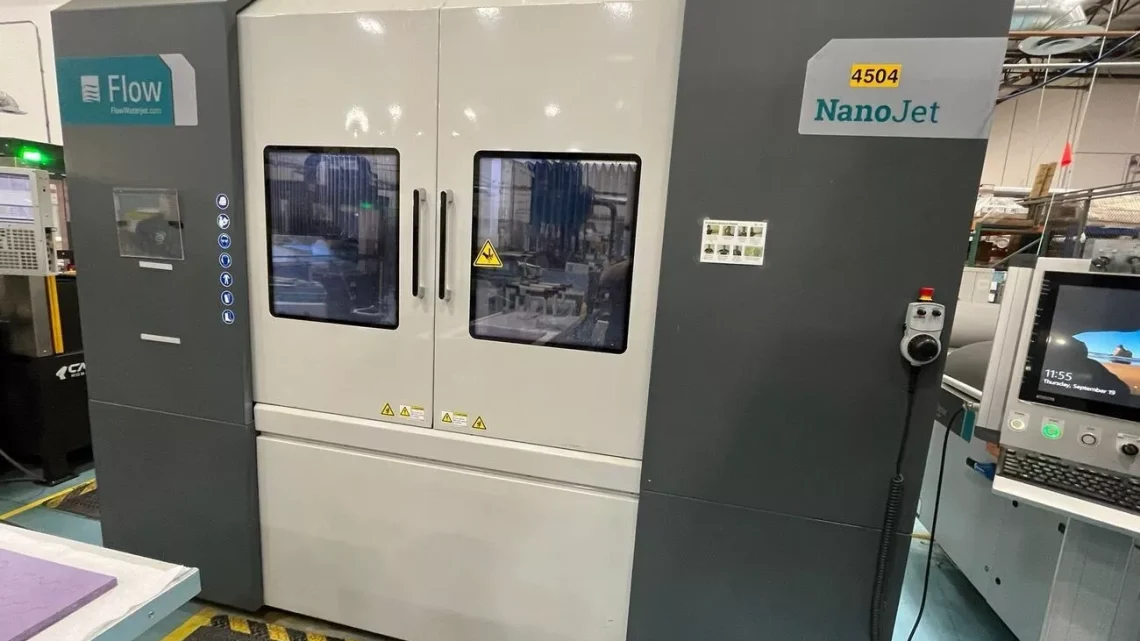
Industrial Insights: How to Spot Quality in Pre-Owned, Used, Secondhand, Surplus CNC Equipment Before Purchase Flow NanoJet 1206 CNC Waterjet Dual Head
When considering a pre-owned / secondhand / surplus CNC system like a Flow NanoJet 1206 dual-head waterjet, identifying quality and spotting risks is essential. Because the machine is complex (mechanics + hydraulics/pumps + electronics + software), you need a meticulous inspection. Below is a structured “due diligence” checklist and technical insight tailored to a machine like the NanoJet, along with red flags and tips.
1. Know the Baseline: What the NanoJet 1206 Should Offer
Before you inspect, you should know the original spec and design features so you can compare:
- The “NanoJet” line from Flow is a precision waterjet series.
- Typical spec for a 1206: 1.2 m × 0.6 m work envelope (approx. 4’ × 2’)
- Linear straightness accuracy: ±0.0008 in / 1 ft (~ ±0.02 mm / 0.3 m)
- Repeatability: ±0.0004 in (~ ±0.01 mm)
- Z-axis travel ~ 6 in (~150 mm)
- Rapid traverse: up to ~590 in/min (~15,000 mm/min)
- Pump / intensifier: the advertised machine (in used listings) is often 50 HP / 87,000 PSI configuration or lower depending on the seller.
Knowing these gives you reference targets when you measure performance or inspect wear.
2. Pre-Inspection Preparations & Documentation Request
Before you visit the machine physically:
- Maintenance history & service logs: Ask for detailed records of maintenance, component replacements, especially pump maintenance, seal replacements, intensifier rebuilds, and software upgrades
- Operating hours: Distinguish between total “power-on time” (which may include idle) vs “cutting hours” under load
- Original & spare parts availability: Ensure that replacement parts for flow controls, high-pressure seals, intensifier pistons, control electronics, and nozzles are still available
- Control and software versions: Which CNC / motion controller is installed? Are the original Flow (or third-party) control software, licenses, and updates still supported?
- Electrical & hydraulic schematics: As-built wiring diagrams, hydraulic / pneumatic diagrams, and spares list
Having documentation helps you correlate what you see on-site with expected behavior or parts history.
3. Visual & Physical Inspection (On-Site)
A detailed walkaround inspection is your first line of defense. Here’s what to watch for:
3.1 Exterior, Structure & Frame
- Frame integrity: Look for cracks, distortions, welds, or visible damage to the gantry, base, beams, and supports
- Corrosion / rust: Especially around areas exposed to water, cutting fluid, or abrasive slurry
- Fasteners & covers: Missing covers, mismatched bolts or patches suggest past repairs or neglect
- Alignment & squareness: Use a straight-edge or precision reference bars to see any obvious sagging or misalignment in the gantry or base
- Machine foundation / mounting: Check how it’s anchored; vibration or looseness could indicate installation issues
3.2 Guideways, Rails, Bearings & Linear Motion Components
- Rails / guideways: Look for scoring, wear marks, pitting, lubrication starvation, or debris
- Carriages / blocks: Should move smoothly with no binding, play, or uneven drag
- Ball screws / drive screws (if present): Inspect for play/backlash; test for smooth rotation; look for runout or wear
- Encoder / feedback devices: Physical integrity, cleanliness, and connections
- Seals & wipers: Good condition, not broken, preventing ingress of grit or abrasive particles
3.3 Motion & Mechanical Systems
- Drive rails, belts, coupling, gearboxes, chain drives (if any) – check for wear, backlash, loose couplings
- Check that the axes (X, Y, Z) move freely when unpowered (with manual jog) and that they don’t show jerky behavior
- Inspect Z-axis vertical slide, travel leadscrew, and check for backlash
3.4 Waterjet / Pump / High-Pressure System
This is arguably the most critical subsystem in a waterjet machine:
- Intensifier / pump unit: Inspect for leaks (oil, high-pressure water, seals), signs of rebuilding or repairs
- Piping, tubing, high-pressure hoses: Check for bulges, cracks, erosion, fittings, and proper supports
- Seals, orifice, mixing chamber, nozzle assemblies: Should be in good condition; signs of erosion or excessive wear degrade cut quality
- Abrasive feed system: Hopper, feed lines, valves, filters, sieves – inspect for clogging, wear, or missing parts
- Water filtration and recycling: Check pumps, filters, strainers, sludge accumulation, tank condition
- Drainage, overflow, and catch systems: Ensure that waste flow paths are intact and not blocked
3.5 Electrical Cabinet, Wiring & Controls
- Cleanliness / dust / moisture: Cabinets should be relatively clean; corrosion or dust is a red flag
- Wiring harnesses and cable routing: Look for chafing, insulation damage, loose wires, splice repairs
- PLC / Control boards: Inspect for burnt components, blown capacitors, or signs of overheating
- Cooling / ventilation / fans: Are they functional? Are dust filters clean?
- Power supply / transformer / UPS (if any): Check for correct voltage, protection, fuses, breakers
- Grounding & shielding: Especially for motion signals and feedback systems
3.6 Control Console, Interface & Software
- Control panel, buttons, touchscreens: All should respond properly; no sticky, worn or broken keys
- Display / HMI condition: No dead pixels, dimming, or flickering
- Software behavior: Boot up properly, no error codes on startup, menus loaded, program files accessible
- Motion commands and jog functions: Manual jog in each axis, see if axes move correctly, with no stutter or unexpected responses
4. Functional & Performance Testing
Once the machine is visually acceptable, functional tests will uncover deeper issues.
4.1 Dry Run / No-Load Motion Tests
- Move each axis across its full travel at slow, medium, and rapid speeds; listen and feel for unusual noises, binding, or abrupt changes in motion
- Reverse direction, stop, and start quickly to test dynamic behavior
- Jog the Z-axis up and down, test backlash and deadband
4.2 Simulated Cutting / “Air-cut” Pattern
- Load a simple program (e.g. square, circle, spiral path) and let the machine run that path with water off; this tests the motion system, synchronization, lookahead, acceleration behavior
- Use a dial indicator or edge probe to check positional accuracy along the path
4.3 Actual Cutting Test (Preferably Using Material)
- Request a real cut test using material of interest (e.g. metal or composite plate)
- Cut known patterns (circle, square, slotted holes) and measure them post-cut with calipers, CMM or other metrology equipment
- Compare cut tolerances vs original spec (e.g. ±0.02 mm / 0.3 m for straightness)
- Observe surface quality, taper, striations — signs of wear or misalignment will show up in the cut surface
4.4 Pressure & Flow Tests
- Test the setup at (or near) its rated operating pressure (if safe to do so)
- Check pressure stability during sustained runs
- Monitor for leaks, sudden fluctuations, pressure drops
- Check intensifier cycle behavior, pressure build-up and holding
4.5 Repeatability & Accuracy Tests
- Use a test gauge (e.g. gauge blocks, precision artifacts) to command moves and measure actual travel
- Run back-and-forth movements and measure variation (repeatability)
- Test in multiple directions, multiple axes
4.6 Warm-up / Thermal Stability
- Let the machine run for an extended period (1–2 hours) under load
- Monitor for drift, thermal expansion effects, component heating, lubricant performance, control stability
5. Critical Red Flags & Deal-Breakers
During inspection, some signs should immediately raise your suspicion:
- Extensive visible corrosion or rust on structural components
- Evidence of flooding, water intrusion, or rust in control cabinets
- High-pressure leaks from pump, hoses, seals, manifolds
- Worn or non-functional seals in the intensifier or mixing chamber
- Excessive backlash, play in guideways or screws
- Cracked or deviated rails, sagging beams
- Non-responsive or flaky control electronics / software faults
- Missing or mismatched parts, repair patches, or undocumented modifications
- No maintenance logs or patchy, undocumented service history
- Control software that is obsolete or unsupported and no path to upgrade
- Inability to perform a real cut test or open working motion test
- Replacement parts no longer available
- Electrical panel “jury-rigged” wiring, burnt components, overheated cables
If you find multiple red flags, the risk of post-purchase repair costs skyrockets.
6. Estimation of Lifecycle & Risk Assessment
You should weigh:
- How many hours are left on high-wear consumables (seals, intensifier parts, orifices)
- Whether the machine’s remaining useful life makes economic sense
- Cost and lead time of major spare parts (pumps, intensifier assemblies, control electronics)
- Whether the seller is willing to provide a warranty or acceptance under performance test
- Risk buffer for unforeseen repairs
7. Negotiation Levers & Contract Safeguards
- Insist on a “test-before-acceptance” clause: machine must pass functional and cut tests
- Have a holdback or escrow until the machine is verified after delivery
- Ask for as-is with spares package: require spare seals, nozzles, pumps, control boards
- Secure all documentation & software licenses in writing
- Clarify your rights on repairs or returns if major subsystems fail within a short period