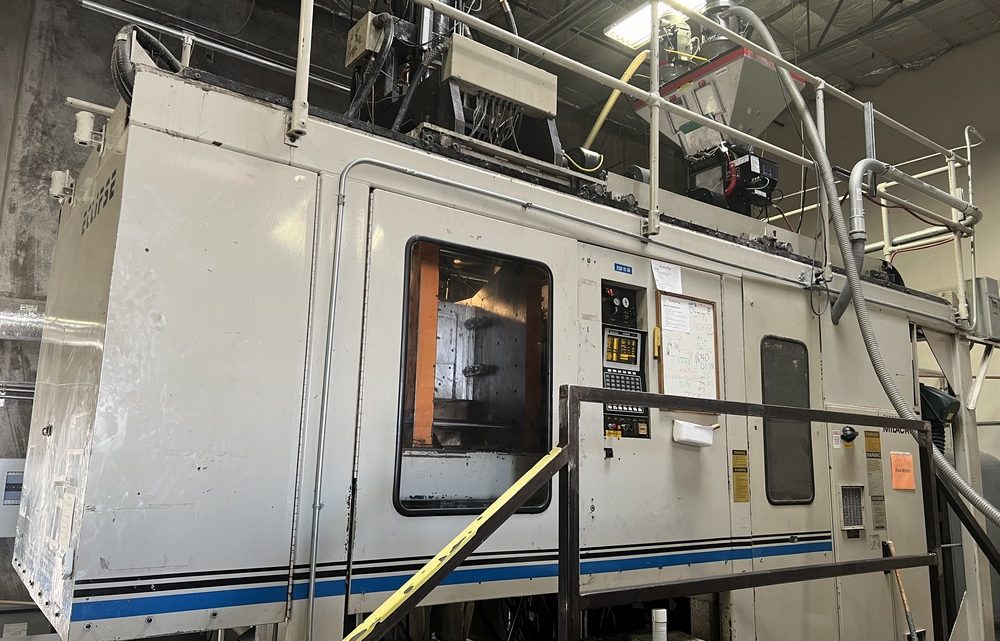
Industrial Insights: How to Spot Quality in Pre-Owned, Used, Secondhand, Surplus CNC Equipment Before Purchase Cincinnati Milacron E90 Blow Molder made in USA
When evaluating a pre-owned Cincinnati Milacron E90 blow molding machine (or similar accumulator-head blow molder) you need to dig deeply into both its mechanical / hydraulic systems and the process-critical wear areas. Below is a tailored, step-by-step “Industrial Insights” guide you can use as a checklist or decision tool to spot quality (or red flags) before purchase.
What to Know about the Cincinnati Milacron E90 as a Baseline
Before inspection, having the “as-designed / catalog specs” helps you catch exaggerations or hidden degradation. From listings and used machine sales, here are representative specs and features for the E90 (or variants) to use as a reference:
- Many E90 units are described as accumulator head blow molders (i.e. accumulator head system).
- A common configuration is single 5 lb shot size, with a 90 mm extruder (i.e. screw diameter ~ 90 mm).
- Typical clamp / platen dimensions: e.g. 40″ horizontal × 30″ vertical clearance in some units.
- Clamp force (depending on variant) in many listings is ~ 50 tons.
- Many E90 machines use CAMAC / Camac PLC control or CAMAC 486 sequencing controllers.
- In a listing of a 1993 E90: “Shot size 10 lbs, platen size 48″ × 40″, hyd. drive output 60 HP, approx output 660 lbs/hr (70% virgin / 30% regrind)”
- The E90 is offered in dual-head versions, accumulator head(s), with substantial hydraulic and clamp systems.
Use these as rough “expected ranges” for comparisons when the seller presents their unit.
What to Inspect & Test — Detailed Checklist
Here’s the detailed checklist (mechanical, hydraulic, control, operational) you should carry with you or demand from the seller. As always, wherever possible see it running (no-load and with material) before committing.
A. Documentation, History & Setup
- Machine identity / nameplate / serial number / build year
- Confirm model (E90) vs what seller claims.
- Write down serial number, and if possible check original build documentation or OEM literature for what the machine should have (clamp force, hydraulic system, control options).
- Service history, maintenance logs, repairs
- Ask for logs of preventive maintenance, overhauls, part replacements (e.g. hydraulic cylinders, seals, accumulator components).
- If the machine has had major breakdowns or neglected maintenance, that is a risk.
- Original drawings, hydraulics schematics, control / PLC / wiring diagrams
- These help for troubleshooting, part replacement, and verifying modifications.
- Insist on getting them transferred with the sale.
- Included tooling, molds, spare parts, accessories
- Are molds, dies, heaters, accumulators, valve banks, spare seals included? What condition are they in?
- If the seller has spares (seals, cylinders, controllers) that’s a positive sign.
- Modifications / retrofits / upgrades
- Has the machine been retrofitted (e.g. new control, updated hydraulics, added safety features)?
- Ensure modifications are documented; check whether they were done properly (alignment, calibration, testing) and whether they introduce any compromises.
B. Mechanical / Structural / Hydraulic Condition
- Frame, platen, tie bars, clamp structure
- Inspect for any cracks, weld repairs, distortions, corrosion, or misalignments in the clamp structure or platen surfaces.
- Use straight edges, precision measurement tools to check platen flatness, parallelism, and alignment.
- Clamp / platen surfaces, bearings, alignment
- The platen surfaces should be flat and free of scored or gouged surfaces.
- Verify parallelism and squareness of moving platen and fixed platen.
- Measure runout or tilt across platen faces.
- Tie bars / guiding rods
- Inspect tie rods or guide bars for wear, bending, surface damage or scoring.
- Check bushings or bearing systems on platen slide mechanisms for play or misalignment.
- Hydraulic cylinders, pistons, seals
- Examine piston rods, cylinder barrels, seals for signs of scoring, pitting, corrosion, leaks.
- Operate the platen (extend / retract) slowly and check for stiction, jerky motion, or asymmetry (i.e. one side dragging).
- Look for external leaks, weeping at seals or port connections.
- Accumulator / accumulator head system
- In an accumulator-head machine, inspect the accumulator, check pressure holding, check seals, valves, and whether the accumulator can maintain correct pressure under static conditions.
- Confirm accumulator head (if two heads) are equal in condition, synchronized, and free of leakage or imbalance.
- Extruder / screw / barrel & melt system
- Since the E90 combines extrusion + blow molding, inspect the screw & barrel: check for wear, pitting, scoring, clearance to barrel walls.
- Test the extruder drive, heater bands, thermocouples, melt zone temperature stability.
- Clamping hydraulics, pressure systems, valve blocks, pumps
- Inspect pump(s), hydraulic supply, manifolds, valve banks, pressure relief / control valves, plumbing and hoses for wear, leaks, fatigue.
- Check the hydraulic fluid condition: clarity, absence of metal particles, correct viscosity, no contamination.
- Measure pressure stability under load; fluctuations or instability are red flags.
- Cooling, temperature control, piping, heat exchangers
- Check cooling circuits, lines, heat exchangers, water jackets, possible blockages or corrosion.
- Ensure there is adequate cooling for extruder, mold, head, and that temperature control is stable.
- Movement systems, linear guides, slide rails
- If there are auxiliary axes (e.g. mold movement, hydraulic indexing, platens shifting), inspect guides, rails, alignment, lubrication, play or slop.
- Frame supports, machine mounting, leveling
- The machine must have been well‐leveled in its prior location. Check for signs of floor stress, uneven mounting, base warpage, anchor bolt damage.
- Safety systems, guards, interlocks, emergency stops
- Inspect whether guard doors, interlocks, safety covers, E-stops are in place and functional.
- For older machines, check whether they can be upgraded to meet your local safety standards.
C. Control & Electrical / Automation
- Controller / PLC / HMI
- Inspect the controller (e.g. Camac PLCs used in many E90 units) for condition, reliability, spare parts availability.
- Ask whether backups / original software / programs are included; whether there have been control upgrades or replacements.
- Sensors, wiring, cables, connectors
- Inspect all sensors (pressure, temperature, flow, position), wiring harnesses, connectors for damage, wear, loose or brittle insulation.
- Look for evidence of overheating, arcing, or amateur rewiring.
- Motors, drives, variable frequency drives (VFDs)
- Test motors (extruder motor, servo motors, platen motors) — spin them, check bearings, insulation, noise, heating.
- If VFDs or drives are used, check their health, control interfaces, spares availability.
- Interface / automation / user programming / parison control
- For complex blow molding, parison programming, synchronization between extruder / accumulator / mold / blow lines is vital. Test these functions.
- Examine historical programs, control logic, ability to modify, diagnostics.
D. Operational / Performance Tests
- No-load / dry-run test
- Run the machine (without material) through all axes: platen open/close, accumulator head motion, extruder rotation (with barrel heaters off if safe), hydraulic cycles, turret or mold indexing if present.
- Listen/feel for smooth motion, absence of jerks, no unexpected vibration or stick–slip in hydraulic movement.
- Clamp / platen stroke, speed, pressure behavior
- Command full stroke / full cycle and measure time, compare with spec or what seller claims.
- Monitor pressure profiles, stability, response to commands, consistency over cycles.
- Accumulator head / shot transfer tests
- If possible, test accumulator charge / discharge cycle, shot transfer, synchronization of accumulator head(s) with extruder output.
- Ensure there is no lag, misfire, or shot‐to‐shot variation.
- Extrusion test under load
- Run some material (if seller permits) through the extruder / accumulator / head to confirm that the melt quality is acceptable, that flow is stable, and that temperature / melt control is smooth.
- Monitor melt pressure, temperature stability, flow consistency, fluctuations or surging.
- Mold / blow / necking / blow cycle test
- If the blow molding function (mold close, blow, part ejection) can be run, test it. Use a mold or dummy piece if available. Measure cycle time, check for proper blow pressure, consistency, part quality.
- Inspect produced parts (if test run) for variation, defects, thickness consistency, structural integrity.
- Thermal stability / drift test
- Run the machine for a prolonged period (several cycles under load), then re-measure key dimensions (platen alignment, pin distances, shot volume consistency) to see whether heating causes drift or misalignment.
- Leak / sealing test under full pressure
- While under operating pressures (hydraulic, accumulator pressure, melt pressure), inspect all seals, joints, pistons, fittings for leaks (even slow weeping).
- Any internal leakage in hydraulic or melt systems is a major concern.
E. Wear / Life Estimation & Risk, Spare Parts & Negotiation
- Estimate remaining life of critical wear components
- Based on observed wear in cylinders, seals, guide runners, accumulator parts, extruder screw/barrel — judge how much life remains and how soon parts may fail.
- If many wear parts are near end of life, refurbishment cost may become prohibitive.
- Availability of spare parts, support, control parts
- For Cincinnati / Milacron legacy machines, check whether spare hydraulics, seals, control modules, PLC parts, accumulators, extruder parts, heads, etc. are still available or can be sourced.
- If parts are obsolete or rare, factor that risk heavily.
- Refurbishment cost feasibility
- For identified defects (e.g. re-machining platen, replacing cylinders/seals, control repair, accumulator rebuild) obtain rough cost estimates.
- Compare cost + risk vs discount you can negotiate.
- Safety / compliance upgrade cost
- If safety guards / interlocks / controls are inadequate or non-compliant, estimate cost to retrofit to your jurisdiction’s standards.
- Transport, reassembly & alignment risk
- Heavy blow molding machines are subject to misalignment or damage during moving. On delivery, recheck all alignments, hydraulic calibrations, platen flatness, etc., before accepting.
- Ensure you reserve the right to reject or adjust after installation if performance is not as promised.
- Acceptance clause / test period
- Negotiate a clause allowing you to run acceptance tests (including under load) after installation, with the right to reject or demand adjustments / compensation if performance is unsatisfactory.
- Price negotiation based on deficiencies
- For every defect or risk you detect, assign a repair cost and deduct from the seller’s asking price or demand the seller fixes them before shipping.
- If multiple critical defects exist, you may walk away unless the discount is large.
Red Flags & “Deal Killers” to Watch For
When you inspect, these signs are especially worrisome and may push the machine into “too risky to buy” territory:
- Significant leakage in hydraulic / accumulator / cylinder systems (especially internal leakage)
- Jerky, inconsistent motion of platen, cylinders, guides
- Mismatch of cycle timing or synchronization problems in accumulator head or mold cycle
- Severe wear, scoring or damage in platen, tie rods, guide surfaces
- Extruder screw / barrel with heavy wear, erosion, pitting — excessive clearance
- Control system failure, missing or broken controller modules, or obsolete electronics with no spares
- Cracked or repaired frame / platen structure
- Evidence of heat damage, distortion, welding repairs in critical zones
- Hydraulics or valves in extremely degraded condition, unstable pressure behavior
- Seller refuses to allow running tests, sample molding, or verification of performance
- No documentation, missing schematics, missing manuals or parts lists
- Safety systems missing, guards removed, interlocks bypassed
Any one of these may be acceptable if discounted properly or fixable, but combinations are dangerous.
How to Incorporate These into Your Decision & Pricing
- Quantify repair/refurbishment costs — for each defect you detect, estimate (or ask vendors) how much to fix.
- Use “as-found” measurements to benchmark your discount.
- Require the seller to fix certain items pre-shipment or provide credits.
- Keep a buffer margin for unexpected problems (hidden wear, surprises during transport).
- Demand final acceptance testing after installation — do not accept “blind” delivery.
- Push for warranty / guarantee on key systems (ex: clutch, control, hydraulics) if possible, even for used machines.